Slopaganda Explained: How AI-Generated Campaign Ads Are Changing Political Advertising in 2026
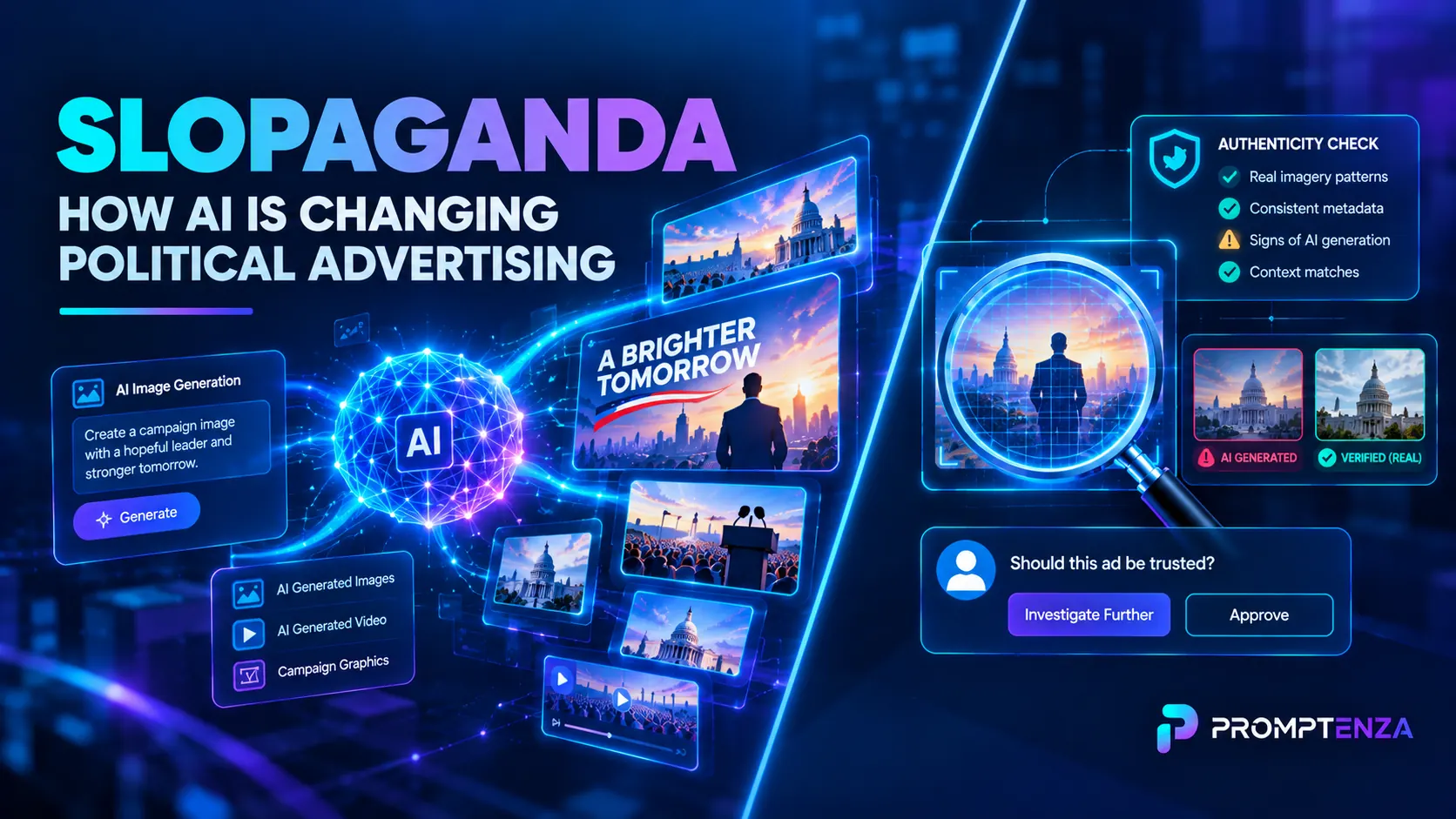
Artificial intelligence is changing how political campaigns create advertisements. Campaigns and political groups can now use AI tools to produce fictional scenes, synthetic voices, manipulated images and videos designed to communicate a political message.
Some advertisements are openly satirical. Others create scenes that never happened or depict political opponents doing things they did not do. Researchers are increasingly tracking this activity as AI-generated political advertising becomes more common in the United States.
One term has emerged to describe a particularly striking category of this content: slopaganda.
The word combines AI slop with propaganda. It describes synthetic political content that uses exaggerated, absurd or obviously artificial scenes to ridicule opponents, reinforce political narratives or influence how audiences perceive candidates.
The trend is no longer just a prediction about the future of political advertising. Research published during the 2026 US midterm election cycle shows that AI-generated and AI-assisted campaign advertisements have already attracted substantial spending.
Quick Answer: What Is Slopaganda?
Slopaganda is a term used to describe AI-generated or AI-assisted political content designed to promote a political message, attack an opponent or influence public opinion. It often uses exaggerated, artificial-looking scenes, fictional situations or manipulated images and videos.
Unlike traditional deepfakes, which may attempt to convince viewers that something false actually happened, some slopaganda is deliberately absurd or satirical. Its purpose may be to create an emotional reaction, make an opponent look ridiculous or reinforce an existing political narrative.
The term has become increasingly relevant during the 2026 US midterm election cycle, when researchers identified hundreds of AI-generated or AI-assisted political advertisements.
The Rise of AI-Generated Political Ads in 2026
The scale of AI use in political advertising has increased considerably.
According to the Wesleyan Media Project, which tracks and analyses US election advertising, researchers had identified at least 289 unique AI-generated or AI-assisted political advertisements by October 29, 2026.
The advertisements were associated with more than $187 million in estimated spending.
For comparison, the project identified less than $50,000 in spending on AI-generated political advertisements during the 2024 election cycle.
That represents a dramatic change in how campaigns and political groups are using AI technology.
The researchers also caution that their figures are likely an undercount. Some advertisements use AI only for selected elements, such as replacing stock footage or enhancing images. Other uses may be difficult to identify without a disclosure from the advertiser.
What the 2026 figures reveal
| Research finding | Reported figure |
|---|---|
| AI-generated or AI-assisted ads identified | At least 289 |
| Estimated advertising spending | More than $187 million |
| Republican candidates and aligned groups’ share of spending | Just over 90% |
| Ads containing an AI-use disclaimer | Approximately 27% |
| Ads without an AI-use disclaimer | Approximately 73% |
These figures reflect the advertisements identified by researchers, not every political advertisement that may have used AI.
The partisan spending figures also describe the advertisements in the researchers’ dataset. They should not be interpreted as proof that only one political party uses AI.
The important development is the speed at which AI has entered campaign advertising and the difficulty of identifying every use of the technology.
What Does Slopaganda Look Like?
Slopaganda does not have one fixed visual style. It can range from cartoonish political satire to realistic-looking synthetic videos.
Some advertisements deliberately use strange or exaggerated imagery. Others create scenes that appear plausible but never happened.
During the 2026 US election cycle, several examples attracted attention.
1. The AI-generated Bible advertisement
One advertisement targeting Texas Senate candidate James Talarico depicted an artificial version of the candidate marking up a Bible with a crayon.
The scene was not a recording of an actual event. It was generated using AI as part of a political attack advertisement.
The example illustrates how synthetic media can place a candidate in a fictional situation to communicate a political message.
2. The fictional political delusion pill advertisement
Another advertisement depicted New York Governor Kathy Hochul and New York City Mayor Zohran Mamdani in a pharmaceutical-style setting.
The fictional scene promoted a supposed political delusion pill.
The advertisement used AI-generated imagery to create a situation that did not occur in real life.
3. The Trojan horse advertisement
A separate advertisement targeting Michigan Senate candidate Abdul El-Sayed depicted him inside a Trojan horse carrying a political message.
Again, the scene was synthetic rather than a record of an actual event.
These examples demonstrate why the term slopaganda has attracted attention: AI makes it possible to create unusual political scenes without organising a real production or capturing the events on camera.
They also demonstrate why viewers need to distinguish satire, political criticism and misleading representations of real people.
How AI Is Changing Political Advertising
AI tools can support several stages of an advertising campaign. They are not limited to generating images or videos.
Campaign teams and advertising professionals can use AI for:
- Script development: Drafting and refining advertising messages.
- Voice production: Creating or editing voiceovers.
- Image generation: Producing fictional scenes, illustrations and campaign visuals.
- Video production: Creating synthetic footage or modifying existing material.
- Editing: Replacing stock footage or enhancing visual elements.
- Audience communication: Supporting campaign outreach and written responses.
The technology can reduce the time and resources needed to create certain advertising materials.
However, there is an important distinction between using AI to improve an advertisement and using it to fabricate an event or misrepresent a real person.
For example, using AI to improve the lighting in a campaign photograph is different from generating a video that makes a candidate appear to say something they never said.
Both involve AI, but their implications for transparency and public trust are not the same.
Slopaganda vs. Deepfakes: What’s the Difference?
The terms slopaganda and deepfake are related, but they do not describe exactly the same thing.
| Feature | Slopaganda | Deepfakes |
|---|---|---|
| Main idea | Synthetic political content used to promote a narrative or influence perception | AI-manipulated or generated media that depicts a person or event deceptively |
| Appearance | Can be exaggerated, absurd or realistic | Often designed to look or sound authentic |
| Purpose | Can include satire, ridicule, persuasion or political messaging | Can include impersonation, deception, entertainment or satire |
| Example | An obviously fictional AI-generated political scene | A fabricated video showing a candidate making a statement they never made |
There is overlap between the two categories. A deepfake can be used as part of a slopaganda campaign, while some slopaganda does not attempt to create a convincing imitation of reality.
The distinction matters because not every AI-generated political advertisement is deceptive, and not every AI-assisted advertisement is a deepfake.
Why Are Campaigns Using AI-Generated Ads?
The growing use of AI in political advertising reflects several practical and strategic factors.
Lower production barriers
Traditional advertising can involve filming locations, actors, editors, equipment and production teams.
AI tools can make some visual production tasks faster and less expensive. Campaigns can use generated imagery and synthetic footage without having to film every scene.
This does not mean every AI advertisement is inexpensive, but the technology can reduce certain production barriers.
Faster content creation
Election campaigns operate under tight schedules. Political events, public statements and campaign developments can create demand for new advertisements at short notice.
AI tools can help advertising teams produce or revise content more quickly.
More creative possibilities
AI can create fictional environments and exaggerated visual scenes that would be difficult to produce using conventional methods.
This gives political advertisers additional ways to communicate their messages.
Emotional impact
Political advertising often relies on emotion, humour, criticism and memorable imagery.
A fictional scene can communicate a political attack quickly, even when viewers understand that the scene itself is not real.
This is one reason the growth of slopaganda deserves attention: an advertisement does not necessarily need to fool viewers about what happened to influence how they feel about a candidate.
Why Some AI Political Ads Are Not Designed to Fool Viewers
It is easy to assume that every synthetic political advertisement is intended to deceive people.
That is not always the case.
Some slopaganda uses exaggerated or ridiculous imagery that viewers are unlikely to mistake for authentic footage.
The intended effect may be satire, ridicule or emotional persuasion rather than convincing viewers that a fictional event actually happened.
For example, an advertisement depicting a candidate inside an obviously fictional political scenario may be designed to make the candidate appear ridiculous.
However, this does not automatically remove the ethical questions surrounding the advertisement.
A fictional scene can still create a misleading impression about a person’s beliefs, actions or political positions.
The more realistic the synthetic media becomes, the more important it is to make its artificial nature clear.
Why AI Disclosure Matters in Political Advertising
One of the biggest concerns surrounding AI-generated campaign advertising is transparency.
When viewers see an advertisement featuring a political candidate, they should be able to understand whether the footage represents a real event or has been generated or substantially manipulated using AI.
Disclosures can help provide that information.
However, the Wesleyan Media Project’s research suggests that AI-use labels are not consistently appearing in the advertisements it has identified.
Only approximately 27% of the advertisements identified by researchers through late October contained an AI disclaimer.
This leaves many viewers without an explicit indication that AI was used.
There are also differences between an advertisement’s ordinary campaign sponsorship disclosure and an AI disclosure. Knowing who paid for an advertisement does not necessarily tell viewers whether its images, voices or scenes were artificially generated.
Clearer disclosure could help audiences assess political advertisements more accurately.
Are There Laws Regulating AI-Generated Political Ads?
Yes. But the rules differ across the United States.
According to the National Conference of State Legislatures (NCSL), 31 states had enacted laws regulating deepfakes in elections and political campaigns as of its October 13, 2026 update.
States generally use two approaches:
- Disclosure requirements: Certain political advertisements containing synthetic or manipulated media must identify that the content was generated or altered.
- Restrictions or prohibitions: Some laws restrict particular deceptive synthetic media, especially when it is distributed close to an election.
NCSL identifies California, Minnesota and Texas among states with restrictions on certain political deepfakes during specified periods before an election. Maryland has also enacted restrictions concerning deceptive election-related deepfakes.
Other states focus primarily on disclosure requirements.
However, these laws do not all cover the same content. Some apply only to materially deceptive media, particular candidates, specific time periods or certain types of political communications.
Why state laws are not always enough
The existence of a law does not automatically mean that every advertisement complies with it.
There are several challenges:
- Laws differ from one state to another.
- Some advertisements may fall outside the scope of a particular law.
- Campaigns and advertisers may interpret requirements differently.
- AI use can be difficult to identify.
- Enforcement may take time, particularly when an advertisement spreads online.
The result is a complicated regulatory environment in which disclosure requirements and enforcement can vary depending on the location and nature of the advertisement.
For this reason, the discussion about AI political advertising is not simply about whether campaigns should use AI. It is also about what transparency should look like when they do.
How Slopaganda Could Affect Public Trust
The growth of AI-generated political advertisements raises questions beyond the accuracy of individual campaign videos.
One concern is that audiences may become less certain about what they see online.
If AI-generated images and videos become increasingly common, viewers may find it harder to distinguish genuine recordings from synthetic material.
This creates several potential problems.
Confusion about real events
A fabricated image or video can circulate without its original context. People who encounter it later may not know that it was generated using AI.
Damage to reputations
A synthetic advertisement can depict a candidate in a fictional situation that creates a negative impression, even if the viewer knows that the scene is artificial.
Greater difficulty evaluating information
When audiences encounter a mixture of authentic footage, edited material, satire and synthetic content, evaluating political claims can become more complicated.
Reduced confidence in genuine media
There is also a broader concern that people may begin questioning authentic photographs and videos simply because AI-generated versions have become more common.
This does not mean every AI-generated advertisement will change an election outcome. The actual effect on voters remains difficult to measure, and researchers will need to examine the evidence after the 2026 election cycle.
How Can Viewers Recognise AI-Generated Political Ads?
There is no single visual clue that reliably identifies every AI-generated advertisement.
Some synthetic images contain unusual details, but newer tools can produce increasingly convincing results. A video that looks realistic is not necessarily authentic, and a video that looks strange is not automatically AI-generated.
Instead of relying on appearance alone, viewers can use a more careful approach.
- Check the original source: Find out which campaign or organisation published the advertisement.
- Look for AI disclosures: Check whether the advertisement identifies generated or manipulated content.
- Find independent reporting: Search for credible news coverage of the specific scene or claim.
- Look for original footage: When an advertisement refers to a public event, check whether an authentic recording exists.
- Separate the image from the claim: Even if a scene is synthetic, the advertisement may contain factual claims that need separate verification.
- Avoid sharing uncertain content as fact: Wait for reliable information before presenting a questionable video or image as evidence.
These steps are more reliable than assuming that an online AI detector can settle every question.
AI detection tools can make mistakes, so their results should not be treated as definitive proof that a video or image is authentic or artificial.
What Does Slopaganda Mean for the Future of AI-Generated Content?
The political advertising trend reveals a wider change in the way synthetic media is being used.
AI-generated content is no longer limited to entertainment, personal creativity or commercial marketing. It is increasingly appearing in public communication, political campaigns and debates about trust.
For AI developers, this creates questions about responsible image and video generation.
For advertisers, it raises questions about transparency and the responsible representation of real people.
For viewers, it makes media literacy increasingly important.
The same image and video generation capabilities that help creators produce campaign visuals can also be used to create misleading representations of public figures.
This is why understanding AI prompting, image generation and synthetic media is becoming more relevant.
If you want to understand how these tools work, explore Promptenza’s guides to AI Image Prompting, AI Video Prompting and AI Prompting Techniques.
What This Trend Means for AI Developers and Content Creators
Slopaganda is not only a political issue. It is also a reminder that AI-generated content can have consequences outside the environment in which it was created.
AI developers and content creators should consider several principles:
- Be transparent: Make it clear when realistic synthetic media is being presented as part of a real-world discussion.
- Avoid false representations: Do not present fabricated scenes involving real people as authentic recordings.
- Respect context: A generated image should not be used in a way that creates a false impression about a person’s actions or statements.
- Check claims: AI-generated visuals should not be treated as evidence that an event occurred.
- Understand the tools: Learn the difference between AI-assisted editing, image generation, video generation and deepfake technology.
These principles apply to political advertisements, commercial campaigns, news illustrations and social media content.
Frequently Asked Questions
What does slopaganda mean?
Slopaganda combines the words AI slop and propaganda. It describes AI-generated or AI-assisted political content used to promote a political message, ridicule opponents or influence public perception. Some examples are deliberately absurd or satirical, while others may create misleading impressions.
Why is slopaganda trending in 2026?
The term has attracted attention because AI-generated and AI-assisted political advertisements have become more widespread during the 2026 US midterm election cycle. Researchers identified at least 289 unique advertisements associated with more than $187 million in spending by October 29, 2026.
How much money has been spent on AI-generated political ads in 2026?
The Wesleyan Media Project identified more than $187 million in estimated spending on at least 289 AI-generated or AI-assisted political advertisements by October 29, 2026. Researchers caution that the actual amount may be higher.
Are all AI-generated political ads deepfakes?
No. Some advertisements use AI to edit footage, replace stock images or create fictional scenes. Deepfakes generally refer to synthetic or manipulated media that deceptively represents a real person or event. Some slopaganda may use deepfake techniques, but the terms are not interchangeable.
Do AI-generated political advertisements have to be labelled?
Requirements vary by US state and by the type of content. Some states require disclosures for certain AI-generated or manipulated political media, while others restrict specific deceptive uses. There is no single uniform state rule covering every AI-assisted advertisement.
Can AI-generated political ads influence voters even when they look fake?
They may influence how viewers perceive a candidate or political issue, even when the scene is obviously artificial. However, the actual effect on voter decisions requires further research.
How can I tell if a political video was generated by AI?
Check its original source, look for disclosures, compare it with authentic recordings and consult reliable reporting. Visual clues and automated AI detectors are not always reliable on their own.
Is slopaganda the same as misinformation?
Not necessarily. Slopaganda describes a type of synthetic political messaging. It may contain misleading claims, satire, exaggeration or fictional scenes. Whether a particular advertisement qualifies as misinformation depends on its claims and how it represents reality.
Test Your AI Knowledge
1. What does the term slopaganda combine?
A. Software and propaganda
B. AI slop and propaganda
C. Social media and advertising
D. Search engines and political campaigns
2. How many AI-generated or AI-assisted political advertisements had the Wesleyan Media Project identified by October 29, 2026?
A. 29
B. 89
C. At least 289
D. More than 2,000
3. What is one important difference between slopaganda and deepfakes?
A. Slopaganda can use obviously artificial or satirical scenes
B. Deepfakes cannot contain video
C. Slopaganda is always created without AI
D. Deepfakes are only used in entertainment
4. What percentage of the identified advertisements contained an AI-use disclaimer?
A. 10%
B. Approximately 27%
C. 65%
D. 100%
5. What is the most reliable way to assess a questionable political video?
A. Judge it only by how realistic it looks
B. Trust every AI detection tool
C. Check the source, disclosures and independent evidence
D. Share it immediately
Answers
- B — Slopaganda combines AI slop and propaganda.
- C — Researchers identified at least 289 advertisements by October 29, 2026.
- A — Slopaganda can include obviously fictional or satirical scenes, while deepfakes often involve deceptive synthetic representations.
- B — Approximately 27% of the advertisements identified by researchers contained an AI-use disclaimer.
- C — Checking sources, disclosures and independent evidence is more reliable than relying on appearance alone.
Final Thoughts
Slopaganda shows how quickly AI-generated content is moving into political communication.
The 2026 US midterm election cycle has demonstrated that campaigns and political groups can use AI to produce advertisements featuring fictional scenes, manipulated images and synthetic videos at a scale that would have been difficult to achieve just a few years ago.
But the issue goes beyond the technology itself. It raises questions about transparency, political persuasion, media literacy and the public’s ability to distinguish authentic events from generated content.
AI can make political advertising more creative and easier to produce. It can also make misleading representations easier to distribute.
The challenge ahead is ensuring that the growing use of AI does not come at the expense of transparency and public trust.