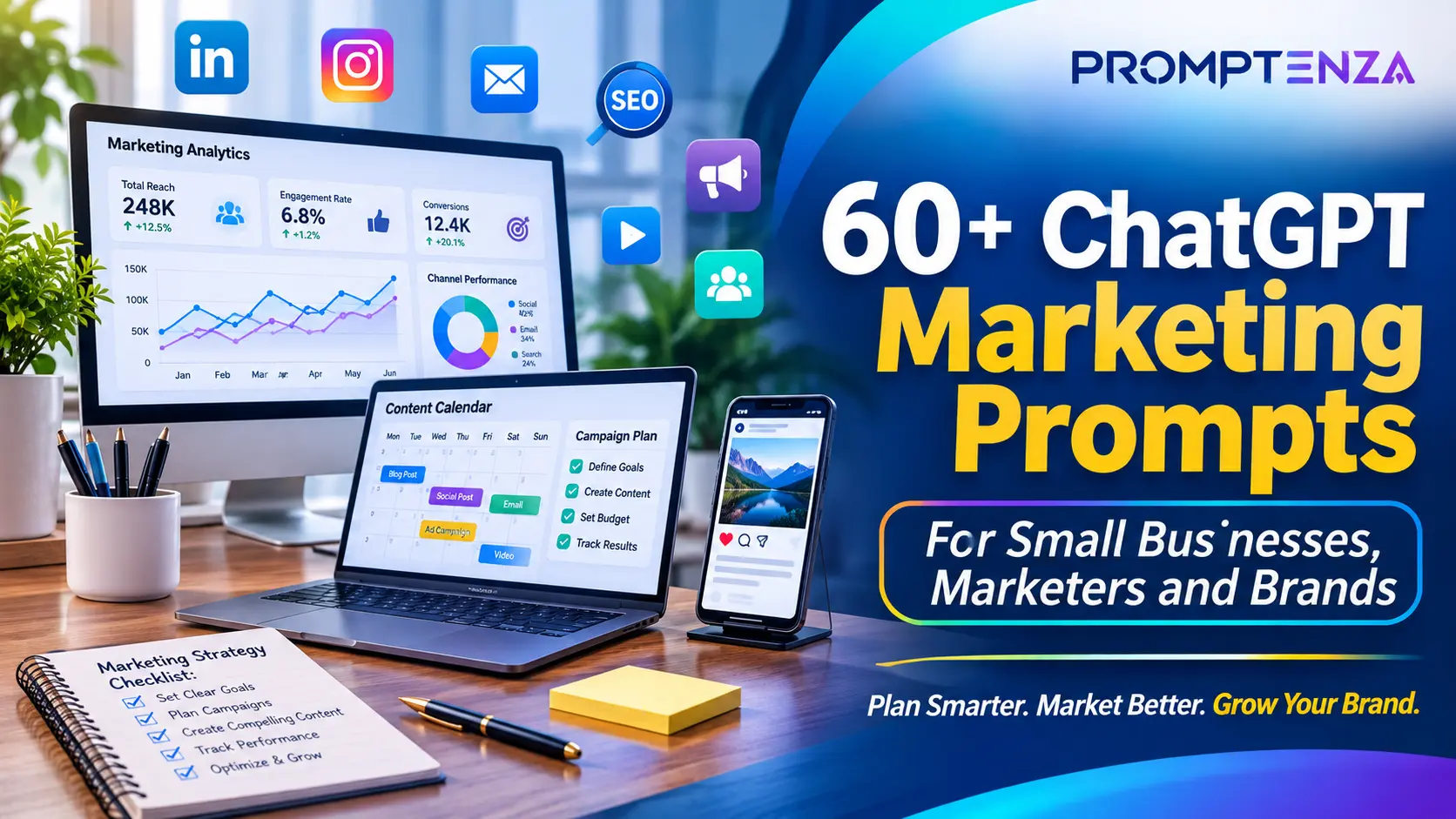
50+ ChatGPT Marketing Prompts for Small Businesses, Marketers and Brands
Marketing a business requires more than publishing social media posts or running advertisements. You need to understand your audience, communicate your value, create useful content and choose the right channels to reach potential customers.
For small businesses and marketing teams, managing all these activities can be challenging. ChatGPT can help simplify the process by generating marketing ideas, developing campaign plans, writing promotional content, researching audiences and organising marketing activities.
In this guide, you will discover 60+ ChatGPT marketing prompts you can copy and customise for different marketing tasks. Whether you are promoting a small business, launching a product, building a brand or managing campaigns for clients, these prompts can help you work through your marketing activities more efficiently.
Quick Answer: How Can ChatGPT Help with Marketing?
ChatGPT can support marketing by helping you develop strategies, generate content ideas, write social media captions, plan email campaigns, research target audiences, create advertising copy and improve brand messaging.
To get useful results, tell ChatGPT what you are marketing, who your target audience is, what you want to achieve and which platform or channel you intend to use.
The best results come from combining clear prompts with accurate business information, real customer insights and human review.
How to Use ChatGPT for Marketing
Before copying the prompts below, understand how to give ChatGPT enough context to produce relevant marketing recommendations.
Follow these steps:
- Describe your business: Explain what your business sells, the services it provides and what makes it different.
- Define your target audience: Include relevant information about your ideal customers, their needs, interests and challenges.
- Set a marketing objective: Decide whether you want to increase brand awareness, attract leads, promote a product, improve engagement or support sales.
- Choose your marketing channel: Specify whether the task involves social media, email, search engines, paid advertising, websites or another channel.
- Provide important details: Include your product information, brand voice, campaign dates, budget constraints and any available customer research.
- Request a specific output: Ask for a marketing plan, content calendar, campaign ideas, captions, email sequence or advertising copy.
- Review the recommendations: Check facts, pricing, product claims and audience assumptions before using the generated content.
For better results, learn how to structure instructions using our guide to Prompt Anatomy: Parts of an Effective AI Prompt.
60+ ChatGPT Marketing Prompts to Copy and Use
The following prompts are grouped by marketing activity. Replace the information in square brackets with details about your business, products or campaign.
1. ChatGPT Marketing Strategy Prompts
A marketing strategy helps you decide what to promote, who to reach and how to communicate your message.
Use these prompts to develop marketing plans and organise your business priorities.
1. Create a marketing strategy for my business
Act as an experienced marketing strategist. My business is [business name], and we sell [products or services] to [target audience]. Our main business goal is [goal]. Develop a practical marketing strategy covering target customers, positioning, marketing channels, content themes, promotional activities and ways to measure progress.
2. Develop a marketing plan for a small business
Create a 90-day marketing plan for my small business, which operates in [industry]. My monthly marketing budget is [budget], and my main objective is [objective]. Organise the plan into monthly priorities, weekly activities and measurable performance indicators.
3. Identify the best marketing channels for my business
My business sells [product or service] to [target audience]. Compare suitable marketing channels, including social media, email, search engines, partnerships and paid advertising. Explain the potential benefits, limitations and resources required for each option.
4. Create a marketing campaign for a new product
Develop a marketing campaign for the launch of [product name]. The product helps customers [main benefit]. My target audience is [audience], and the launch date is [date]. Suggest campaign messages, promotional content, marketing channels and a launch timeline.
5. Develop a unique marketing position
Help me develop a clear market positioning statement for my business. We offer [products or services], serve [target audience] and differ from competitors because [unique qualities]. Suggest positioning statements that communicate our value clearly.
6. Create a marketing budget allocation plan
Help me organise a marketing budget of [amount] for [business type]. Recommend how I could evaluate spending across content creation, social media, email marketing, search engine optimisation, paid advertising and other relevant activities. Explain the assumptions behind your recommendations.
7. Create a marketing plan for a seasonal promotion
Develop a marketing plan for a seasonal promotion involving [product or service]. The campaign will run from [start date] to [end date]. Suggest promotional themes, content ideas, customer messages and a schedule for publishing campaign materials.
2. ChatGPT Social Media Marketing Prompts
Social media can help businesses communicate with customers, introduce products and build brand awareness.
These prompts can help you plan and create content for platforms such as Instagram, Facebook, LinkedIn, TikTok and X.
8. Create a social media marketing strategy
Develop a social media strategy for my business, [business name]. We operate in [industry] and target [audience]. Recommend suitable platforms, content categories, posting frequency, engagement activities and performance indicators.
9. Generate 30 days of social media content ideas
Create a 30-day social media content calendar for my [business type]. My target audience is [audience], and my main objective is [objective]. Include daily post topics, recommended formats, content angles and calls to action.
10. Write engaging social media captions
Write 10 social media captions promoting [product or service]. The target audience is [audience]. Use a [friendly/professional/playful] brand voice. Include natural calls to action and relevant hashtags where appropriate.
11. Create social media campaign ideas
Suggest 10 creative social media campaign ideas for a business selling [product or service]. The campaigns should appeal to [target audience] and encourage [desired action]. Include the campaign concept, suggested content format and participation idea.
12. Develop a social media engagement plan
Create a practical engagement plan for my [platform] account. My business is [business type], and my audience is [audience]. Suggest ways to encourage meaningful conversations, respond to comments and build relationships with followers.
13. Write short-form video content ideas
Generate 15 short-form video ideas for my business in [industry]. Each idea should include a hook, main message, suggested visuals and a call to action. Focus on content that educates, entertains or helps my target audience.
14. Create a social media promotion for a product
Develop a social media promotion for [product name]. Explain the product’s main benefits, the problem it addresses and why the target audience may find it useful. Create post ideas for introducing, explaining and promoting the product.
3. ChatGPT Content Marketing Prompts
Content marketing involves creating useful material that attracts and informs potential customers.
If your business publishes articles, guides or educational resources, these prompts can help you organise your content strategy.
15. Develop a content marketing strategy
Create a content marketing strategy for [business name], which operates in [industry]. Our target audience is [audience], and our main business objective is [objective]. Suggest content categories, topics, formats, distribution channels and performance indicators.
16. Generate blog post ideas
Suggest 30 useful blog post ideas for a business in [industry]. The target audience is [audience], and the main products or services are [products or services]. Group the ideas into educational, problem-solving, comparison and product-related topics.
17. Create a content calendar
Build a four-week content calendar for my business. Include blog articles, social media posts, newsletters and short-form video ideas. Organise the content around [main topics] and explain how each piece supports the marketing objective.
18. Turn one topic into multiple content formats
I have created content about [topic]. Suggest ways to repurpose it into a blog post, social media carousel, short video, email newsletter, infographic and LinkedIn post. Keep the central message consistent while adapting each format to its platform.
19. Write an educational blog outline
Create a detailed blog post outline about [topic] for [target audience]. Include a compelling title, introduction, logical headings, practical examples, frequently asked questions and a relevant call to action.
20. Develop a content distribution strategy
I have published an article about [topic]. Create a distribution plan explaining how I can promote it through social media, email newsletters, professional communities and other relevant channels. Suggest a realistic publishing schedule.
21. Create a brand storytelling content plan
Help me develop a storytelling strategy for [business name]. Our background is [business story], our mission is [mission] and our target audience is [audience]. Suggest story angles that communicate our values and build trust without making unsupported claims.
4. ChatGPT SEO Marketing Prompts
Search engine optimisation can help potential customers discover your website through relevant search queries.
ChatGPT can assist with brainstorming keywords, organising content topics and improving website copy. However, its suggestions should be checked against actual search data and current search results.
22. Generate SEO keyword ideas
Act as an SEO content strategist. My website is about [industry or niche], and my target audience is [audience]. Generate relevant keyword ideas for my products, services and educational content. Group them by search intent and topic.
23. Create an SEO content cluster
Develop a topical content cluster around [main topic] for my website. Suggest one cornerstone article and supporting articles. Explain the search intent of each article and how they could link to one another naturally.
24. Improve an existing website page
Review the following website content and suggest improvements to its title, headings, introduction, readability, keyword relevance and calls to action. Preserve accurate information and avoid unnatural keyword repetition.
Content: [paste content]
25. Create SEO-friendly product descriptions
Write an informative product description for [product name]. The target customer is [audience], and the main product benefits are [benefits]. Include the primary keyword [keyword] naturally, explain the product’s value and finish with a clear call to action.
26. Generate blog titles for SEO
Generate 15 informative and engaging blog title ideas about [topic]. The primary keyword is [keyword], and the target audience is [audience]. Make the titles clear, useful and relevant to the likely search intent.
27. Develop an internal linking strategy
My website covers [main topic] and contains these articles: [list article titles and URLs]. Suggest relevant internal linking opportunities. Recommend natural anchor text and explain which pages should link to one another based on their topics.
28. Create an SEO content refresh plan
Help me develop a content refresh plan for an existing article about [topic]. Identify sections that may need updated information, clearer explanations, additional examples, improved headings and better internal links. Do not invent current facts or performance data.
5. ChatGPT Email Marketing Prompts
Email marketing can help businesses communicate with existing customers, introduce new products and share useful information.
These prompts can support newsletters, promotional emails and customer follow-ups.
29. Create an email marketing strategy
Develop an email marketing strategy for my business, which sells [products or services] to [audience]. Suggest newsletter topics, customer segments, email frequency, campaign objectives and ways to evaluate performance.
30. Write a promotional marketing email
Write a persuasive but honest promotional email for [product or service]. Explain its main benefits, identify the intended customer and include a clear call to action. Use a [friendly/professional] tone.
31. Create a welcome email sequence
Develop a three-email welcome sequence for new subscribers to [business name]. Introduce the brand, explain what subscribers can expect and highlight relevant products or resources. Include a subject line and purpose for each email.
32. Write a product launch email sequence
Create a three-part email campaign for the launch of [product name]. Include an announcement email, a product benefits email and a launch reminder. Use accurate product information and avoid unsupported promises.
33. Write a customer re-engagement email
Draft a friendly re-engagement email for subscribers who have not interacted with my business recently. The business offers [products or services]. Remind them of the value we provide and suggest a relevant next step without using pressure tactics.
34. Create a monthly newsletter
Write a monthly newsletter for [business name] targeting [audience]. Include an introduction, three useful updates or insights, a featured product or resource and a clear call to action. Keep the message informative and easy to read.
6. ChatGPT Advertising and Promotional Prompts
Advertising requires clear messaging and an understanding of the audience. ChatGPT can help you develop different creative approaches and draft advertising copy.
35. Write Google Ads copy
Create three variations of advertising copy for [product or service]. The target audience is [audience], and the main benefit is [benefit]. Suggest relevant headlines and descriptions while avoiding unsupported claims. Check the current platform character limits before publication.
36. Create Facebook and Instagram ad ideas
Suggest 10 advertising concepts for promoting [product or service] to [target audience] on Facebook and Instagram. Include the main message, creative direction, suggested headline and call to action.
37. Develop a product promotion campaign
Create a promotional campaign for [product name]. The campaign goal is [goal], the target audience is [audience] and the available budget is [budget]. Suggest campaign themes, promotional messages, content formats and ways to measure performance.
38. Write persuasive advertising headlines
Generate 20 advertising headlines for [product or service]. Focus on its genuine benefits, customer needs and key differentiators. Create different styles, including direct, educational, curiosity-driven and benefit-focused headlines.
39. Develop an advertising creative brief
Create an advertising creative brief for a campaign promoting [product or service]. Include the campaign objective, audience, key message, product benefits, creative direction, required assets and call to action.
40. Improve an existing advertisement
Review the advertisement below and suggest ways to improve its clarity, relevance, headline and call to action. Identify vague claims or unsupported statements that should be corrected.
Advertisement: [paste advertisement]
7. ChatGPT Market Research Prompts
Understanding customers and competitors can help businesses make better marketing decisions.
ChatGPT can help organise research questions, analyse information you provide and develop customer profiles. It should not be treated as a source of verified market statistics unless those figures are independently supported.
41. Create an ideal customer profile
Help me develop an ideal customer profile for my business. We sell [product or service] in [market or location]. Describe the likely customer needs, problems, purchasing considerations, interests and reasons they may choose a product like ours. Separate assumptions from facts.
42. Identify customer pain points
My business provides [product or service] to [target audience]. Identify possible customer challenges that this product or service may address. Suggest questions I can ask real customers to validate these assumptions.
43. Develop customer survey questions
Create 15 customer survey questions for a business in [industry]. The survey should help us understand customer needs, product satisfaction, purchasing behaviour and areas for improvement. Use clear, unbiased questions.
44. Create a competitor research framework
Develop a competitor analysis framework for my business in [industry]. Include competitor products, pricing information, positioning, marketing channels, customer reviews and differentiating factors. Explain which information should be verified through research.
45. Analyse customer feedback
Analyse the following customer feedback and identify recurring themes, positive experiences, complaints and possible improvement opportunities. Organise the findings into categories and do not assume that the feedback represents every customer.
Feedback: [paste feedback]
8. ChatGPT Branding and Brand Awareness Prompts
A consistent brand helps customers understand what a business represents and why its products or services may be relevant.
Use these prompts to develop brand messaging and communication ideas.
46. Develop a brand identity statement
Help me create a brand identity statement for [business name]. We offer [products or services], serve [target audience] and want customers to associate our brand with [values]. Suggest a clear brand positioning statement and supporting messages.
47. Create a brand voice guide
Develop a brand voice guide for my business. Our brand personality is [describe personality], our target audience is [audience] and our communication should feel [tone]. Include writing principles, preferred expressions and examples of language to avoid.
48. Write a compelling brand story
Write a brand story for [business name]. We started because [background], our mission is [mission] and we help customers [main value]. Make the story authentic, clear and customer-focused. Do not invent company history or achievements.
49. Generate brand awareness campaign ideas
Suggest 10 brand awareness campaign ideas for a business in [industry]. The target audience is [audience], and the main objective is to increase awareness of [brand or product]. Include campaign concepts, suitable channels and ways to evaluate results.
50. Develop a consistent brand messaging framework
Create a messaging framework for [business name]. Include our main value proposition, key customer benefits, supporting messages, brand personality and a short brand introduction suitable for our website and social media profiles.
9. ChatGPT Product Marketing Prompts
Product marketing focuses on communicating what a product does, who it serves and why customers may find it useful.
51. Create a product positioning statement
Help me position [product name] for [target audience]. Its main features are [features], and it helps customers [problem or need]. Create a positioning statement that clearly communicates its value.
52. Write a product launch announcement
Write a product launch announcement for [product name]. Include its purpose, main features, intended audience and availability date. Use an engaging but accurate tone and finish with a clear call to action.
53. Generate product benefit statements
Review the following product features and explain how each may benefit customers. Present the results in a table with the feature, practical benefit and a possible marketing message.
Product features: [list features]
54. Create a product comparison guide
Help me create a fair comparison between [my product] and [alternative product or category]. Compare relevant features, use cases, pricing information provided and limitations. Avoid making claims that cannot be verified.
55. Write frequently asked questions for a product page
Generate 10 useful FAQs for a product page about [product name]. Use the following product information: [details]. Focus on customer concerns, features, usage, availability and purchasing considerations. Do not invent product specifications.
10. ChatGPT Small Business Marketing Prompts
Small businesses may have limited budgets, staff and time. These prompts focus on practical marketing activities that can be adapted to available resources.
56. Create a low-budget marketing plan
Develop a practical marketing plan for my small business with a monthly budget of [amount]. We sell [product or service] to [audience]. Prioritise affordable activities and explain the time, resources and potential limitations of each recommendation.
57. Generate local marketing ideas
Suggest 15 marketing ideas for a small business operating in [city or location]. We provide [products or services] to [target audience]. Include local partnerships, community engagement, online visibility and customer referral ideas.
58. Develop a customer referral campaign
Create a customer referral campaign for my business. We sell [product or service], and our customers are [audience]. Suggest a simple referral process, campaign messages and ways to measure participation. Do not assume discounts or rewards that I have not approved.
59. Create a customer retention marketing plan
Develop a customer retention plan for [business name]. We serve [audience] and offer [products or services]. Suggest ways to maintain customer relationships through useful content, feedback, follow-ups, loyalty activities and customer support.
60. Build a weekly marketing action plan
Create a weekly marketing action plan for a small business owner who has [number] hours available each week. Include content creation, social media engagement, customer communication, marketing research and performance reviews. Prioritise activities based on the available time.
Example: Using ChatGPT to Create a Marketing Plan for a Small Business
Imagine you own a small skincare business that sells natural skincare products online. You want to increase brand awareness and attract more potential customers but have limited marketing resources.
Instead of asking ChatGPT to “help me market my business”, provide specific information.
Example prompt:
Act as a digital marketing strategist. I own a small skincare business selling natural skincare products online. My target audience includes adults interested in skincare and personal care. My marketing budget is limited, and I want to increase brand awareness and attract more visitors to my online store.
Create a practical 30-day marketing plan. Include social media content ideas, educational blog topics, email newsletter suggestions, product promotion ideas and a weekly activity schedule. Prioritise affordable marketing activities and explain how I can measure progress.
Possible marketing plan structure:
| Week | Marketing focus | Example activities |
|---|---|---|
| Week 1 | Brand awareness | Introduce the business, products and brand story |
| Week 2 | Educational content | Publish skincare guides and product information |
| Week 3 | Customer engagement | Share FAQs, respond to questions and collect feedback |
| Week 4 | Product promotion | Create a product campaign and review results |
This gives the business owner a starting framework that can be adjusted based on available resources, customer feedback and actual campaign performance.
How to Get Better Results from ChatGPT Marketing Prompts
A marketing prompt should provide more than a business name and a general instruction. The more relevant context you provide, the easier it is for ChatGPT to produce useful recommendations.
1. Define Your Target Audience Clearly
Avoid describing your audience simply as “everyone”.
Explain who you want to reach, what they need, what problems they experience and what influences their purchasing decisions. If you do not have reliable customer research, ask ChatGPT to suggest hypotheses and questions for validating them.
2. Give ChatGPT Accurate Product Information
Provide your actual product features, prices, services, benefits and limitations. This reduces the risk of generating misleading promotional claims.
3. Specify Your Marketing Objective
A campaign designed to increase brand awareness may require a different approach from one designed to generate enquiries or promote a product launch.
State the outcome you want to work towards.
4. Adapt Content to Each Platform
Do not use the same content everywhere without considering the platform. Ask ChatGPT to adapt the message for Instagram, LinkedIn, Facebook, TikTok, email or your website.
5. Request Multiple Creative Approaches
Ask ChatGPT to generate several headlines, campaign ideas or content angles. Compare the alternatives rather than automatically choosing the first suggestion.
6. Use Real Marketing Data
Provide actual customer feedback, website analytics, campaign results and search performance information when available. ChatGPT can help organise and interpret the information you supply, but it should not invent performance figures.
7. Review Every Marketing Message
Check promotional claims, pricing, product details, testimonials, dates and links before publishing. Marketing content should be accurate, transparent and consistent with your brand.
Common Mistakes to Avoid When Using ChatGPT for Marketing
ChatGPT can make marketing work more organised, but it does not automatically create an effective marketing strategy.
Avoid these mistakes:
- Using vague prompts: General instructions often produce generic marketing ideas.
- Ignoring your target audience: Content that does not address customer needs may struggle to attract attention.
- Publishing without editing: AI-generated content should be reviewed for accuracy, originality and brand consistency.
- Using unsupported claims: Do not publish invented statistics, testimonials, product benefits or guarantees.
- Ignoring platform requirements: Advertising platforms and social networks have different content formats and policies.
- Overlooking customer research: AI-generated audience profiles are hypotheses, not proof of actual customer behaviour.
- Measuring only likes and followers: Consider whether your marketing activities are supporting meaningful objectives such as enquiries, qualified leads, website visits or sales.
- Expecting immediate results: Marketing generally requires testing, learning and consistent improvement.
Frequently Asked Questions About ChatGPT Marketing Prompts
1. Can ChatGPT help with marketing?
Yes. ChatGPT can help develop marketing strategies, generate campaign ideas, write social media content, create email drafts, organise content calendars and analyse information you provide.
2. What are the best ChatGPT prompts for marketing?
Useful marketing prompts include instructions for developing a marketing strategy, identifying target audiences, creating content calendars, writing advertising copy, planning email campaigns and researching competitors. The best prompt depends on your marketing objective.
3. Can ChatGPT create a marketing strategy for a small business?
Yes. Provide your business type, target audience, products or services, objectives, available budget and preferred marketing channels. ChatGPT can use this information to develop a draft strategy that you can review and adapt.
4. Can ChatGPT write social media marketing content?
Yes. It can generate captions, content ideas, video scripts, promotional messages and publishing calendars. You should adapt the results to your brand voice and the requirements of each platform.
5. Can ChatGPT help with SEO marketing?
Yes. ChatGPT can assist with keyword brainstorming, content outlines, topic clusters, product descriptions, title ideas and internal linking suggestions. Use SEO tools and actual search data to verify keyword opportunities and performance.
6. Is ChatGPT useful for small business marketing?
It can be useful for brainstorming, drafting content, organising campaigns and preparing marketing materials. However, small businesses still need to understand their customers, review recommendations and choose activities that fit their resources.
7. Can ChatGPT replace a marketing professional?
No. It can assist with many marketing tasks, but effective marketing also requires business knowledge, strategic judgement, customer understanding, creativity and performance analysis.
8. How can I make ChatGPT generate better marketing ideas?
Provide detailed information about your business, target audience, objectives, products, budget and preferred channels. Ask for specific outputs, examples and alternative approaches. Refine the results using real customer and campaign information.
Test Your Marketing Prompting Knowledge
Test your understanding of how to use ChatGPT effectively for marketing.
1. What should you include in a marketing prompt to get more relevant results?
A. Only your business name
B. Business information, target audience, objective and relevant context
C. A random list of keywords
D. Only the preferred writing style
2. Why should you define your target audience before generating marketing content?
A. To make every campaign identical
B. To help ensure the content addresses the needs of the intended customers
C. To avoid researching customers
D. To guarantee more sales
3. What should you do with ChatGPT-generated market research assumptions?
A. Treat them as verified statistics
B. Publish them without review
C. Validate them using reliable research and actual customer information
D. Ignore customer feedback
4. Which is a suitable use of ChatGPT for SEO marketing?
A. Guaranteeing a first-page Google ranking
B. Generating keyword ideas and content outlines for further review
C. Inventing search volume statistics
D. Automatically increasing website traffic
5. Why should marketing content be reviewed before publication?
A. To check accuracy, brand consistency and promotional claims
B. To make it longer
C. To remove all calls to action
D. To avoid understanding the target audience
Answers
- B – Relevant business context and clear objectives help ChatGPT produce more useful recommendations.
- B – Understanding the intended audience helps make marketing messages more relevant.
- C – AI-generated assumptions should be checked against actual research and customer information.
- B – ChatGPT can support SEO planning, but keyword opportunities and results need independent verification.
- A – Reviewing content helps prevent inaccurate claims and inconsistent messaging.
Final Thoughts
ChatGPT can be a useful assistant for businesses that want to organise their marketing activities, generate ideas and create promotional content more efficiently.
The 60 prompts in this guide provide starting points for developing marketing strategies, planning social media campaigns, writing advertisements, researching audiences and communicating product value.
You do not need to use every prompt at once. Start with the marketing task that matters most to your business, provide accurate information and refine the results based on your audience and objectives.
For more practical ways to use AI at work, explore our ChatGPT Prompts for Work guide. You can also learn how to write clearer instructions with Prompt Anatomy: Parts of an Effective AI Prompt.