40+ ChatGPT Job Search Prompts to Find Jobs and Apply More Effectively
Finding a suitable job can take time. You need to identify relevant vacancies, compare opportunities, understand job requirements and prepare applications that communicate your experience clearly.
ChatGPT can help organise this process. It can suggest job-search strategies, analyse job descriptions, identify relevant search terms, prepare questions for recruiters and help you track applications.
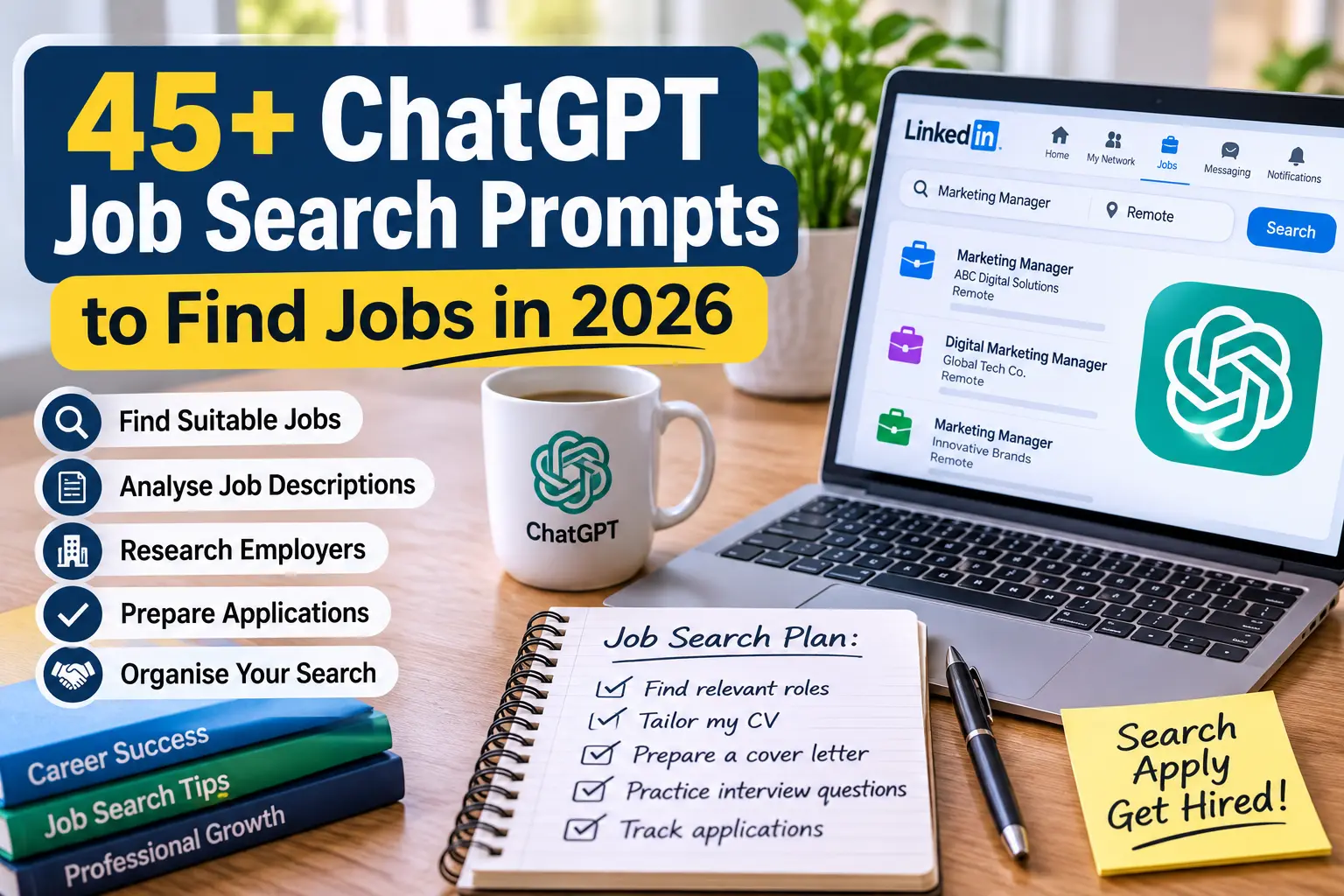
In this guide, you will find 45 ChatGPT job search prompts you can copy and customise to make your job search more organised and focused.
Quick Answer: How Can You Use ChatGPT for Job Searching?
You can use ChatGPT to plan a job search, identify suitable job titles, generate search keywords, analyse job descriptions, research employers, prepare application messages and organise your applications.
For the best results, provide your qualifications, skills, experience, preferred industry, location and career goals. ChatGPT can help you plan and evaluate your search, but you should verify vacancies, deadlines and employer details on official websites before applying.
How to Use ChatGPT for Your Job Search
Before using the prompts, prepare some basic information about your professional background and the opportunities you want.
You may need:
- Your education and qualifications
- Your previous or current job titles
- Your professional and technical skills
- Your preferred industry
- Your preferred work location
- Your salary expectations, if relevant
- Your preferred working arrangement, such as remote, hybrid or on-site
- Your short-term and long-term career goals
Follow these steps:
- Open ChatGPT.
- Choose a job-search task you need help with.
- Copy one of the prompts below.
- Replace the bracketed instructions with your information.
- Review the suggestions and verify important details.
- Use official company career pages or reputable job boards to confirm vacancies and submit applications.
Important: ChatGPT can help you research and organise a job search, but it may not have access to every current vacancy. Never assume a suggested job opening is still available without checking the employer’s official listing.
45 ChatGPT Job Search Prompts You Can Copy and Use
These prompts cover different stages of the job search process, from identifying suitable roles to following up after submitting an application.
1. ChatGPT Prompts for Finding Suitable Jobs
Start by identifying the types of jobs that match your education, skills and professional background.
Prompt 1: Identify jobs that match my qualifications
Act as a career adviser. Based on my education, qualifications, work experience and skills, suggest 15 job titles that may be suitable for me. My education is [qualification], my experience is [experience], and my strongest skills are [skills]. Explain briefly why each role may be relevant.
Prompt 2: Find alternative job titles
I am interested in working as a [target job title]. Suggest alternative job titles that involve similar responsibilities and skills. Include entry-level, intermediate and specialist roles where appropriate.
Prompt 3: Explore jobs in my industry
List career opportunities in the [industry] sector for someone with experience in [skills or qualifications]. Group the roles by experience level and explain the typical responsibilities.
Prompt 4: Identify entry-level opportunities
I am looking for entry-level jobs in [industry or field]. My qualifications are [qualifications], and my skills include [skills]. Suggest suitable job titles and explain the typical requirements employers may expect.
Prompt 5: Identify remote job opportunities
Based on my professional background in [field], suggest remote-friendly job titles I could explore. Explain the skills, tools and experience commonly associated with each role. Do not invent current vacancies.
Prompt 6: Explore jobs without a degree
I have skills and experience in [area] but do not have a university degree. Suggest realistic career paths and job titles where practical skills, certifications, portfolios or work experience may be relevant.
Prompt 7: Identify jobs after graduation
I recently graduated with a degree in [course]. Suggest suitable entry-level job titles, industries and career paths I can explore. Include examples of skills and projects I should highlight when applying.
2. ChatGPT Prompts for Job Search Keywords
Using suitable search terms can help you discover opportunities that may not appear when you search for only one job title.
Prompt 8: Generate job search keywords
I am searching for jobs in [industry or profession]. Generate a list of job-search keywords, alternative job titles and related phrases I can use on job boards and company career websites.
Prompt 9: Create Boolean job search strings
Create Boolean search strings for finding [target job title] opportunities. Include alternative job titles, related skills and useful variations. Explain how I can use the search strings on job platforms that support Boolean search.
Prompt 10: Find keywords from a job description
Analyse this job description and extract the most important job titles, technical skills, qualifications and experience requirements. Organise them into a keyword list I can use to search for similar opportunities. Job description: [paste description].
Prompt 11: Find related job opportunities
I am searching for [target job title], but I want to explore similar roles. Suggest related positions with overlapping responsibilities and skills. Explain how each role differs from my original target.
Prompt 12: Create location-based search terms
Help me generate job-search keywords for finding [job title] opportunities in [city or country]. Include local variations of the job title, relevant industries and alternative terms employers may use.
3. ChatGPT Prompts for Analysing Job Descriptions
A job title alone does not tell you everything about a position. Reviewing the job description can help you understand the responsibilities and determine whether an opportunity matches your background.
Prompt 13: Analyse a job description
Act as a recruitment specialist. Analyse the following job description and summarise the main responsibilities, required qualifications, essential skills and preferred experience. Identify the most important requirements. Job description: [paste text].
Prompt 14: Determine whether I am a suitable candidate
Compare my qualifications, skills and work experience with this job description. Identify where I meet the requirements, where I have gaps and which areas I should investigate further. Do not automatically classify me as qualified or unqualified. My background: [paste details]. Job description: [paste text].
Prompt 15: Identify transferable skills
Review this job description and identify transferable skills from my previous experience that may be relevant. My previous role was [job title], and my responsibilities included [responsibilities]. Explain how I can communicate these skills honestly in my application.
Prompt 16: Explain unfamiliar job requirements
Explain the requirements in this job description using simple language. Identify technical terms, tools, qualifications and responsibilities I may need to understand before applying. Job description: [paste text].
Prompt 17: Compare two job opportunities
Compare these two job descriptions. Evaluate their responsibilities, required skills, qualifications, experience expectations and potential career development opportunities. Present the comparison in a table. Job A: [paste description]. Job B: [paste description].
Prompt 18: Identify questions to ask before applying
Based on this job description, suggest useful questions I should investigate before applying. Focus on responsibilities, reporting structure, working arrangements, required qualifications and expectations. Job description: [paste text].
4. ChatGPT Prompts for Researching Companies and Employers
Researching an employer can help you understand its business, work environment and expectations before submitting an application.
Prompt 19: Create a company research checklist
Create a checklist for researching [company name] before applying for a job. Include its products or services, industry, business model, official website, career opportunities, company values and publicly available information about its workplace.
Prompt 20: Prepare company research questions
I am considering applying to [company name] for a [job title] position. Generate 15 questions I should investigate about the organisation, the role and its expectations before applying.
Prompt 21: Understand a company’s industry
Explain the industry in which [company name] operates. Summarise the main industry trends, competitors, common challenges and skills that may be valuable for employees in this sector. Identify information that needs current verification.
Prompt 22: Evaluate a job opportunity
Help me evaluate this job opportunity using the information provided. Consider the responsibilities, qualifications, work location, employment type, career development and any unclear details. Identify questions I should ask the employer before making a decision. Job information: [paste details].
Prompt 23: Prepare for a company application
I am applying for a [job title] position at [company name]. Based on the company information and job description I provide, identify the organisation’s likely priorities for this role and suggest which parts of my experience I should highlight. Company information: [paste information]. Job description: [paste description].
5. ChatGPT Prompts for Planning Your Job Search
A structured job-search plan helps you stay organised and avoid applying randomly to positions that do not match your goals.
Prompt 24: Create a 30-day job search plan
Create a practical 30-day job search plan for someone seeking a [job title] position in [industry or location]. Include weekly goals for finding vacancies, researching employers, preparing applications, networking and reviewing progress.
Prompt 25: Create a weekly job search schedule
Design a realistic weekly job-search schedule for me. I can spend [number] hours per week searching for jobs. Include time for vacancy research, application preparation, networking, skills development and follow-ups.
Prompt 26: Prioritise job opportunities
Help me create a system for prioritising job opportunities based on my qualifications, skills, career goals, location, salary expectations and work preferences. Suggest a simple scoring method I can use to compare vacancies.
Prompt 27: Organise multiple job applications
Create a job application tracking template with columns for company name, job title, vacancy link, application date, closing date, application status, contact person and follow-up date.
Prompt 28: Set realistic job-search goals
Help me establish measurable weekly goals for my job search. I am looking for [job title] opportunities in [industry or location]. Create goals that focus on relevant applications, employer research, networking and professional development.
Prompt 29: Review my job-search progress
Review my job-search progress based on the information below. Identify what is working, where I may need to improve and what actions I should prioritise next week. My recent activities and results are: [insert details].
6. ChatGPT Prompts for Applying to Jobs
Once you identify a suitable vacancy, ChatGPT can help you prepare a more relevant application.
Prompt 30: Tailor my application to a job description
Act as a professional job application adviser. Review my experience and the job description below. Suggest which qualifications, skills and achievements I should emphasise in my application. Do not invent experience or qualifications. My background: [paste details]. Job description: [paste description].
Prompt 31: Write a job application email
Write a professional email applying for the position of [job title] at [company name]. Mention my relevant qualifications and experience, explain my interest in the role and refer to the attached application documents. Keep it concise and professional.
Prompt 32: Write an application message to a recruiter
Draft a short professional message to a recruiter about a [job title] vacancy. My background is [brief background], and my relevant skills are [skills]. Express my interest and ask about the application process politely.
Prompt 33: Improve my application statement
Review and improve my application statement for a [job title] position. Make it clear, relevant and professional. Preserve my original meaning and do not add qualifications, achievements or experience I have not provided. Here is my draft: [paste text].
Prompt 34: Prepare a job application checklist
Create a checklist of documents and information I should prepare before applying for a [job title] position. Include a CV or résumé, cover letter, qualifications, portfolio where relevant and any role-specific requirements.
7. ChatGPT Prompts for Networking and Finding Opportunities
Not every opportunity is discovered through a job advertisement. Professional networking can also help you learn about employers, industries and potential openings.
Prompt 35: Write a networking message
Write a polite LinkedIn message to a professional working in [industry]. I want to introduce myself, explain my interest in the field and ask whether they would be willing to share general career advice. Keep it concise and respectful.
Prompt 36: Contact a former colleague
Draft a friendly but professional message to a former colleague asking whether they know of relevant opportunities in [industry or profession]. Briefly explain the type of role I am seeking without making the message sound demanding.
Prompt 37: Ask about an unadvertised opportunity
Write a professional email to [company name] expressing interest in potential opportunities in [department or profession], even though I have not found a specific vacancy. Briefly introduce my background and ask whether the organisation accepts expressions of interest.
Prompt 38: Prepare for a career networking event
Help me prepare for a professional networking event focused on [industry]. Suggest a short self-introduction, useful questions to ask employers and professionals, and ways to follow up after meeting someone.
8. ChatGPT Prompts for Following Up on Applications
Following up professionally can help you communicate continued interest and request an update without putting unnecessary pressure on the employer.
Prompt 39: Write an application follow-up email
Write a polite follow-up email about my application for the [job title] position at [company name]. I applied on [date]. Express continued interest and ask whether there is an update on the recruitment process.
Prompt 40: Follow up after an interview
Draft a professional follow-up email after my interview for the [job title] position at [company name]. Thank the interviewer for their time, mention one relevant discussion point and express continued interest in the role.
Prompt 41: Respond to an application update
Help me write a professional response to this recruitment update. Keep the tone appreciative and respectful. Message received: [paste message].
Prompt 42: Request feedback after rejection
Write a polite email thanking an employer for considering my application and asking whether they can share any constructive feedback that may help me improve future applications.
Prompt 43: Reconnect with an employer
Draft a professional message to [recruiter or hiring manager] to express continued interest in future opportunities at [company name]. I previously applied for [job title] on [date]. Keep the message courteous and concise.
9. ChatGPT Prompts for Improving Your Job Search Strategy
Use these final prompts to identify gaps, improve your approach and make better decisions as your search progresses.
Prompt 44: Identify skills I should develop
Based on my target role as a [job title] and the job descriptions I have collected, identify skills or qualifications that appear frequently. Separate essential requirements from additional skills I could develop to strengthen my applications.
Prompt 45: Build a job-search improvement strategy
Review my current job-search approach and suggest improvements. My target roles are [roles], my preferred locations are [locations], and my recent application results are [results]. Identify practical changes I can make to improve the relevance and quality of my search.
Example: Using ChatGPT to Build a Job Search Strategy
Suppose you have a degree in business administration, some administrative experience and an interest in human resources.
You could use the following prompt:
Act as a career adviser. I have a degree in Business Administration and two years of administrative experience. I want to move into Human Resources. Suggest suitable entry-level and intermediate job titles, transferable skills from my current experience, useful job-search keywords and a four-week job-search plan. Separate roles that may require additional qualifications from those I could reasonably explore with my current background.
ChatGPT might suggest exploring roles such as:
- HR Assistant
- Recruitment Assistant
- Human Resources Administrator
- Talent Acquisition Coordinator
- People Operations Assistant
These are possible search directions, not guaranteed matches. Review the requirements of individual vacancies before applying.
How to Track Your Job Applications
One of the most useful ways to stay organised is to maintain a job application tracker.
You can ask ChatGPT to create a template, then copy it into a spreadsheet or document.
| Company | Job title | Date applied | Status | Follow-up date |
|---|---|---|---|---|
| Company A | HR Assistant | [Date] | Applied | [Date] |
| Company B | Recruitment Assistant | [Date] | Interview | [Date] |
| Company C | HR Administrator | [Date] | Awaiting response | [Date] |
Update the tracker whenever you submit an application, receive a response or complete an interview.
Tips for Getting Better Results from ChatGPT
Use these practical tips to make your job-search prompts more effective:
- Be specific about your target role: Give ChatGPT a clear job title, industry and preferred location.
- Provide your real qualifications: Accurate information helps it suggest more relevant opportunities.
- Paste complete job descriptions: This makes it easier to identify responsibilities and requirements.
- Ask for alternatives: Explore related job titles instead of searching for only one position.
- Request structured outputs: Tables and checklists make job-search information easier to compare and organise.
- Verify current vacancies: Check official employer websites and reputable job boards before applying.
- Protect your personal information: Avoid sharing passwords, bank details, government identification numbers or other sensitive information in prompts.
- Keep your applications personalised: Review AI-generated messages before sending them to employers.
Common Mistakes to Avoid When Using ChatGPT for Job Searching
ChatGPT can make job searching more organised, but it should not replace careful research and decision-making.
Avoid these mistakes:
- Assuming suggested vacancies are current: Verify every opportunity through an official employer listing.
- Applying to every suggested role: Focus on positions that genuinely match your qualifications, skills and goals.
- Using generic application messages: Personalise each application to the employer and vacancy.
- Ignoring job requirements: Read the complete description and check essential qualifications before applying.
- Trusting unverified employer information: Confirm company details using reliable, independent sources.
- Inventing experience: Never add qualifications, employment history or achievements that are not true.
- Sharing sensitive information: Be cautious of suspicious recruitment requests and never provide financial or identity information without verifying the organisation and the legitimate purpose.
Frequently Asked Questions About ChatGPT Job Search Prompts
1. Can ChatGPT help me find a job?
Yes. ChatGPT can help identify suitable job titles, generate search keywords, analyse job descriptions, prepare application materials and organise your search. You should verify actual vacancies on employer websites or reputable job platforms.
2. What is the best ChatGPT prompt for finding jobs?
A useful starting prompt provides your qualifications, skills, work experience, preferred industry and location. Ask ChatGPT to suggest relevant job titles, alternative search terms and possible career paths.
3. Can ChatGPT find current job vacancies?
ChatGPT may be able to research current opportunities when web search or another suitable live source is available. However, availability and accuracy must be checked against the employer’s official vacancy listing.
4. Can ChatGPT help me find remote jobs?
Yes. It can suggest remote-friendly job titles, relevant search keywords and skills associated with remote work. You should verify the location restrictions and remote-working conditions in each vacancy.
5. Can ChatGPT analyse job descriptions?
Yes. It can summarise responsibilities, identify required skills and qualifications, explain unfamiliar terminology and compare job requirements with your background.
6. Can ChatGPT help me apply for jobs?
Yes. It can help tailor application statements, draft application emails, prepare recruiter messages and create application checklists. Always review the final content before submitting it.
7. Can ChatGPT create a job application tracker?
Yes. You can ask it to create a table or spreadsheet structure for recording companies, job titles, application dates, deadlines, statuses and follow-up dates.
8. Is ChatGPT enough to find a job?
No. ChatGPT is a support tool, not a recruitment platform or a guarantee of employment. A successful job search also requires checking real vacancies, submitting suitable applications, developing relevant skills and communicating with employers.
Test Your Job Search Prompting Knowledge
1. What information should you provide when asking ChatGPT to suggest suitable jobs?
A. Only your first name
B. Your qualifications, skills, experience and career goals
C. Random job titles
D. Other people’s CVs
2. Why should you verify vacancies suggested by ChatGPT?
A. Every suggested vacancy is guaranteed to be current
B. Job listings and application deadlines can change
C. Employers never remove vacancies
D. ChatGPT automatically submits applications
3. What is the purpose of analysing a job description?
A. To understand the responsibilities and requirements
B. To avoid reading the vacancy
C. To invent additional qualifications
D. To guarantee an interview
4. How can a job application tracker help?
A. It guarantees a job offer
B. It replaces your CV
C. It helps organise applications, deadlines and follow-ups
D. It automatically contacts recruiters
5. What should you do before sending an AI-generated application email?
A. Send it without reading it
B. Add invented achievements
C. Review and personalise it
D. Remove the employer’s name
Answers
- B – Your background helps ChatGPT suggest more relevant opportunities.
- B – Vacancies, deadlines and application requirements can change.
- A – Analysing the description helps you understand what the employer expects.
- C – A tracker keeps your job-search activities organised.
- C – Reviewing and personalising the email helps ensure accuracy and relevance.
Final Thoughts
Job searching becomes easier to manage when you have a clear strategy. ChatGPT can help you identify suitable roles, explore alternative job titles, understand job descriptions, prepare applications and track your progress.
The 45 prompts in this guide provide a practical starting point. Use them to organise your search, but always verify vacancies, research employers and ensure that every application accurately represents your qualifications and experience.
If you are preparing for your next career opportunity, explore these related Promptenza guides:
- ChatGPT Resume Writing Prompts: 40+ Prompts to Improve Your CV
- ChatGPT Cover Letter Prompts for Job Applications
- ChatGPT Job Interview Practice Prompts
- ChatGPT LinkedIn Profile Prompts
- Prompt Anatomy: Parts of an Effective AI Prompt