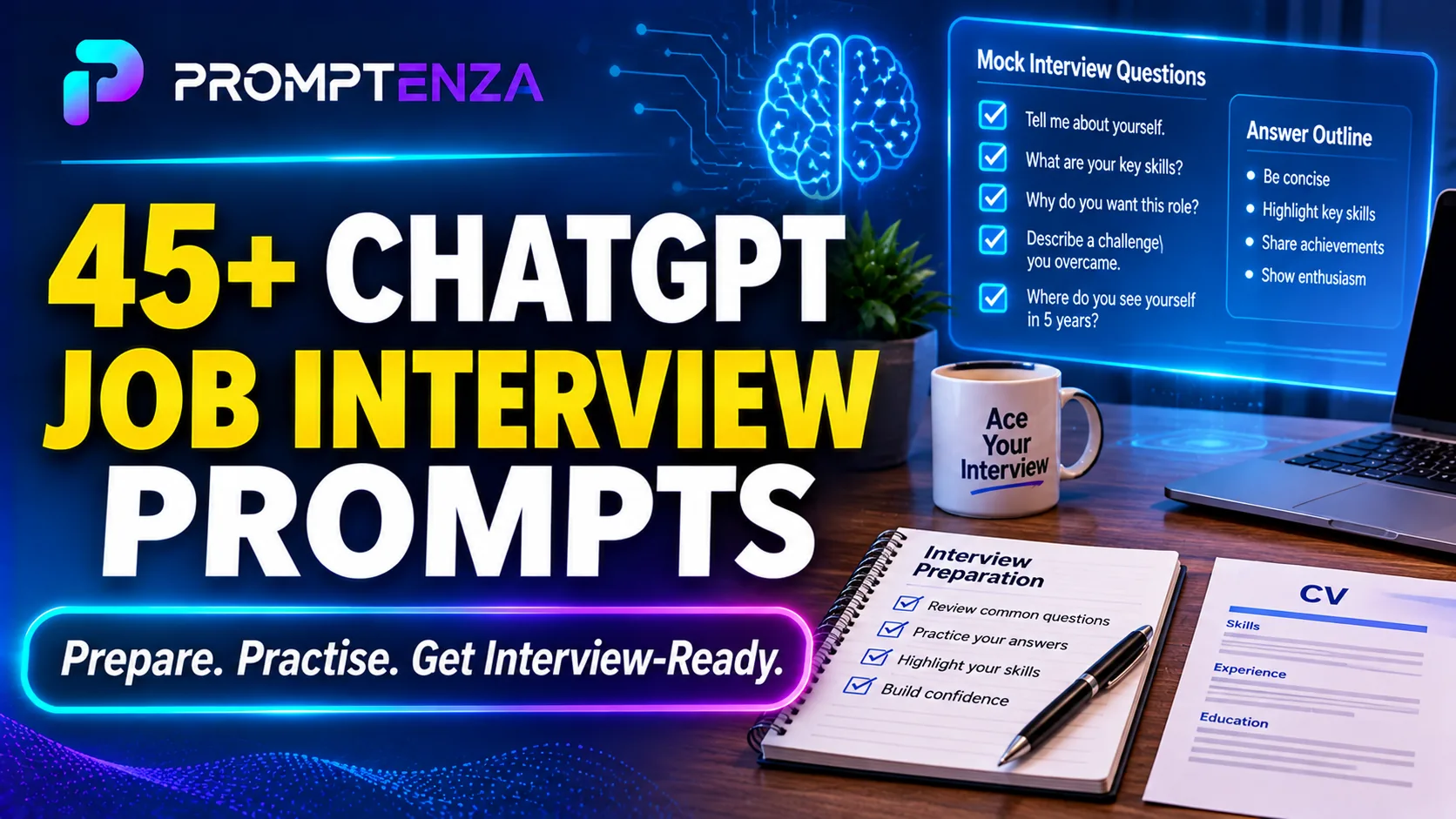
40+ ChatGPT Job Interview Practice Prompts to Prepare for Any Interview
Preparing for a job interview can be stressful, especially when you are unsure which questions an employer might ask or how to communicate your experience confidently.
ChatGPT can help you prepare by generating realistic interview questions, conducting mock interviews, improving your answers and identifying areas where you need more preparation.
Whether you are applying for your first job, preparing for a management position, changing careers or attending a technical interview, the right prompts can help you practise before meeting an employer.
In this guide, you’ll discover 45+ ChatGPT job interview practice prompts you can copy and paste to prepare for different interview situations. You’ll also learn how to practise common interview questions, structure stronger answers and avoid mistakes that could affect your preparation.
Quick Answer: How Can You Use ChatGPT to Practise for a Job Interview?
You can use ChatGPT as an interview practice assistant by giving it your target job title, experience, job description and interview requirements. It can generate likely questions, simulate an interview, evaluate your answers and suggest improvements.
Example prompt:
Act as an experienced job interviewer and career coach. Help me prepare for an interview for a [Job Title] position at [Company Name]. Use the job description and my professional background below to generate 10 realistic interview questions. Ask me one question at a time and wait for my response before continuing. After each answer, evaluate its relevance, clarity, structure and use of examples. Suggest improvements while keeping my answers truthful and consistent with my actual experience.
This approach allows you to practise answering questions rather than simply reading prepared answers.
How to Use ChatGPT for Job Interview Preparation
You can use ChatGPT before an interview to understand the position, anticipate questions and practise explaining your qualifications.
Follow these steps.
Step 1: Get the Job Description
Copy the job advertisement or save the main responsibilities and qualifications. This gives ChatGPT context about the role.
Step 2: Provide Your Professional Background
Share relevant information such as:
- Your education and qualifications
- Previous work experience
- Professional skills
- Relevant projects
- Major achievements
- Certifications where applicable
Avoid sharing unnecessary private information.
Step 3: Ask ChatGPT to Identify Likely Questions
Request questions based on the position and employer’s requirements. Ask for a mixture of general, behavioural and role-specific questions.
Step 4: Practise Answering Questions
Use the mock interview prompts in this article. Ask ChatGPT to present one question at a time and evaluate your responses.
Step 5: Improve Your Answers
Request feedback on clarity, relevance, structure and examples. Rewrite weak answers using your actual experience.
Step 6: Practise Again
Repeat the exercise with different questions. Focus on communicating your experience naturally rather than memorizing complete answers.
For additional job application preparation, explore our guides to ChatGPT Resume Writing Prompts and ChatGPT Cover Letter Prompts.
45 Best ChatGPT Job Interview Practice Prompts
These prompts cover different interview stages and professional situations. Replace the bracketed information with your own details.
1. General Job Interview Preparation Prompts
Start with these prompts if you want to understand what to expect before an interview.
Prompt 1: Generate Common Interview Questions
Act as an experienced recruiter. I am preparing for a [Job Title] interview. Generate 15 common interview questions for this position, covering my background, qualifications, skills, work experience and interest in the role. Include a brief explanation of what each question is designed to assess.
Prompt 2: Prepare for a Specific Job Interview
Help me prepare for an interview at [Company Name] for the position of [Job Title]. Review the job description below and identify the most important skills and responsibilities. Generate relevant interview questions based on these requirements.
Prompt 3: Create an Interview Preparation Plan
Create a practical three-day interview preparation plan for a [Job Title] interview. Include time for researching the employer, reviewing my experience, practising common questions and preparing questions to ask the interviewer.
Prompt 4: Identify My Strongest Qualifications
Review my CV and the job description below. Identify five qualifications or experiences I should emphasize during my interview. Explain how each one relates to the employer’s requirements.
Prompt 5: Prepare for an Interview with Limited Experience
Help me prepare for an entry-level [Job Title] interview. Generate realistic questions and show me how to discuss my education, projects, transferable skills and willingness to learn without pretending to have experience I do not possess.
Prompt 6: Understand What the Interviewer Wants
Act as a career coach. Explain what an employer is likely assessing when asking common interview questions for a [Job Title] position. Give me practical advice on how to prepare relevant and truthful responses.
2. Common Job Interview Question Prompts
These prompts help you practise questions that appear in many different types of interviews.
Prompt 7: Answer Tell Me About Yourself
Help me prepare a professional answer to the interview question “Tell me about yourself.” Use my education, relevant work experience, key skills and career interests. Keep the answer natural, focused and suitable for a [Job Title] interview.
Prompt 8: Answer Why Should We Hire You?
Help me develop a strong answer to “Why should we hire you?” for a [Job Title] position. Connect my actual qualifications, experience and skills to the job requirements. Avoid exaggerated claims and generic statements.
Prompt 9: Answer Why Do You Want This Job?
Help me answer the interview question “Why do you want this job?” Use the job description and information about the company that I provide. Connect my professional interests to the responsibilities of the position.
Prompt 10: Answer What Are Your Strengths?
Review my professional background and help me identify three relevant strengths for a [Job Title] interview. Explain how I can support each strength with a genuine example.
Prompt 11: Answer What Are Your Weaknesses?
Help me prepare a thoughtful answer to “What is your greatest weakness?” Suggest ways to discuss a genuine professional development area, explain what I am doing to improve and avoid presenting a fake weakness.
Prompt 12: Answer Where Do You See Yourself in Five Years?
Help me answer the interview question “Where do you see yourself in five years?” Create a realistic response that reflects professional growth, learning and my interest in contributing to the organization.
Prompt 13: Answer Why Are You Leaving Your Current Job?
Help me prepare a professional and positive answer to “Why are you leaving your current job?” Use the circumstances I provide. Avoid criticizing my previous employer and keep the response respectful.
Prompt 14: Answer What Do You Know About Our Company?
Help me prepare for the question “What do you know about our company?” Use the company information I provide to identify relevant facts about its work, services, values and industry. Organize them into a concise interview response.
3. Behavioural Interview Practice Prompts
Behavioural questions ask you to explain how you handled situations in the past. The STAR method can help structure your responses.
STAR stands for:
- Situation: Explain the circumstances.
- Task: Describe your responsibility.
- Action: Explain what you did.
- Result: Describe the outcome.
Prompt 15: Practise STAR Interview Questions
Act as a behavioural interview coach. Generate 10 STAR interview questions for a [Job Title] position. Ask me one question at a time and evaluate whether my answer clearly explains the situation, task, action and result.
Prompt 16: Describe a Challenging Work Situation
Help me prepare an answer to “Tell me about a challenging situation you faced at work.” Use my actual experience to structure the response with the STAR method. Keep the answer concise and focused on what I learned.
Prompt 17: Describe a Teamwork Experience
Help me answer “Tell me about a time you worked successfully as part of a team.” Use my experience to explain my contribution, how I collaborated with others and the outcome.
Prompt 18: Describe a Time You Solved a Problem
Create a structured interview answer explaining how I solved a professional or academic problem. Use the STAR method and focus on my reasoning, actions and results.
Prompt 19: Describe a Leadership Experience
Help me prepare an answer to “Tell me about a time you demonstrated leadership.” Use a genuine example from my work, studies, volunteering or projects. Explain how I supported others and what happened.
Prompt 20: Describe a Mistake You Made
Help me answer “Tell me about a mistake you made and what you learned from it.” Use an honest example, explain how I addressed the situation and highlight what I changed afterward.
Prompt 21: Describe How You Handle Conflict
Generate a professional answer to “Tell me about a time you disagreed with a colleague or team member.” Use my actual experience and demonstrate communication, problem-solving and professionalism.
Prompt 22: Describe How You Handle Pressure
Help me answer “How do you work under pressure?” Use a relevant example to explain how I prioritize tasks, manage deadlines and maintain quality.
4. Mock Interview Prompts
These are especially useful because they allow you to practise a realistic interview conversation.
Prompt 23: Complete Mock Job Interview
Act as a professional interviewer conducting a mock interview for a [Job Title] position. Ask me 10 questions, one at a time. Wait for my response before asking the next question. At the end, evaluate my overall performance and identify areas for improvement.
Prompt 24: Strict Interviewer Simulation
Conduct a realistic mock interview for a [Job Title] position. Ask challenging but fair questions about my experience, qualifications and professional decisions. Do not reveal the next question until I answer the current one.
Prompt 25: Friendly Interview Practice
Act as a supportive interviewer helping me build confidence. Ask common questions for a [Job Title] position, one at a time. After every answer, provide constructive feedback and suggest a clearer way to communicate my points.
Prompt 26: Final Interview Simulation
Simulate a final-round interview for a [Job Title] position. Focus on my professional judgment, problem-solving abilities, communication and suitability for the organization. At the end, provide an evaluation and practical recommendations.
Prompt 27: Panel Interview Simulation
Act as a panel of three interviewers evaluating me for a [Job Title] position. Give each interviewer a different focus, such as technical knowledge, communication and leadership. Ask questions one at a time and provide an overall assessment at the end.
Prompt 28: Interview Under Time Pressure
Conduct a timed-style interview simulation for a [Job Title] position. Ask 10 questions that I should practise answering concisely. After each response, suggest ways to make it more direct and relevant.
5. Technical and Role-Specific Interview Prompts
Use these prompts to prepare for interviews that require specialist knowledge.
Prompt 29: Software Developer Interview
Act as a technical interviewer for a software developer position. Generate questions covering programming fundamentals, problem-solving, software development practices and the technologies listed in my CV. Ask one question at a time and evaluate my responses.
Prompt 30: Marketing Interview
Help me prepare for a marketing job interview. Generate questions about campaign planning, content strategy, audience research, marketing performance and communication. Use my experience and the job description to make the questions relevant.
Prompt 31: Accounting Interview
Act as an accounting recruitment specialist. Generate interview questions covering financial reporting, accounting principles, reconciliations, attention to detail and relevant accounting software. Include practical scenarios appropriate to my experience level.
Prompt 32: Teaching Interview
Help me prepare for a teaching interview. Generate questions about lesson planning, classroom management, student engagement, assessment and communication with parents. Include suggestions for structuring answers using genuine examples.
Prompt 33: Customer Service Interview
Create a mock interview for a customer service representative position. Include questions about handling complaints, communicating with customers, resolving problems and working under pressure.
Prompt 34: Management Interview
Act as a senior recruitment interviewer. Generate questions for a management position covering leadership, decision-making, team development, performance management and strategic planning.
Prompt 35: Remote Job Interview
Prepare me for a remote job interview. Generate questions about independent working, time management, written communication, virtual collaboration and handling competing priorities.
6. Salary, Difficult Questions and Final Interview Preparation
These prompts can help you prepare for conversations that may be more challenging.
Prompt 36: Discuss Salary Expectations
Help me prepare a professional response to “What are your salary expectations?” Consider the job title, location, experience level and salary information I provide. Suggest a polite way to discuss compensation while remaining open to negotiation.
Prompt 37: Explain an Employment Gap
Help me prepare a concise and professional response to questions about an employment gap. Use only the explanation I provide and help me redirect the conversation toward my qualifications and readiness for the role.
Prompt 38: Prepare for Unexpected Questions
Generate 10 challenging but realistic interview questions for a [Job Title] position. Explain what each question is assessing and provide guidance on how to approach it.
Prompt 39: Prepare Questions to Ask the Interviewer
Generate 12 thoughtful questions I can ask an interviewer at the end of a [Job Title] interview. Cover job responsibilities, team structure, expectations, workplace culture and professional development.
Prompt 40: Follow-Up Interview Preparation
Help me prepare for a second-round interview for a [Job Title] position. Generate questions that may explore my previous answers in more depth, my suitability for the team and my understanding of the organization.
Prompt 41: Improve My Interview Answers
Review the interview question and my draft answer below. Identify unclear statements, missing examples and irrelevant information. Rewrite the answer to make it more structured, specific and natural without changing the facts.
Prompt 42: Create a Personal Interview Cheat Sheet
Using my CV and the job description, create a one-page interview preparation sheet. Include my strongest qualifications, relevant achievements, examples of problem-solving, questions to ask the interviewer and important points to remember.
Prompt 43: Evaluate My Interview Performance
Review my mock interview answers. Score each response for relevance, clarity, structure, evidence and professionalism. Identify my strongest answers and provide specific improvements for weaker ones.
Prompt 44: Prepare a Thank-You Message After an Interview
Write a short, professional thank-you email following my interview for a [Job Title] position at [Company Name]. Thank the interviewer for their time, mention a relevant discussion point I provide and express continued interest in the opportunity.
Prompt 45: Complete Interview Preparation Review
Act as a career coach. Review my CV, job description and interview preparation notes. Identify the most important areas I should revise before the interview. Create a final checklist covering my experience, likely questions, examples, employer research and questions to ask.
Example: Practising a Job Interview with ChatGPT
Let’s look at how you can use ChatGPT to prepare for a real interview.
Example job information
| Detail | Example |
|---|---|
| Position | Marketing Assistant |
| Company | ABC Digital Solutions |
| Education | Bachelor’s degree in Marketing |
| Experience | Internship supporting social media campaigns |
| Skills | Content writing, communication and basic analytics |
| Interview type | First-round interview |
Copy-and-paste mock interview prompt
Act as an experienced recruiter at ABC Digital Solutions. I am applying for a Marketing Assistant position.
My background:
- Bachelor’s degree in Marketing.
- Internship experience supporting social media campaigns.
- Skills in content writing, communication and basic analytics.
- Experience assisting with a student marketing campaign.
Conduct a realistic first-round interview. Ask me one question at a time. Wait for my answer before continuing. After each response, evaluate my clarity, relevance and use of examples. Help me improve my answers without inventing experience or achievements.
Example interview question
Interviewer: Tell me about yourself and why you are interested in this Marketing Assistant position.
Example answer:
“I have a bachelor’s degree in Marketing and practical experience supporting social media campaigns during my internship. Through that experience, I developed an interest in digital marketing, content creation and audience engagement.
I have also participated in a student marketing campaign, which helped me develop my communication and teamwork skills. I am interested in this Marketing Assistant position because it would allow me to apply my academic knowledge, build on my practical experience and contribute to the company’s marketing activities.”
This answer provides a clear introduction, connects education to experience and explains the applicant’s interest in the position.
How to Answer Common Job Interview Questions
Some interview questions appear across different industries. Preparing a structured response can help you communicate more effectively.
| Interview question | What the interviewer wants to understand |
|---|---|
| Tell me about yourself | Your professional background and relevance |
| Why should we hire you? | Your suitability for the position |
| What are your strengths? | Your relevant capabilities |
| What is your weakness? | Self-awareness and willingness to improve |
| Describe a challenge you faced | Problem-solving and decision-making |
| Where do you see yourself in five years? | Your professional goals |
| Why do you want to work here? | Your interest in the employer |
| How do you handle pressure? | Organization and prioritization |
Use the STAR Method for Behavioural Questions
When an interviewer asks you to describe a past situation, the STAR method can help you organize your response.
For example, if asked about a time you solved a problem:
- Situation: Briefly explain the problem.
- Task: Describe what you were responsible for.
- Action: Explain the steps you took.
- Result: Share the outcome and what you learned.
Use genuine examples from your employment, education, volunteering or personal projects.
Tips for Getting Better Results from ChatGPT Interview Prompts
1. Provide the Actual Job Description
The more relevant information ChatGPT receives, the easier it is to generate questions that match the role.
2. Practise One Question at a Time
Avoid asking ChatGPT to generate all your answers at once. A conversational mock interview encourages you to think through each response.
3. Use Your Real Experience
Do not memorize examples that did not happen. Build your answers around genuine work, academic or project experiences.
4. Request Honest Feedback
Ask ChatGPT to identify unclear explanations, unsupported claims and answers that do not address the question.
5. Practise Speaking Your Answers
Reading an answer is different from explaining it aloud. Practise speaking naturally so you become comfortable expressing your ideas.
6. Research the Employer Separately
ChatGPT can help organize company information you provide, but you should verify important details through the employer’s official website and job advertisement.
7. Prepare Your Own Questions
An interview is also an opportunity to understand the role. Prepare relevant questions about responsibilities, expectations, team structure and professional development.
Common Mistakes to Avoid When Using ChatGPT for Interview Preparation
- Memorizing every answer: Prepared responses should guide your thinking, not replace natural communication.
- Using invented examples: Only discuss experiences and achievements that are genuine.
- Ignoring the job description: General interview questions alone may not prepare you for role-specific discussions.
- Accepting every AI suggestion: Review feedback and use what is accurate and relevant.
- Preparing only for common questions: Include behavioural, technical and situational questions where relevant.
- Giving overly long answers: Practise answering directly and supporting your points with useful examples.
- Ignoring company research: Understand the employer and the responsibilities before attending the interview.
Frequently Asked Questions About ChatGPT Interview Practice Prompts
1. Can ChatGPT help me prepare for a job interview?
Yes. ChatGPT can generate interview questions, conduct mock interviews, review your answers and suggest ways to improve your preparation.
2. What is the best ChatGPT prompt for interview practice?
A useful prompt asks ChatGPT to act as an interviewer, provides your job title and job description, and instructs it to ask one question at a time before evaluating your responses.
3. Can ChatGPT conduct a mock interview?
Yes. Ask ChatGPT to simulate an interview for a particular position. You can practise answering questions one at a time and receive feedback after each response.
4. Can ChatGPT help me answer “Tell me about yourself”?
Yes. Provide your education, relevant work experience, skills and career interests. ChatGPT can help organize this information into a concise professional introduction.
5. Can ChatGPT prepare me for behavioural interview questions?
Yes. It can generate behavioural questions and help you structure genuine examples using the STAR method: Situation, Task, Action and Result.
6. Can I use ChatGPT to prepare for a technical interview?
Yes. You can request questions related to your profession, programming languages, tools, technical knowledge and problem-solving skills. Always verify technical explanations and practise solving problems independently.
7. Can ChatGPT help me answer salary expectation questions?
Yes. It can help you prepare a professional response using information about the position, location, experience level and salary expectations you provide. Verify market salary information independently.
8. Should I memorize ChatGPT-generated interview answers?
No. Use generated answers as preparation examples. Adapt them to your actual experience and practise communicating naturally rather than memorizing scripts.
Test Your Job Interview Prompting Knowledge
Check how much you’ve learned about using ChatGPT to prepare for job interviews.
1. What information should you provide to generate relevant interview questions?
A. Only your first name
B. Your job title, background and job description
C. A random company name
2. What does the STAR method stand for?
A. Skills, Training, Answers and Results
B. Situation, Task, Action and Result
C. Strategy, Time, Ability and Review
3. What is the best way to practise a mock interview with ChatGPT?
A. Ask for all answers and memorize them
B. Ask one question at a time and respond naturally
C. Skip difficult questions
4. What should you do if ChatGPT suggests an achievement you never accomplished?
A. Include it anyway
B. Present it as a personal experience
C. Remove it and use genuine information
5. Why should you research the employer before an interview?
A. To understand the organization and prepare relevant responses
B. To memorize unrelated company information
C. To avoid answering questions
6. What should you do after receiving AI feedback on your answers?
A. Accept everything without reviewing
B. Evaluate the suggestions and use what is accurate
C. Ignore your own experience
Answers
- B — Your job title, background and job description.
- B — Situation, Task, Action and Result.
- B — Ask one question at a time and respond naturally.
- C — Remove it and use genuine information.
- A — To understand the organization and prepare relevant responses.
- B — Evaluate the suggestions and use what is accurate.
Final Thoughts
Preparing for a job interview involves more than memorizing common questions. You need to understand the position, communicate your experience and demonstrate how your skills relate to the employer’s needs.
ChatGPT can make this process easier by generating realistic questions, simulating interviews and helping you improve your responses.
Start with the prompts in this guide, practise using your actual experience and review your answers before the interview.
If you’re still preparing your application, explore our guides to ChatGPT Resume Writing Prompts and ChatGPT Cover Letter Prompts to strengthen the other parts of your job search.