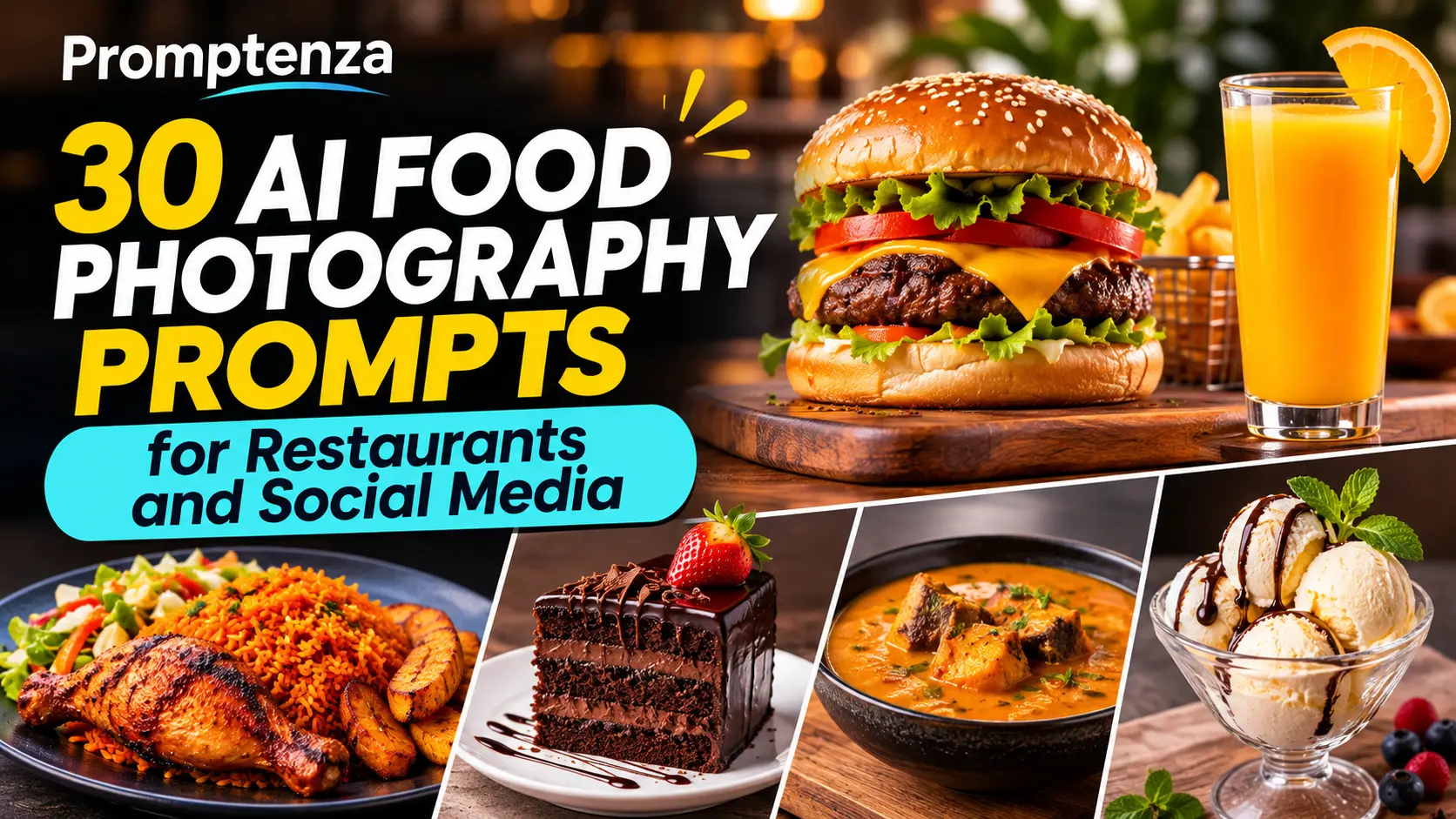
30 AI Food Photography Prompts for Restaurants and Social Media
Food photography can make a restaurant menu, social media post, or food delivery listing more visually appealing. With AI image generators, restaurants, food businesses, and content creators can explore different food photography styles by describing the dish, ingredients, composition, lighting, background, and intended use.
However, getting a useful result requires more than asking an AI tool to create a beautiful food photograph. A good prompt should explain what the food looks like, how it is presented, which details matter, and the kind of photograph you want.
This guide provides 30 AI food photography prompts you can copy and customize. You will find examples for restaurant menus, social media, desserts, drinks, traditional meals, food advertising, and delivery platforms. You will also learn how to write better food photography prompts, refine generated images, and avoid misleading customers with inaccurate visuals.
Quick Answer: What Are the Best AI Food Photography Prompts?
The best AI food photography prompts describe the dish, ingredients, presentation, setting, lighting, composition, and photographic style.
For example, instead of writing:
Create a beautiful photograph of a burger.
Use a more descriptive prompt:
Create a photorealistic restaurant food photograph of a freshly prepared beef burger with a toasted sesame bun, lettuce, tomato, cheese, and a clearly visible beef patty. Present it on a simple ceramic plate on a wooden restaurant table. Use soft natural window lighting, a close three-quarter camera angle, and a softly blurred restaurant background. Keep the ingredients recognizable and the food presentation realistic. Create a polished image suitable for a restaurant social media post.
A useful food photography prompt usually includes:
- Dish: Name the food or drink being photographed.
- Ingredients: Describe the visible ingredients and toppings.
- Presentation: Explain how the dish should be arranged or served.
- Background: Specify the restaurant, studio, table, or outdoor setting.
- Lighting: Choose soft daylight, studio lighting, or another clear lighting direction.
- Composition: Request a close-up, overhead view, three-quarter angle, or wider scene.
- Photography style: Choose restaurant menu photography, editorial food photography, or social media advertising.
- Constraints: Identify details that must remain accurate, especially when using a reference photograph.
How to Write an Effective AI Food Photography Prompt
A good food photography prompt works like a creative brief for a food photographer. It describes the dish and explains how the final image should present it.
OpenAI’s official image-prompting guidance recommends defining the intended result, describing the subject and composition, specifying visible details, and stating important constraints. Google’s official image-generation guidance similarly recommends describing the subject, composition, action, location, style, and editing instructions.
These are official prompting recommendations from the respective companies. They are not guarantees that every image generator will reproduce food, ingredients, or textures accurately.
The AI Food Photography Prompt Formula
Use this structure as a starting point:
Dish + Ingredients + Presentation + Background + Lighting + Composition + Photography Style + Constraints
| Prompt element | What to describe | Example |
|---|---|---|
| Dish | The food or drink | Grilled chicken with rice |
| Ingredients | Visible components | Grilled chicken, rice, vegetables, and sauce |
| Presentation | How the food is served | Arranged on a ceramic dinner plate |
| Background | The environment | Warm modern restaurant table |
| Lighting | How the food is illuminated | Soft natural window light |
| Composition | Camera viewpoint | Three-quarter close-up |
| Style | Intended photographic appearance | Professional restaurant menu photography |
| Constraints | What must remain accurate | Preserve the actual ingredients and portion |
You do not need to include every detail in every prompt. Choose the details that matter most to the image.
Why Specific Food Details Matter
Compare these two prompts:
Basic prompt:
Create a picture of fried rice.
More specific prompt:
Create a photorealistic restaurant food photograph of a serving of fried rice with visible vegetables and egg, presented in a shallow white ceramic bowl. Place the bowl on a clean wooden table with a softly blurred restaurant background. Use warm natural window lighting and a slightly elevated three-quarter camera angle. Keep the rice grains, vegetables, and serving arrangement clearly visible.
The second prompt gives the image generator a clearer description of the food, presentation, background, lighting, and camera angle.
For more guidance on building effective instructions, read Prompt Anatomy: Parts of an Effective AI Prompt.
30 AI Food Photography Prompts You Can Copy and Customize
The following prompts are organized by purpose. You can copy them into an image generator and customize the dish, ingredients, background, and presentation.
Important: If you are creating promotional images for a real restaurant, use the actual dish and ingredients as your reference. An attractive generated image should not misrepresent what customers will receive.
1. Restaurant Menu Food Photography Prompts
These prompts are designed for restaurant menus, website food galleries, and promotional materials.
Prompt 1: Professional restaurant food photograph
Create a photorealistic restaurant food photograph of [insert actual dish]. Show the real ingredients clearly, with the food neatly arranged on a simple ceramic plate. Place it on a clean restaurant table with a softly blurred background. Use soft, balanced natural lighting, a three-quarter camera angle, and professional restaurant menu photography styling. Preserve the actual dish and its recognizable ingredients.
Prompt 2: Elegant fine-dining presentation
Create a high-end editorial food photograph of [insert actual dish], presented carefully on a large minimalist ceramic plate. Use a refined restaurant setting, subtle background details, and soft directional studio lighting. Frame the dish from a three-quarter angle so the presentation and ingredients are visible. Keep the plating believable and avoid adding ingredients that are not part of the dish.
Prompt 3: Casual restaurant meal
Create a realistic restaurant photograph of [insert actual meal] served on a wooden dining table. Show the full plate clearly, with natural food textures and realistic colors. Use warm daylight, a comfortable restaurant background, and a slightly elevated camera angle. The image should feel inviting and suitable for a casual restaurant menu.
Prompt 4: Restaurant special of the day
Create a professional promotional food photograph of [insert actual daily special]. Arrange the dish attractively while preserving its real ingredients and portion. Use soft restaurant lighting, a clean background, and a close three-quarter composition. Leave some uncluttered space around the plate for a separate promotional headline to be added later.
Prompt 5: Restaurant signature dish
Create a premium editorial photograph of [insert restaurant’s signature dish]. Present the dish in its actual serving style, with its main ingredients clearly visible. Use controlled soft lighting, realistic textures, and a tasteful restaurant background. Frame the dish as the central subject, with enough detail to make its presentation recognizable.
2. Social Media Food Photography Prompts
These prompts are suitable for restaurant Instagram posts, Facebook content, food business promotions, and other social media visuals.
Prompt 6: Instagram food post
Create a visually appealing, photorealistic social media food photograph of [insert actual dish]. Present the food on a clean plate with a simple, attractive background. Use soft natural lighting, realistic food textures, and a slightly elevated three-quarter camera angle. Compose the image vertically with the dish as the main focus and some uncluttered space for a caption or graphic to be added separately. Keep the actual ingredients and presentation accurate.
Prompt 7: Facebook restaurant promotion
Create a polished promotional food photograph of [insert actual restaurant meal]. Show the complete dish on a simple serving plate, placed on a warm wooden table. Use balanced natural lighting and a softly blurred restaurant background. Frame the image in a square composition suitable for a Facebook post. Keep the food clearly visible and avoid adding text, logos, or decorative ingredients that are not part of the meal.
Prompt 8: Food carousel cover image
Create an eye-catching editorial food photograph of [insert featured dish] for the first slide of a restaurant social media carousel. Position the meal prominently in the center, with a clean background and soft directional lighting. Use a slightly elevated camera angle to reveal the ingredients and presentation. Leave sufficient negative space for a short title to be added later. Maintain realistic colors and food textures.
Prompt 9: Behind-the-scenes food preparation
Create a realistic documentary-style photograph showing [insert actual food] being prepared in a professional restaurant kitchen. Show the cook’s hands arranging the ingredients or finishing the dish, without making the person the main subject. Use natural kitchen lighting, visible food textures, and a close three-quarter composition. Keep the scene believable, clean, and suitable for a restaurant social media story.
Prompt 10: Food close-up for social media
Create a detailed close-up food photograph of [insert actual dish]. Focus on the visible ingredients, surface textures, and freshly prepared appearance. Use soft directional lighting, a shallow depth-of-field look, and a simple background. Keep the main part of the dish in focus and use realistic colors. Compose the image for a vertical social media post without adding artificial ingredients.
3. Traditional Meals and Local Cuisine Prompts
These prompts are useful for restaurants serving regional dishes, traditional meals, and culturally specific food. Replace the examples with the actual recipe and serving style.
Prompt 11: Ghanaian jollof rice
Create a photorealistic food photograph of Ghanaian jollof rice served on a simple ceramic plate. Show the red-orange rice with clearly visible grains, accompanied by [insert actual sides, such as grilled chicken, fried plantain, or salad]. Present the meal in a realistic restaurant setting with a clean wooden table. Use warm natural daylight, a three-quarter camera angle, and detailed food textures. Preserve the actual sides and portion without inventing additional ingredients.
Prompt 12: Waakye food photography
Create a realistic restaurant food photograph of a serving of Ghanaian waakye. Show the rice and beans with [insert the actual accompaniments, such as spaghetti, gari, egg, fish, meat, or shito]. Arrange the ingredients naturally on a serving plate or in the actual takeaway packaging. Use soft daylight, a slightly elevated camera angle, and a clean background. Keep the meal culturally recognizable and accurately represented.
Prompt 13: Banku and grilled fish
Create a photorealistic food photograph of Ghanaian banku served with grilled fish and [insert the actual pepper sauce and accompaniments]. Present the food on a traditional serving plate, with the grilled fish clearly visible and its texture realistically represented. Use warm natural lighting and a close three-quarter angle. Create a welcoming restaurant food photograph without adding ingredients that are not included in the meal.
Prompt 14: Fufu and soup
Create a realistic food photograph of a serving of Ghanaian fufu with [insert the actual soup, such as light soup or groundnut soup]. Show the fufu and soup in their appropriate serving bowls, with any included fish or meat visible. Use a slightly elevated three-quarter camera angle, natural food colors, and soft restaurant lighting. Keep the traditional presentation recognizable and avoid changing the ingredients.
Prompt 15: Traditional food platter
Create a premium editorial food photograph of a traditional [insert cuisine or regional food platter]. Arrange the actual dishes and accompaniments neatly on a large serving platter. Use a warm, natural background with subtle cultural details that do not distract from the food. Photograph from a slightly elevated angle with soft directional lighting. Preserve the authentic ingredients, serving style, and proportions.
4. Desserts and Bakery Photography Prompts
Desserts and baked goods often benefit from close-up compositions that reveal their texture, layers, toppings, and presentation.
Prompt 16: Chocolate cake photography
Create a photorealistic dessert photograph of a slice of chocolate cake with clearly visible layers and [insert actual frosting or topping]. Place the slice on a simple dessert plate with a clean café background. Use soft window lighting, a close three-quarter angle, and realistic cake textures. Keep the cake’s actual decoration and ingredients accurate.
Prompt 17: Cupcake product photograph
Create a professional bakery photograph of [insert actual cupcake flavor] with its real frosting and decoration. Arrange several cupcakes neatly on a clean display surface, with one cupcake positioned prominently in the foreground. Use soft studio lighting, a simple pastel background, and a shallow depth-of-field look. Keep the frosting, toppings, and colors consistent with the actual product.
Prompt 18: Doughnut photography
Create an appetizing, photorealistic photograph of [insert actual doughnut type]. Show the doughnut’s surface, glaze, filling, and toppings clearly. Arrange it on a clean plate or bakery display surface. Use soft natural light, a close-up composition, and a softly blurred background. Avoid adding fillings or decorations that are not part of the product.
Prompt 19: Ice cream dessert photography
Create a realistic dessert photograph of [insert actual ice cream flavor] served in a simple glass bowl or cone. Show the real toppings and texture clearly, with natural-looking ice cream surfaces. Use bright but soft lighting, a clean background, and a close-up three-quarter camera angle. Keep the colors believable and avoid excessive melting or unrealistic decorations.
Prompt 20: Pastry and bakery display
Create a professional bakery photograph showing an assortment of [insert actual pastries, such as croissants, meat pies, cinnamon rolls, or muffins]. Arrange the pastries neatly on a bakery counter or serving tray. Use warm natural lighting, realistic golden-brown textures, and a slightly elevated camera angle. Keep each pastry recognizable and avoid adding products that are not part of the assortment.
5. Drinks and Beverage Photography Prompts
Drink photography benefits from clear glassware, realistic liquid colors, and lighting that reveals the beverage without changing its appearance.
Prompt 21: Fresh fruit juice
Create a photorealistic beverage photograph of [insert actual fruit juice] served in a clear glass. Show the natural color and texture of the juice, with [insert actual fruit garnish if included] beside the glass. Place it on a clean table with a softly blurred background. Use bright diffused daylight and a close-up composition. Do not add ingredients or garnishes that are not part of the drink.
Prompt 22: Iced coffee photography
Create a professional café photograph of an iced coffee served in a clear glass with visible ice cubes and realistic coffee color. Place the glass on a clean café table with a softly blurred background. Use soft side lighting, subtle reflections, and a close three-quarter camera angle. Keep the beverage presentation natural and avoid adding toppings that are not included.
Prompt 23: Smoothie photography
Create a realistic food and beverage photograph of [insert actual smoothie flavor] in a transparent glass. Show the smoothie’s natural color and thick texture. Include only the actual ingredients or garnishes, such as fruit slices, if they are part of the recipe or presentation. Use soft daylight, a simple bright background, and a close-up composition suitable for a café menu.
Prompt 24: Traditional beverage photography
Create a photorealistic photograph of [insert actual traditional beverage, such as sobolo or fresh coconut drink]. Present it in the appropriate glass or serving container, showing its actual color and appearance. Use a simple, culturally appropriate setting with soft natural lighting and a close three-quarter composition. Keep the beverage authentic and do not invent ingredients or decorations.
Prompt 25: Restaurant cocktail or mocktail
Create a premium beverage photograph of [insert actual cocktail or non-alcoholic mocktail]. Show the drink in its correct glassware, with its real color, ice, and included garnish. Use controlled studio lighting, a clean dark or neutral background, and subtle reflections on the glass. Keep the presentation realistic and do not add ingredients or decorative elements that are not part of the actual drink.
6. Food Advertising and Delivery Platform Prompts
These prompts are designed for food businesses preparing promotional graphics, online menus, and delivery listings. Check the requirements of the platform where the image will appear.
Prompt 26: Food delivery listing photograph
Create a clean, realistic food delivery listing photograph of [insert exact menu item]. Show the complete meal in its actual serving container or packaging, with all included ingredients visible. Use a simple neutral background, balanced lighting, and a slightly elevated camera angle. Keep the food centered, clearly visible, and free from unnecessary props. Do not add sides, drinks, or toppings that are not included in the order.
Prompt 27: Restaurant food advertising banner
Create a premium horizontal food advertising photograph featuring [insert actual restaurant dish] as the main subject. Present the food attractively on a clean table with a softly blurred restaurant background. Use warm directional lighting and a three-quarter camera angle. Leave clear negative space on one side for a promotional headline and restaurant logo to be added separately. Preserve the actual ingredients and serving size.
Prompt 28: Food combo promotion
Create a professional promotional photograph of [insert actual meal combination]. Arrange the main dish, side items, and drink exactly as included in the offer. Use a clean tabletop setting, balanced studio lighting, and a slightly elevated three-quarter camera angle. Make every included item visible without changing the actual portions. Leave space for pricing and promotional text to be added separately.
Prompt 29: Food catering platter
Create a high-quality editorial photograph of a catering platter featuring [insert actual dishes and accompaniments]. Arrange the food neatly on an appropriate serving tray, showing the different items clearly. Use soft natural lighting, a slightly elevated angle, and a clean event-table setting. Keep the quantities and ingredients realistic and consistent with the actual catering service.
Prompt 30: Restaurant food campaign photograph
Create a polished restaurant campaign photograph featuring [insert the restaurant’s actual featured dish]. Make the food the main subject, with a visually appealing but believable presentation. Use professional food photography lighting, a carefully chosen background, and a three-quarter camera angle. Leave uncluttered space for a campaign headline and brand identity to be added later. Preserve the actual dish, ingredients, and portion, and avoid adding misleading visual details.
How to Customize AI Food Photography Prompts
You can adapt any of the 30 prompts by changing the dish, presentation, background, lighting, and composition.
1. Change the food or cuisine
Replace the sample dish with the actual menu item you want to photograph.
Examples include:
- Jollof rice with grilled chicken.
- Waakye with egg and fish.
- Banku with grilled tilapia.
- Fufu with groundnut soup.
- Fried rice with vegetables.
- Chocolate cake.
- Fresh fruit juice.
- Vegetable salad.
- Grilled seafood platter.
For culturally specific meals, describe the correct ingredients and serving style rather than relying on a broad cuisine label alone.
2. Change the background
Try replacing the background with:
- A clean restaurant table.
- A modern café counter.
- A neutral studio surface.
- A wooden dining table.
- A bright kitchen setting.
- A simple outdoor dining environment.
- A bakery display counter.
Choose a background that supports the dish instead of competing with it.
3. Change the camera angle
| Camera angle | What it shows | Useful for |
|---|---|---|
| Overhead | The entire dish from above | Pizza, platters, bowls, and table spreads |
| Three-quarter angle | The food from above and the side | Restaurant meals and plated dishes |
| Eye-level | The side and height of the food | Burgers, cakes, drinks, and layered desserts |
| Close-up | Fine details and textures | Desserts, toppings, and food surfaces |
| Wider composition | Food and surrounding environment | Restaurant tables and catering displays |
4. Change the lighting
| Lighting description | Intended appearance |
|---|---|
| Soft natural daylight | Fresh, natural food presentation |
| Diffused studio lighting | Controlled, balanced food photography |
| Warm side lighting | Richer visual atmosphere |
| Bright even lighting | Clear menu and delivery images |
| Backlighting | Visible highlights around drinks and translucent food |
| Directional lighting | More defined texture and shadows |
These descriptions guide the desired appearance. They do not guarantee that an image generator will reproduce a particular physical lighting setup.
5. Change the image format
Consider the intended placement before generating an image.
| Image format | Possible use |
|---|---|
| Square | Social media posts and some menu layouts |
| Portrait | Stories, reels covers, and vertical promotional graphics |
| Landscape | Website banners and restaurant advertising |
| Wide horizontal | Campaign headers and website hero images |
Always check the current image dimensions and file requirements of the platform where you intend to publish.
How to Make AI Food Photography Look More Realistic
A detailed prompt can help communicate the desired appearance, but the generated result still needs to be inspected.
Use these techniques to improve your results.
1. Describe the actual ingredients
Do not simply ask for delicious-looking food. Identify the ingredients that should be visible.
For example:
Show the grilled chicken, rice, vegetables, and sauce separately and clearly. Do not add additional side dishes.
This is particularly important for restaurant menu and delivery images.
2. Describe the food’s texture
Texture can help distinguish different types of food.
Examples include:
- Crispy fried coating.
- Flaky pastry layers.
- Smooth creamy sauce.
- Grilled surface with natural browning.
- Visible rice grains.
- Freshly cut fruit.
- Glossy cake frosting.
Use descriptions that accurately reflect the real dish.
3. Choose a suitable camera angle
An overhead view may work well for a platter, while a three-quarter angle can show the height of a burger or cake.
Think about which details customers need to see before selecting the composition.
4. Avoid unnecessary props
A food photograph does not need many decorative objects.
Ask for a clean background and include only props that support the presentation. Too many objects can distract from the dish or create inaccurate impressions about what is included.
5. Use reference photographs for accuracy
If the image represents a real restaurant dish, upload an authorized photograph of that dish when the image generator supports reference images.
Then specify which changes are acceptable.
For example:
Use the supplied photograph as the reference for the actual dish. Improve the background and lighting while preserving the food, ingredients, portion size, plate, and arrangement. Do not add toppings, side dishes, sauces, or garnishes that are not visible in the original photograph.
This approach gives the generator a clearer visual reference, although it does not guarantee perfect preservation.
6. Refine one detail at a time
If the image is close to what you want, use a focused follow-up instruction.
For example:
Keep the dish, ingredients, plate, and camera angle unchanged. Make the background slightly brighter and soften the shadows.
This makes it easier to assess the result than rewriting the entire prompt.
Responsible Use of AI Food Photography for Restaurants
AI-generated food images can be useful for creative concepts, campaign mockups, and visual planning. However, restaurants should be careful when using them to advertise actual products.
A photograph can influence what customers expect to receive. If a generated image shows extra ingredients, a larger portion, or a different presentation, it may create a misleading impression.
Follow these practical guidelines:
- Represent the actual dish: Do not show ingredients or toppings that are not included.
- Avoid exaggerated portions: Do not make a standard meal appear substantially larger than it is.
- Use accurate product references: When promoting a real menu item, use an authorized photograph of the actual food as a reference.
- Check every generated image: Inspect ingredients, textures, utensils, packaging, and serving details.
- Avoid false claims: Do not use generated imagery to suggest that a dish is organic, locally sourced, freshly prepared, or made with a particular ingredient unless that claim is accurate.
- Consider disclosure: Where a generated image could reasonably be mistaken for a photograph of the actual dish, make its illustrative or AI-generated nature clear.
- Respect image rights: Use photographs, logos, and reference images that you have permission to use.
For a real restaurant, the safest approach is to use AI to improve the presentation of genuine food photography rather than inventing a dish customers cannot actually order.
Limitations of AI Food Photography Generators
AI image generators can produce attractive food visuals, but they have limitations that matter when creating restaurant and advertising images.
1. Ingredients may be inaccurate
A generator may add, remove, or change ingredients even when the prompt specifies what should be included. This can be especially problematic for restaurant menus and delivery listings.
2. Food textures may look unnatural
Sauces, melted cheese, rice, meat, pastry, and other food textures can appear artificial or inconsistent. Inspect the image closely before publishing it.
3. Portion sizes may change
AI-generated images may make a serving appear larger or smaller than the actual meal. This can create unrealistic customer expectations.
4. Cultural dishes may be represented incorrectly
A generator may misunderstand traditional meals, cooking methods, ingredients, or serving styles. This is why detailed descriptions and accurate reference photographs are particularly useful for regional cuisines.
5. Text and logos may be incorrect
Image generators may create inaccurate text on packaging, signs, menus, or branded objects. Add important restaurant names, prices, and logos separately using a graphics editor.
6. Reference-image editing may change other details
An instruction to change the background or lighting may also affect the food itself. Always compare the edited result with the original reference photograph.
7. Different generators produce different results
The same prompt can produce different images across tools. Results also depend on the model, reference image, settings, and complexity of the scene.
Treat the prompts in this guide as adaptable starting points, not guaranteed recipes for a perfect image.
AI Food Photography Prompts vs. AI Product Photography Prompts
Food photography and product photography share some techniques, but they have different visual priorities.
Food photography focuses on ingredients, textures, freshness, preparation, and serving presentation. Product photography focuses more broadly on the appearance, packaging, shape, branding, and commercial presentation of an item.
| Content type | Main focus | Example |
|---|---|---|
| AI food photography prompts | Prepared meals, ingredients, drinks, and desserts | Restaurant jollof rice photograph |
| AI product photography prompts | Product appearance and commercial presentation | Packaged skincare product |
| General AI photo prompts | Different photographic subjects and styles | Food, portraits, travel, and landscapes |
Explore these related Promptenza guides:
- 25 AI Product Photography Prompts for Better Product Images — for product-focused commercial visuals.
- 30+ AI Photo Prompts: Best AI Image Prompt Examples — for a wider collection of AI photo examples.
- AI Image Prompting — for broader guidance on generating images with AI.
- AI Prompting Techniques — for techniques that help make AI instructions clearer.
- AI Prompt Examples — for more practical prompts across different tasks.
- AI Prompt Templates — for reusable prompt structures.
- 25 AI Portrait Prompts for Realistic and Professional Photos — for portraits and professional headshots.
- Prompt Anatomy: Parts of an Effective AI Prompt — for understanding the components of a well-structured prompt.
Frequently Asked Questions About AI Food Photography Prompts
1. What are the best AI food photography prompts?
The best prompts describe the actual dish, ingredients, presentation, background, lighting, camera angle, and intended photographic style. For restaurant marketing, include instructions to preserve the real ingredients and serving size.
2. How do I create realistic food photos with AI?
Start with a specific description of the dish and its ingredients. Add details about the plate, background, lighting, and camera angle. Use an accurate reference photograph when available, and inspect the result for unrealistic details.
3. Can I use AI food photography for restaurant menus?
AI can help create concepts and visual mockups for restaurant menus. However, if an image represents an actual menu item, it should accurately reflect the dish customers will receive. Avoid adding ingredients, sides, or portions that are not included.
4. What is the best AI prompt for restaurant food photography?
A useful starting point is:
Create a photorealistic restaurant food photograph of [actual dish]. Show its real ingredients and serving size clearly. Present it on a simple plate with a clean restaurant background. Use soft natural lighting, a three-quarter camera angle, and professional menu photography styling. Do not add ingredients or decorations that are not part of the actual dish.
5. How do I make AI food images look more appetizing?
Describe the actual food’s texture, presentation, lighting, and composition. Use a suitable camera angle and a background that supports the dish. Avoid unrealistic colors, excessive effects, and invented ingredients.
6. Can I use AI food prompts for Ghanaian dishes?
Yes. You can customize prompts for dishes such as jollof rice, waakye, banku and grilled fish, fufu and soup, and other traditional meals. Describe the correct ingredients, accompaniments, and serving style to help the image generator understand the dish.
7. Which camera angle is best for food photography?
It depends on the dish. Overhead views can work well for bowls and platters, three-quarter angles are versatile for plated meals, and eye-level views can show the height of burgers, cakes, and layered desserts.
8. Can AI generate food images for Instagram?
Yes. You can describe the dish, background, lighting, and intended portrait or square composition. Check the current image dimensions and requirements for the platform before publishing.
9. Why do AI-generated food images sometimes look fake?
Image generators may misunderstand food textures, ingredients, reflections, portions, and presentation. More specific prompts and accurate reference photographs can help, but the results still require human inspection.
10. Should I upload a real food photograph as a reference?
If you are promoting a real restaurant dish, an authorized reference photograph can help communicate its actual appearance. Explain which elements should remain unchanged, and inspect the final result to ensure the food has not been altered misleadingly.
11. Can AI create food advertising banners?
Yes. You can ask for a horizontal or vertical food campaign image with space for a headline and logo. For reliable branding, add the actual restaurant logo and promotional text separately after generating the image.
12. Are longer food photography prompts always better?
No. A prompt should contain enough detail to communicate the desired image without unnecessary or conflicting instructions. Focus on the dish, ingredients, presentation, lighting, background, and composition.
Test Your Knowledge: AI Food Photography Prompts
1. Which details are most useful in an AI food photography prompt?
A. Only the restaurant name
B. Dish, ingredients, presentation, lighting, background, and composition
C. Website hosting provider
D. File size and download speed
2. What should a restaurant do when using AI images to advertise a real menu item?
A. Add extra ingredients to make the meal look better
B. Make the serving appear larger
C. Ensure the image accurately represents the actual dish
D. Remove all visible food details
3. Which camera angle is often useful for showing the height of a burger or layered cake?
A. Three-quarter or eye-level angle
B. Only an overhead angle
C. A completely hidden angle
D. A distant aerial view
4. Why can reference photographs be useful?
A. They guarantee perfect results
B. They provide a visual reference for the actual dish
C. They automatically add restaurant branding
D. They remove the need to inspect the final image
5. What should you do if an AI-generated image adds ingredients that are not part of the meal?
A. Publish it without checking
B. Use it as an accurate menu photograph
C. Correct the image or regenerate it using clearer instructions
D. Increase the number of decorative objects
Answers and Explanations
- B — These details give the generator a clearer description of the intended food photograph.
- C — Restaurant advertising should accurately represent the meal customers can order.
- A — Three-quarter and eye-level angles can reveal the height and structure of a dish.
- B — A reference photograph helps communicate the actual food’s appearance, although it does not guarantee exact preservation.
- C — Correcting inaccurate details helps prevent misleading promotional imagery.
Final Thoughts: Create Better Food Images With Clear AI Prompts
AI food photography prompts can help restaurants and content creators explore different visual styles for menus, social media, food campaigns, and online listings.
The most useful prompts describe the actual dish, ingredients, presentation, background, lighting, and camera angle. Start with one of the 30 examples in this guide, customize it for your food business, and refine the result with focused instructions.
Remember that an attractive image is not necessarily an accurate image. If you are advertising a real dish, check that the generated visual represents the ingredients, portion, and presentation customers will receive.
For more practical prompting guidance, explore AI Prompting Techniques, AI Prompt Examples, and Prompt Anatomy.
Official Sources and Further Reading
The prompting recommendations in this article draw on official documentation from the following providers:
- OpenAI — Image Prompting Guide: https://developers.openai.com/api/docs/guides/image-prompting
- OpenAI — Image Generation in the API: https://developers.openai.com/api/docs/guides/image-generation
- Google — Gemini Image Generation Prompting Guidance: https://blog.google/products-and-platforms/products/gemini/image-generation-prompting-tips/
- Google Cloud — Gemini Image Generation Best Practices: https://docs.cloud.google.com/gemini-enterprise-agent-platform/models/capabilities/gemini-image-generation-best-practices
These sources provide guidance on communicating visual instructions and editing images. Their recommendations are company-published guidance, not independent proof that a particular prompt will produce accurate food photography across every image generator.