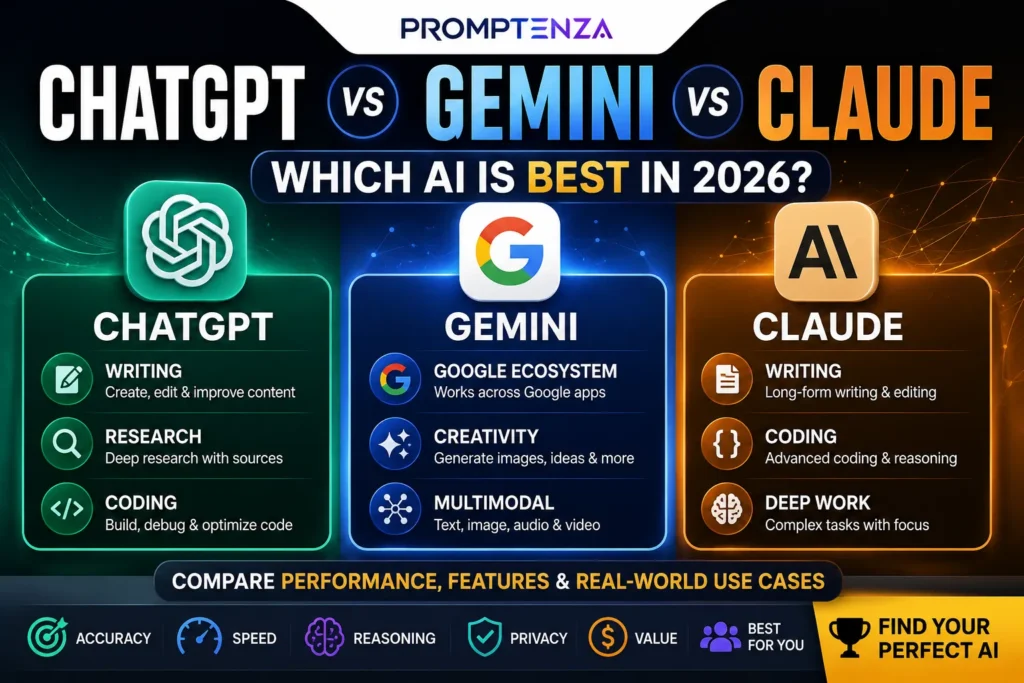
AI-generated writing is now produced by many different systems, including ChatGPT, Google Gemini, and Anthropic’s Claude. That has created a common question:
Can AI detectors actually tell which AI wrote a piece of text?
The short answer is sometimes, but not with certainty.
Traditional AI detectors analyze linguistic and statistical patterns that may be associated with machine-generated writing. They generally do not “know” that a particular paragraph came from ChatGPT, Gemini, or Claude.
However, the technology is changing.
Google has developed SynthID, an invisible watermarking system for text generated through Gemini, while Anthropic introduced text watermarking for newer Claude models released after August 2, 2026, along with a detection API in private preview.
OpenAI, meanwhile, previously tested an AI-text classifier but discontinued it in 2023 because of its low accuracy. OpenAI has continued working on content provenance, although its current public verification tooling is focused on supported images and audio rather than providing a general ChatGPT text detector.
Quick answer: AI detectors can sometimes identify text that resembles AI-generated writing, but a conventional detector generally cannot reliably prove that a passage came specifically from ChatGPT, Gemini, or Claude. Newer provenance technologies such as Gemini’s SynthID and Claude’s text watermarking can provide stronger signals when the relevant watermark is present.
Related: How Do AI Detectors Work? A Complete Guide to AI Detection
Can AI Detectors Tell Which AI Wrote a Text?
Usually, no.
Most AI detectors are designed to answer a broader question:
Does this text resemble AI-generated writing?
They are not necessarily designed to answer:
Was this written by ChatGPT?
or:
Was this generated by Gemini rather than Claude?
This distinction matters.
A detector might identify patterns associated with large language models without being able to determine the exact model responsible.
For example, a paragraph generated by ChatGPT could potentially be classified as AI-generated without the detector being able to establish that ChatGPT produced it.
The same applies to Gemini and Claude.
How AI Detectors Try to Identify AI-Generated Text
Traditional AI detectors typically analyze characteristics of the writing rather than looking for a secret label saying “Made by ChatGPT.”
Depending on the system, analysis may consider patterns such as:
- Predictability of word choices
- Sentence structure
- Vocabulary patterns
- Statistical characteristics
- Writing style
- Repetition
- Linguistic regularities
- Patterns learned from human and AI-written examples
The detector then produces a classification or probability-like score.
This approach has an important limitation:
Different AI models can produce similar writing patterns.
And humans can sometimes produce writing that looks statistically similar to AI-generated text.
That is why AI detection should not automatically be interpreted as proof of authorship.
Can AI Detectors Detect ChatGPT?
Yes, Sometimes — But Not Reliably Enough to Prove ChatGPT Wrote It
A conventional AI detector can analyze text produced by ChatGPT and may classify it as likely AI-generated.
But that does not mean the detector can definitively identify ChatGPT as the source.
This is an important distinction:
AI detection ≠ ChatGPT identification
For example:
Text:
An essay generated by ChatGPT
Possible detector result:
“Likely AI-generated”
That result does not necessarily mean:
“This was definitely generated by ChatGPT.”
The detector may simply recognize characteristics that are common among AI-generated text.
OpenAI itself says that ChatGPT cannot reliably determine whether a particular piece of writing was generated by AI, including whether ChatGPT itself wrote it.
Why ChatGPT Text Can Be Difficult to Identify
ChatGPT outputs can vary significantly depending on:
- The prompt
- The model being used
- The requested writing style
- The subject
- The length of the response
- Editing after generation
- Translation
- Other transformations
A highly polished essay may contain characteristics associated with AI-generated writing, while a heavily edited AI response may become much harder for a conventional detector to classify.
This is one reason detector scores should be treated as signals rather than absolute proof.
Can AI Detectors Detect Gemini?
Yes, But There Are Two Different Detection Approaches
Gemini introduces an important distinction because Google has developed SynthID for text.
There are therefore two broad approaches to identifying Gemini-generated writing:
- General AI detection
- Google’s provenance watermarking
A conventional AI detector analyzes the text for patterns associated with AI-generated writing.
SynthID takes a different approach.
What Is Gemini SynthID?
SynthID is Google’s technology for embedding an invisible watermark into AI-generated content.
Google DeepMind says SynthID has been expanded to text generated through the Gemini app and web experience.
Instead of simply analyzing the finished text for general AI-like characteristics, SynthID introduces a signal during the generation process.
Large language models select tokens one after another.
SynthID modifies the probability distribution used during generation in a way that creates a detectable statistical pattern while remaining imperceptible to readers.
In simplified form:
Gemini generates text → SynthID adds an invisible statistical signal → the text looks normal → compatible detection technology can check for the signal
That is fundamentally different from a generic AI detector.
Does SynthID Mean Every Gemini Text Can Be Proven AI-Generated?
No.
This distinction is extremely important.
Google describes SynthID as a tool for identifying content generated by Google AI, but also says it is not a silver bullet for identifying all AI-generated content.
The watermark works best under certain conditions.
Google says SynthID text watermarking performs better on longer and more diverse responses. Its confidence can decrease when text is thoroughly rewritten or translated. It is also less effective for factual responses where there are fewer reasonable choices in the generated wording.
So:
SynthID is stronger as a provenance signal than a general AI-writing guess, but it is not universal proof of AI authorship.
Can a Normal AI Detector Detect Gemini?
Potentially, yes.
A general AI detector does not necessarily need to know that text came from Gemini.
It can analyze the text and determine whether its characteristics resemble AI-generated writing.
However, the result may not identify Gemini specifically.
For example:
Detector result:
82% likely AI-generated
That does not necessarily mean:
82% likely generated by Gemini.
Those are completely different claims.
Can AI Detectors Detect Claude?
Yes, Conventional Detectors Can Analyze Claude Text
Like ChatGPT and Gemini, Claude generates natural-language text that can be analyzed by conventional AI-detection systems.
But again, there is an important distinction between:
detecting AI-like characteristics
and:
proving Claude generated the text.
Historically, a conventional detector would generally analyze Claude output using its own classification methodology.
In 2026, however, Anthropic introduced a different approach for newer Claude models.
Claude Now Has Text Watermarking
Anthropic announced in August 2026 that future Claude models would generate text containing a watermark designed to help determine the likelihood that Claude was involved in writing the text.
Anthropic says the watermark applies to models released after August 2, 2026 under its implementation of the EU AI Act’s transparency requirements.
The watermark is:
- Invisible to readers
- Embedded during generation
- Designed not to affect writing quality
- Not tied to a specific user
- Detectable using the appropriate verification system
Anthropic also says its detection API is currently in private preview for eligible organizations and plans to expand access over time.
How Claude’s Watermark Works
Claude’s watermark takes advantage of the fact that language models make many choices while generating text.
For example, a sentence might have several reasonable ways to continue.
The watermark changes the source of randomness used for some of these choices.
Over a sufficiently long passage, those choices can form a detectable statistical pattern.
The reader does not see anything unusual.
But a verifier with the appropriate key can test whether the pattern is consistent with Claude’s watermark.
This is closer to provenance verification than conventional AI detection.
Does Claude’s Watermark Prove Claude Wrote the Entire Document?
No.
Anthropic says the watermark can establish that Claude was likely involved, but it cannot determine exactly how Claude was involved.
For example, it cannot necessarily distinguish between:
- Claude writing the entire passage
- Claude heavily editing human writing
- Claude translating text
- Claude making substantial revisions
Anthropic also explains that if Claude only performs light proofreading on human-written text, there may be too few Claude-generated words for the watermark to register reliably.
Therefore:
Claude watermark detected ≠ Claude wrote every word
It is evidence of Claude involvement, not a complete reconstruction of authorship.
ChatGPT vs. Gemini vs. Claude Detection
The three ecosystems are increasingly different.
| AI system | General AI detectors | Provider-specific provenance |
|---|---|---|
| ChatGPT | Can analyze text for AI-like patterns | OpenAI’s current public provenance verification focuses on supported images/audio rather than a general ChatGPT text detector |
| Gemini | Can be analyzed by general AI detectors | Google uses SynthID for Gemini-generated text |
| Claude | Can be analyzed by general AI detectors | Newer Claude models use text watermarking with detection API access in private preview |
Which AI Is Easiest to Detect?
There is no universal answer.
It depends on:
- Which detector is being used
- Which model generated the text
- How much text is available
- Whether the text has been edited
- Whether a provider-specific watermark is present
- The type of writing
- The language
- Whether the content is factual or creative
A detector that performs well on one model may perform differently on another.
This is why claims such as:
“This detector can always identify ChatGPT.”
or:
“Gemini cannot be detected.”
should be treated cautiously.
AI Detection vs. Provenance Detection
This distinction is becoming increasingly important.
AI Detection
A conventional AI detector asks:
Does this text look like it was generated by AI?
It typically uses a classifier or statistical analysis.
Provenance Detection
A provenance system asks:
Does this content contain a signal showing that a particular AI system was involved?
Watermarking and Content Credentials are examples of provenance technologies.
The difference is similar to comparing:
recognition vs. verification
A conventional detector makes an inference from the content.
A provenance system looks for a signal intentionally associated with its origin.
Why Provenance Can Be More Useful
Suppose a detector sees a paragraph and says:
AI likelihood: 90%
That is a prediction.
Now suppose a provider-specific verifier detects a valid watermark associated with a model.
That can provide a much stronger provenance signal for that particular provider.
However, provenance also has limitations.
If the watermark or metadata is removed, degraded, or never existed, the verifier may not be able to establish origin.
This means provenance is powerful, but it is not the same as having a complete record of everything that happened to a document.
Can AI Detectors Tell ChatGPT From Gemini?
Usually, not reliably from the text alone.
A general-purpose detector may classify both as AI-generated because both are produced by large language models.
Some specialized systems may have been trained on outputs from particular models and therefore perform differently across them.
But a high AI score should not automatically be interpreted as:
“This is definitely Gemini.”
or:
“This is definitely ChatGPT.”
The safest interpretation is:
The detector found characteristics associated with AI-generated writing.
Unless there is a reliable provider-specific provenance signal, identifying the exact model is a much stronger claim.
Can AI Detectors Tell ChatGPT From Claude?
The same principle applies.
Both systems generate language using large language models.
Their outputs can have distinctive tendencies, but writing style can overlap substantially.
A general detector may therefore identify:
Likely AI-generated
without being able to establish:
Generated specifically by Claude
Anthropic’s new watermarking system changes this for supported Claude outputs because it can provide a provider-specific signal when detectable.
What Happens If AI Text Is Edited?
Editing makes detection more complicated.
Consider this process:
AI-generated text → human editing → final document
The more the original text changes, the more difficult it can become for a conventional detector to recognize the original statistical characteristics.
Watermarking can also be affected by significant changes to the original text.
This means the final document may not preserve enough information to determine exactly how it was produced.
What About AI-Paraphrasing Tools?
AI-generated text can also be transformed by another system.
For example:
Model A → AI paraphraser → final text
Now the final text may contain characteristics from multiple systems.
Some detection tools attempt to identify AI-paraphrased or AI-altered text.
However, detection systems can still produce errors, and their results should not automatically be treated as definitive proof of authorship.
Why Short Text Is Harder to Detect
AI detection generally becomes more difficult when there is very little text.
There simply aren’t many patterns available to analyze.
A short paragraph, sentence, headline, or social-media post may therefore be much harder to evaluate confidently than a long article.
This is also one reason provider-specific watermarking systems tend to work better when they have more generated text to analyze.
What About AI-Generated Facts and Simple Answers?
Factual answers can create another challenge.
Suppose an AI is asked:
What is the capital of France?
There is very little freedom in the answer.
The correct answer is:
Paris
A watermarking system has fewer opportunities to adjust word choices without affecting accuracy.
Google notes that SynthID text watermarking is less effective on factual prompts because there are fewer opportunities to adjust token probabilities while maintaining factual accuracy.
This illustrates an important point:
Not all AI-generated text contains the same amount of detectable information.
Can ChatGPT Tell Whether It Wrote Something?
No, not reliably.
This is an important misconception.
You might paste an essay into ChatGPT and ask:
“Did you write this?”
That does not provide reliable authorship verification.
OpenAI explicitly states that ChatGPT does not have reliable knowledge of whether it generated a particular piece of writing and may produce unsupported answers to questions about whether text was AI-generated.
So asking an AI model to act as its own detector is not a reliable substitute for provenance or independent analysis.
What If an AI Detector Says Human Writing Is AI-Generated?
This is called a false positive.
It means the system classified human-written text as likely AI-generated.
False positives are one of the biggest concerns surrounding AI detection.
AI detectors can sometimes mistake polished, predictable, formal, or highly structured human writing for AI-generated text.
This is why a detector score should not automatically be treated as proof that a person used ChatGPT, Gemini, or Claude.
Can AI Detectors Be Wrong About AI-Generated Text?
Yes.
The opposite problem is a false negative.
A false negative occurs when AI-generated writing is classified as human-written.
This can happen when:
- The text is short
- The model’s writing resembles ordinary human prose
- The text has been heavily edited
- The writing is translated
- The detector was not trained for that model or style
- The content contains predictable factual language
This is one reason no single AI detector should be treated as infallible.
For a deeper look at the evidence behind detector accuracy, see Are AI Detectors Accurate? What the Research Shows.
Should You Trust an AI Detector’s Percentage?
Be careful.
A result such as:
AI-generated: 85%
does not necessarily mean:
“There is an 85% probability that this person used ChatGPT.”
The exact interpretation depends on the detector.
Different AI detection tools calculate and present their scores differently.
It is therefore important to read the detector’s methodology instead of treating the percentage as a universal probability.
Can AI Detection Prove Who Wrote Something?
No.
Detection and authorship are different questions.
A detector may identify a pattern.
It generally cannot reconstruct:
- Who entered the prompt
- Who edited the output
- Which model was used
- How many times the content was regenerated
- Whether a human wrote some sections
- Whether another AI system edited the text
- Whether the final document represents the original output
Even Claude’s watermarking system has this limitation.
Anthropic says its watermark can indicate that Claude was likely involved but cannot determine whether Claude wrote the entire piece or merely helped edit it.
AI Detector vs. Source Matching
AI detection and plagiarism detection are also different processes.
An AI detector asks whether writing resembles AI-generated content.
A plagiarism or similarity checker looks for overlap with existing sources.
For example:
AI detector:
“This writing appears likely to have been generated by AI.”
Plagiarism checker:
“This section matches text found on an existing webpage.”
A document can therefore be:
- AI-generated but original
- Human-written but copied
- AI-generated and copied from an existing source
- Human-written and completely original
For a detailed comparison, see AI Detector vs. Plagiarism Checker: What’s the Difference?.
A Practical AI Detector-Use Workflow
If you need to evaluate whether a piece of text may have been AI-generated, avoid relying on a single detector score. A better approach is to use AI detection as one step in a broader verification process.
Step 1: Preserve the Original Text
Before checking the content, save the original version.
Avoid repeatedly copying, rewriting, translating, or formatting the text before testing it because those changes can affect detection results.
For longer documents, keep the original file and note:
- The document date
- The author or source
- The version being analyzed
- Any known editing or collaboration
Step 2: Check the Text Length
Very short passages provide less information for many AI detection systems.
If possible, analyze a meaningful section of the document rather than relying on a headline, sentence, or short paragraph.
Do not assume that a result from a tiny sample is representative of an entire document.
Step 3: Run the Text Through an AI Detector
Use a reputable AI detection tool and record the result.
Pay attention to:
- Overall AI-detection score
- Sections specifically flagged
- Confidence indicators
- Supported languages
- Whether the detector identifies AI-generated or AI-paraphrased content
- Any limitations stated by the provider
Do not treat the percentage as a universal probability that AI was used.
Step 4: Check for Provider-Specific Provenance
If the origin may involve a system with a supported provenance technology, check for that signal where an appropriate verification tool is available.
For example, Google has developed SynthID for Gemini-generated text, while Anthropic has introduced text watermarking for newer Claude models.
A provider-specific watermark can provide a different type of evidence from a conventional AI detector because it is associated with the content-generation process rather than simply the writing style.
Step 5: Check for Plagiarism or Source Overlap
AI detection and plagiarism detection answer different questions.
Run a separate similarity or plagiarism check when source reuse matters.
You may discover that:
- The text appears AI-generated but is original.
- The text appears human-written but contains copied material.
- The text contains both AI-generated and copied sections.
- The text does not show significant source overlap.
For more detail, see AI Detector vs. Plagiarism Checker: What’s the Difference?.
Step 6: Compare With Known Writing
When appropriate, compare the document with previous verified writing from the same author.
Look for meaningful differences in:
- Vocabulary
- Sentence structure
- Tone
- Organization
- Subject knowledge
- Citation habits
- Typical mistakes or stylistic patterns
A sudden change in writing style can be worth investigating, but it is not proof of AI use.
Step 7: Review the Document’s History
For school, workplace, or editorial investigations, document history can sometimes provide more useful context than a detector score alone.
Depending on the software, this may include:
- Drafts
- Revision history
- Track changes
- Research notes
- Outlines
- Citation records
- Earlier versions
A progression from outline to draft to final version can provide useful evidence about how the document was produced.
Step 8: Ask for Context When Necessary
If the result matters, give the author an opportunity to explain the work.
Useful questions might include:
- How did you research this?
- What sources did you use?
- Can you explain this section?
- Do you have earlier drafts?
- Which parts were edited after the first draft?
This is particularly important when an AI detector produces a surprising result.
Step 9: Compare Multiple Signals
At this stage, consider the evidence together.
For example:
| Signal | What it tells you |
|---|---|
| AI detector score | Whether the text resembles AI-generated writing |
| Provider watermark | Whether a supported AI provider may have generated the text |
| Similarity checker | Whether text overlaps with existing sources |
| Draft history | How the document developed |
| Previous writing | Whether the writing style changed significantly |
| Author explanation | Additional context about how the work was produced |
No single signal should automatically determine the conclusion.
Step 10: Make a Proportionate Decision
The final decision should reflect the strength of the evidence.
A useful framework is:
Low concern:
The detector produces a low or ambiguous result and there is no other evidence suggesting AI involvement.
Needs review:
The detector produces a strong result, but there is no independent evidence confirming the source.
Stronger evidence:
A detector result is supported by provider-specific provenance, document history, source evidence, or other independent information.
Important: Even strong evidence of AI involvement does not automatically establish misconduct. The relevant rules, assignment requirements, workplace policies, or publishing standards still matter.
A Simple AI Detection Workflow
For everyday use, the process can be reduced to:
Preserve original → Check text length → Run AI detector → Check provenance → Run similarity check → Review drafts → Compare evidence → Make a contextual decision
This approach is considerably safer than:
Paste text → Get “90% AI” → Declare the author used ChatGPT
The first workflow treats detection as evidence.
The second treats detection as proof.
That distinction is essential because AI detectors can produce both false positives and false negatives.
Quick Checklist
Before acting on an AI detector result, ask:
- Did I analyze the original text?
- Was there enough text to make the result meaningful?
- What exactly does the detector’s percentage represent?
- Does the tool support this language and type of content?
- Is there provider-specific provenance available?
- Did I check for source overlap separately?
- Is there a draft or revision history?
- Can the author explain the work?
- Am I relying on more than one signal?
- Does the final decision follow the relevant policy?
The goal is not simply to detect AI. The goal is to make a well-supported judgment about how the content was produced.
How Schools and Editors Should Interpret AI Detection
AI detection is most useful when treated as one piece of evidence.
For example, an educator might consider:
- Previous writing samples
- Draft history
- Revision history
- Citations
- Research notes
- Assignment requirements
- The student’s explanation
- AI detection results
- Similarity results
A detector should not automatically replace human judgment.
This is particularly important when a detection result could affect a student’s academic record, employment, or reputation.
ChatGPT vs. Gemini vs. Claude: What Can Actually Be Detected?
Here’s the practical summary:
| Question | ChatGPT | Gemini | Claude |
|---|---|---|---|
| Can a general AI detector analyze the text? | Yes | Yes | Yes |
| Can a general detector always identify it? | No | No | No |
| Can a general detector prove the exact model? | No | No | No |
| Provider-specific text watermark? | No general public ChatGPT text verifier currently documented | Yes, SynthID | Yes for newer Claude models |
| Provider-specific verification available? | Current OpenAI public verifier focuses on supported images/audio | SynthID ecosystem supports Gemini text identification | Detection API currently in private preview |
| Can editing affect detection? | Yes | Yes | Yes |
| Does detection prove authorship? | No | No | No |
The Most Important Difference: Detection vs. Proof
The phrase “AI detected” can sound more definitive than it really is.
There are several levels of evidence.
Level 1: Writing-Style Analysis
A detector sees patterns that resemble AI-generated writing.
Evidence: Moderate or uncertain.
Level 2: Model-Specific Classification
A system has been trained or calibrated around particular model outputs.
Evidence: Potentially stronger, but still not absolute.
Level 3: Provider-Specific Watermark
A valid watermark associated with a specific AI provider is detected.
Evidence: Stronger provenance signal.
Level 4: Direct Generation Record
A verified record shows where the content came from.
Evidence: Strongest provenance evidence.
Even a watermark does not necessarily answer every authorship question.
What the Future of AI Detection Looks Like
The industry is moving beyond simple “AI vs. human” classifiers.
Instead, there is increasing interest in content provenance.
That includes technologies such as:
- Digital watermarks
- Content Credentials
- C2PA metadata
- Provider-specific verification
- Cryptographic provenance
- Detection APIs
Google’s SynthID is one example of this approach.
Anthropic’s Claude watermarking is another.
OpenAI is also pursuing a provenance-based approach using Content Credentials and SynthID for supported media.
This could eventually make the question less about:
“Does this writing sound like AI?”
and more about:
“Is there reliable evidence showing where this content came from?”
That is a much more useful question for publishers, educators, researchers, and platforms.
Frequently Asked Questions
Can AI detectors detect ChatGPT?
They can analyze ChatGPT-generated text and may classify it as likely AI-generated, but conventional AI detectors cannot reliably prove that ChatGPT specifically produced the text.
Can AI detectors detect Gemini?
Yes. General AI detectors can analyze Gemini output. Google also has its own SynthID technology that can watermark Gemini-generated text and provide a provider-specific provenance signal.
Can AI detectors detect Claude?
Yes. General AI detectors can analyze Claude-generated text. Newer Claude models also use Anthropic’s text watermarking system, with detection currently available through a private-preview API for eligible organizations.
Can an AI detector tell whether text came from ChatGPT, Gemini, or Claude?
Usually not with certainty. General detectors typically identify characteristics associated with AI-generated writing rather than proving which specific model produced it.
Is Gemini easier to detect because of SynthID?
SynthID provides a different kind of evidence because it is a provider-specific watermark. However, it is not a universal detector for all AI-generated text, and its effectiveness can be affected by substantial rewriting or translation.
Does Claude’s watermark prove Claude wrote the entire document?
No. The watermark can indicate that Claude was likely involved, but it does not establish exactly how Claude contributed.
Can ChatGPT detect whether ChatGPT wrote an essay?
No. OpenAI says ChatGPT cannot reliably determine whether it generated a particular piece of writing.
Can AI detectors make mistakes?
Yes. AI detectors can produce both false positives and false negatives. Human-written text can sometimes be incorrectly classified as AI-generated.
Does a high AI detector score prove someone used AI?
No. A detector score is evidence that the system identified characteristics associated with AI-generated writing. It does not independently prove who wrote the text or which AI tool was used.
Can editing make AI-generated text harder to detect?
Yes. Substantial rewriting can change the characteristics used by conventional detectors and can also reduce the confidence of some watermarking systems.
Are AI detectors becoming more accurate?
Detection technology continues to evolve, but there is no universal detector that can reliably identify every AI-generated passage. Provider-specific provenance technologies may provide stronger evidence when a valid watermark or credential is available.
Test Your AI Detection Knowledge
1. Can a general AI detector always identify ChatGPT?
A. Yes
B. No
Answer: B
General detectors can identify AI-like characteristics, but they cannot reliably prove that ChatGPT specifically generated the text.
2. What is Google’s SynthID?
A. A plagiarism checker
B. An invisible AI-content watermarking technology
C. A grammar checker
D. A chatbot
Answer: B
SynthID can embed imperceptible watermarks into AI-generated content, including text generated through Gemini.
3. Does Claude now use text watermarking?
A. Yes
B. No
Answer: A
Anthropic says newer Claude models released after August 2, 2026 use text watermarking to help determine whether Claude was involved in generating the text.
4. Does a high AI detector score prove ChatGPT was used?
A. Yes
B. No
Answer: B
A conventional detector score does not prove which model generated the text.
5. Can AI detectors produce false positives?
A. Yes
B. No
Answer: A
Human-written text can sometimes be incorrectly classified as AI-generated.
6. Can heavily edited AI text become harder to detect?
A. Yes
B. No
Answer: A
Editing can alter the characteristics used by conventional detectors.
7. Does a Claude watermark prove Claude wrote every word?
A. Yes
B. No
Answer: B
A watermark indicates likely Claude involvement but does not establish exactly how Claude contributed.
8. Can ChatGPT reliably tell you whether it wrote a piece of text?
A. Yes
B. No
Answer: B
ChatGPT cannot reliably identify whether it generated a particular piece of writing.
9. Which provides stronger provider-specific evidence?
A. A generic AI detector score
B. A valid provider-specific watermark
C. A spelling checker
D. A word counter
Answer: B
A valid watermark can provide provenance evidence associated with a particular provider, although it still has limitations.
10. What is the safest way to interpret an AI detector?
A. As absolute proof
B. As one piece of evidence
C. As proof of cheating
D. As proof of authorship
Answer: B
AI detection results should be interpreted alongside other evidence and context.
Final Takeaway
Can AI detectors detect ChatGPT, Gemini and Claude?
Yes—but the answer depends on what “detect” means.
A conventional AI detector can analyze text from all three systems and may identify patterns associated with AI-generated writing. But that does not necessarily mean it can prove which model generated the text.
The technology is now moving toward a more sophisticated approach.
Google Gemini: Google uses SynthID to watermark AI-generated text, creating a provider-specific provenance signal.
Anthropic Claude: Newer Claude models use text watermarking, with a detection API currently in private preview for eligible organizations.
OpenAI ChatGPT: OpenAI’s earlier general AI-text classifier was discontinued because of low accuracy, while its current public provenance verification focuses on supported images and audio rather than a general ChatGPT text detector.
The biggest lesson is simple:
An AI detector can provide a signal. A provenance system can provide stronger evidence. Neither should automatically be treated as a complete record of authorship.
As AI-generated content becomes harder to distinguish from human writing, the future of detection is likely to depend increasingly on watermarking, provenance standards, verification tools, and multiple sources of evidence rather than a single percentage score.
For a broader look at the best tools and how AI detection technology works, see AI Detectors: How AI Detection Tools Work, Accuracy & Best Tools.
Related Promptenza Guides
- How Do AI Detectors Work? A Complete Guide to AI Detection
- Are AI Detectors Accurate? What the Research Shows
- AI Detector vs. Plagiarism Checker: What’s the Difference?
- AI Detectors: How AI Detection Tools Work, Accuracy & Best Tools
- Why Do AI Detectors Flag Human Writing as AI-Generated?