AI detectors and plagiarism checkers are often mentioned together, especially in education, publishing, and content creation. But they do two fundamentally different jobs.
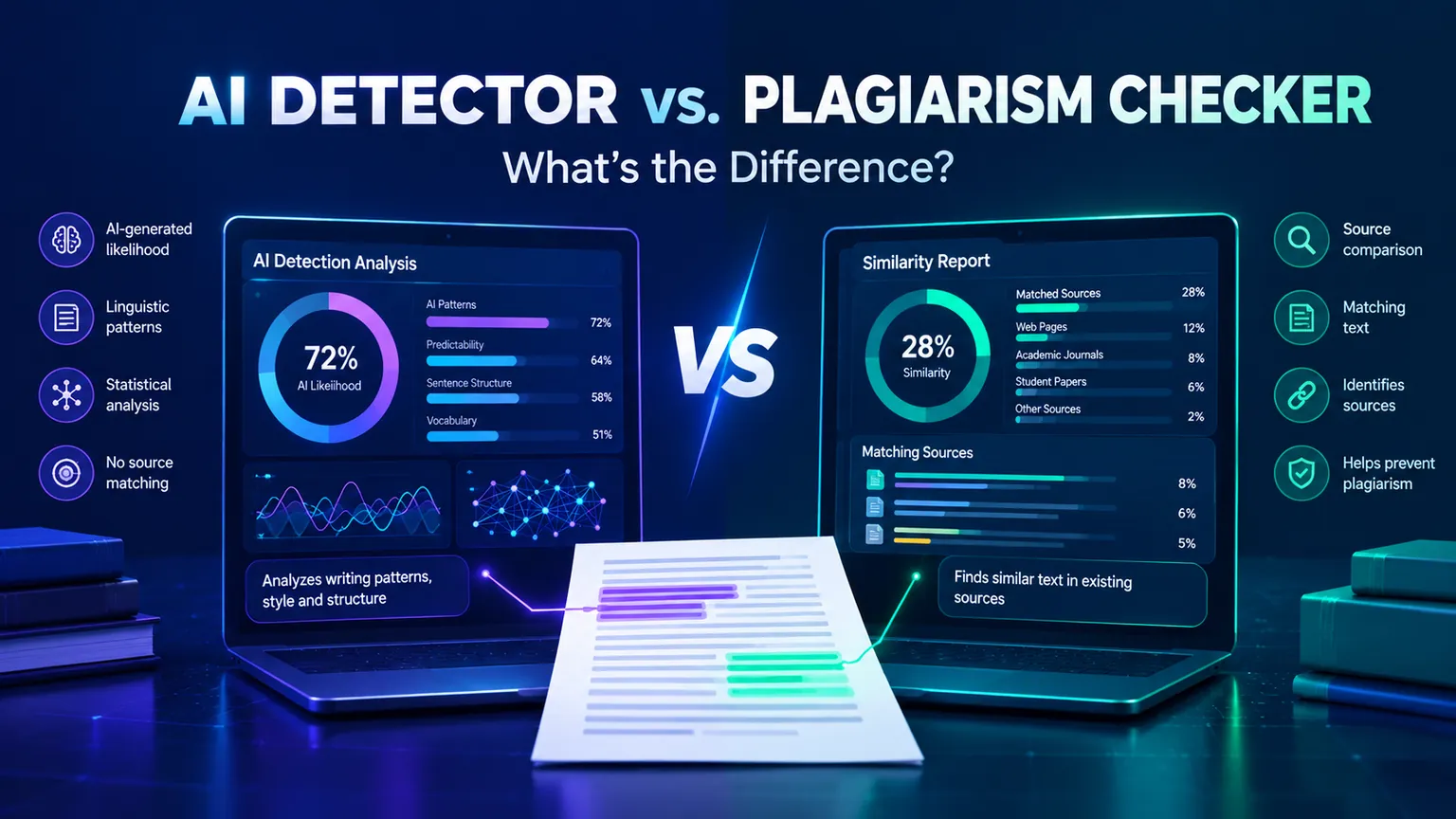
A plagiarism checker looks for similarity between submitted text and existing sources. An AI detector estimates whether the writing resembles text generated by artificial intelligence.
That distinction is important because a document can have a high similarity score without being plagiarized, or receive an AI-detection score without containing copied material.
For example, a properly cited quotation may increase a similarity score even though it is not plagiarism. Likewise, original AI-generated text may have little or no similarity to an existing source while still being identified as potentially AI-generated.
Turnitin explicitly separates its AI Writing Report from its Similarity Report: the AI-writing percentage and similarity score are calculated independently and answer different questions.
Quick answer: A plagiarism checker looks for matching or similar text in existing sources, while an AI detector analyzes writing patterns to estimate whether text may have been generated by AI. Neither score, by itself, proves plagiarism or establishes authorship.
Related: How Do AI Detectors Work? A Complete Guide to AI Detection
AI Detector vs. Plagiarism Checker at a Glance
| Feature | AI Detector | Plagiarism Checker |
|---|---|---|
| Main purpose | Estimate whether writing resembles AI-generated text | Find matching or similar text |
| Primary question | “Does this text look AI-generated?” | “Does this text match existing sources?” |
| What it analyzes | Linguistic and statistical patterns | Textual similarity |
| Needs a matching source? | No | Usually yes |
| Typical result | AI-likelihood or AI-generated percentage | Similarity percentage and source matches |
| Identifies sources? | Generally no | Yes |
| Proves authorship? | No | No |
| Automatically proves plagiarism? | No | No |
| Can produce false positives? | Yes | Similarity can also be misinterpreted |
| Can be useful together? | Yes | Yes |
The key difference is simple:
AI detection is about the characteristics of the writing.
Plagiarism detection is about similarity to other sources.
What Is a Plagiarism Checker?
A plagiarism checker is a system that compares submitted text against a collection of existing material to identify matching or similar passages.
Depending on the service, its comparison database may include:
- Websites
- Online publications
- Academic journals
- Books or publications
- Previously submitted student work
- Other indexed documents
Turnitin’s Similarity Report, for example, compares submitted text against selected databases that can include billions of current and archived web pages, publications, and previously submitted works.
When the system finds matching text, it highlights the passage and identifies the corresponding source.
This creates a similarity report.
But there is an important distinction:
Similarity is not automatically plagiarism.
Turnitin explicitly says that its Similarity Report identifies matching text and does not itself determine whether plagiarism has occurred. A match could be a properly cited quotation, a bibliography entry, or another legitimate use of source material.
What Is an AI Detector?
An AI detector is designed to estimate whether text contains characteristics associated with AI-generated writing.
Instead of searching for an identical passage elsewhere, an AI detector analyzes the submitted text itself.
Depending on the system, this can involve characteristics such as:
- Word and token patterns
- Predictability
- Sentence structure
- Linguistic patterns
- Statistical characteristics
- Other features learned by machine-learning models
The system then produces an estimate or classification.
For example, an AI detector might report that a particular percentage of qualifying text is likely AI-generated.
Turnitin’s current AI Writing Report describes its percentage as the amount of qualifying text that its model identifies as likely AI-generated or potentially AI-generated and subsequently modified using certain AI text-altering tools.
Importantly, the detector is not searching for a copied source.
It is making a prediction based on characteristics of the text.
The Simplest Difference: Similarity vs. AI Detection
Think of the two tools as answering different questions.
A plagiarism checker asks:
“Where else does this wording appear?”
An AI detector asks:
“Does this writing resemble text produced by an AI system?”
That means they can produce very different results for the same document.
Example: Original AI-Generated Article
Imagine someone asks an AI system to write a 1,500-word article about renewable energy.
The AI produces completely original wording that does not directly copy an existing webpage.
A plagiarism checker might find:
Similarity: Low
An AI detector might find:
AI likelihood: High
Why?
Because the text may not match any indexed source, but its linguistic characteristics may resemble AI-generated writing.
This is a perfect example of why plagiarism detection and AI detection are not interchangeable.
Example: Human-Written Article With a Quotation
Now imagine a student writes an essay independently and includes a properly cited quotation from a published researcher.
The similarity checker may identify the quotation as a match.
For example:
Similarity: 18%
But that does not automatically mean the student plagiarized the material.
The quotation may be:
- Properly attributed
- Correctly quoted
- Included in the bibliography
- Required as evidence for the argument
Turnitin notes that quoted and cited material can still appear as similarity matches.
The similarity report therefore needs to be interpreted rather than treated as an automatic plagiarism verdict.
Example: Human Writing With a High AI Score
Now consider a completely human-written article.
The author uses:
- Formal language
- Consistent sentence structure
- Conventional transitions
- Highly polished grammar
- Technical vocabulary
An AI detector may identify some of those characteristics as resembling AI-generated writing.
The result could therefore indicate a high AI likelihood even though the author wrote the content themselves.
This is known as a false positive.
Turnitin explicitly warns that its AI detection model may misidentify human-written text and says the AI score should not be used as the sole basis for adverse action against a student.
What Does a Plagiarism Checker Actually Measure?
A similarity checker generally measures the amount of text that matches or closely resembles material in its comparison database.
A simplified calculation looks like:
Similarity percentage = matching text ÷ total submitted text × 100
Turnitin describes its overall similarity percentage in essentially these terms: the percentage represents how much submitted text matches sources in its databases.
However, the percentage alone doesn’t explain why the text matched.
A match could come from:
- A direct quotation
- A properly cited source
- A commonly used phrase
- A bibliography
- A student’s previous submission
- An improperly copied passage
- Other legitimate or problematic similarities
This is why the individual source matches are often more useful than simply looking at the headline percentage.
What Does an AI Detector Measure?
An AI detector is measuring something fundamentally different.
Instead of asking whether a passage matches an existing source, it estimates whether the text has characteristics associated with AI-generated writing.
For example, the system may analyze patterns across qualifying prose and produce an AI-writing percentage.
Turnitin’s documentation makes the distinction explicit: its AI-writing percentage is independent of the Similarity Score, and AI-writing highlights do not form part of the Similarity Report.
This means:
Similarity score ≠ AI score
They should not be interpreted as two measurements of the same thing.
Can a Document Have 0% Similarity but Still Be AI-Generated?
Yes.
A generative AI system can produce original wording that does not substantially match the sources contained in a plagiarism checker’s database.
Therefore:
Low similarity does not prove human authorship.
A plagiarism checker was not designed to determine whether a person or AI generated the text.
It was designed to identify textual similarity.
This is one of the most important reasons AI detection became a separate technology.
Can a Document Have High Similarity but Be Human-Written?
Yes.
A human-written document may contain a large amount of source material.
For example, a research paper may contain:
- Direct quotations
- Definitions
- Technical terminology
- Properly cited evidence
- Bibliographic material
All of these can contribute to similarity.
Turnitin specifically notes that matching text does not automatically indicate plagiarism and that context, citations, quotations, and the nature of the assignment need to be considered.
A high similarity score therefore requires investigation.
It is not automatically a plagiarism verdict.
Can AI-Generated Text Have a High Similarity Score?
Yes.
AI-generated writing can sometimes contain language that resembles or reproduces material found elsewhere.
This could happen because:
- The AI reproduces common wording
- The prompt requests a specific source
- The generated content contains quotations
- The model produces text similar to indexed material
- The user supplies source material to the AI
- The resulting document combines generated text with copied material
In this situation, the two systems could identify different issues.
The plagiarism checker may identify source similarity.
The AI detector may identify AI-like writing patterns.
Both results may therefore be relevant.
Can Plagiarism Checkers Detect AI Writing?
Not necessarily.
A traditional plagiarism checker is primarily designed to identify similarities between submitted text and its comparison sources.
If AI-generated content is completely original relative to those sources, the similarity checker may have little to report.
Some modern platforms combine plagiarism/similarity checking with separate AI-writing detection capabilities.
However, the two functions remain conceptually different.
Turnitin is a good example: its Similarity Report and AI Writing Report are separate components with separate scores and interpretations.
Can AI Detectors Detect Plagiarism?
Not reliably.
An AI detector is not designed primarily to identify where text came from.
Suppose a person copies a paragraph from a website.
The text may be completely human-written.
An AI detector could potentially classify it as human-like because it does not resemble AI-generated writing.
But a plagiarism checker could identify a strong match to the original website.
Therefore:
Human-written does not mean original.
And:
AI-generated does not automatically mean plagiarized.
These are separate questions.
Why You May Need Both Tools
In some situations, using both types of analysis can provide more information.
Consider a submitted essay.
AI detector
It may ask:
Does the writing resemble AI-generated content?
Similarity checker
It may ask:
Does the writing match existing sources?
Together, they provide two different signals.
For example:
| AI result | Similarity result | Possible interpretation |
|---|---|---|
| Low | Low | Little AI-like signal and little matching text |
| High | Low | AI-like writing with little source overlap |
| Low | High | Human-like writing with substantial source similarity |
| High | High | AI-like writing plus substantial source similarity |
These results still require context.
They do not automatically establish misconduct or authorship.
AI Detection and Plagiarism Detection Are Not Opposites
It’s tempting to think:
Human = plagiarism checker
AI = AI detector
But the reality is more complicated.
A document can be:
- Human-written and original
- Human-written and copied
- Human-written and properly cited
- AI-generated and original
- AI-generated and source-based
- AI-generated and combined with copied material
- Human-written with AI assistance
- Human-written with some AI-edited sections
This is why a single automated score cannot answer every question about a document.
AI Detector vs. Plagiarism Checker: How the Technology Differs
Plagiarism Detection Uses Source Comparison
A similarity checker needs something to compare against.
Its basic process is:
Submitted text → database comparison → matching passages → source report
The system identifies text that resembles material in its databases.
Turnitin’s Similarity Report, for example, identifies matching text and provides source information for review.
AI Detection Uses Classification
An AI detector approaches the problem differently:
Submitted text → linguistic/statistical analysis → classification model → AI-likelihood estimate
The detector does not need to find an identical source.
Instead, it evaluates characteristics of the submitted writing.
This makes the two technologies fundamentally different.
What Is a Similarity Score?
A similarity score represents the proportion of submitted text that matches material in the selected comparison sources.
It does not mean:
“This percentage was plagiarized.”
For example, a 30% similarity score does not automatically mean 30% of the document was plagiarized.
Some matches may be legitimate.
Turnitin explicitly explains that similarity scores should be reviewed in context and that a high score does not automatically establish plagiarism.
What Is an AI Detection Score?
An AI detection score estimates how much qualifying text a detector believes resembles AI-generated writing.
It does not mean:
“There is exactly a 70% chance that AI wrote this document.”
The exact meaning depends on the detector.
Turnitin, for example, defines its AI percentage as the amount of qualifying text its model identifies as likely AI-generated or potentially AI-generated and modified by certain AI text-altering tools.
Always check the specific tool’s documentation before interpreting its percentage.
Why Neither Score Should Be Treated as a Verdict
Both systems are designed to provide evidence for review.
Neither should automatically replace human judgment.
For plagiarism checking, the reviewer needs to examine:
- What source was matched?
- How much text matched?
- Was the passage quoted?
- Was it cited?
- Is the wording common?
- Does the assignment naturally require source material?
For AI detection, the reviewer may need to consider:
- How much text was analyzed?
- What detector was used?
- What does its score actually mean?
- Could the writing style produce a false positive?
- Is there additional evidence about the writing process?
Turnitin explicitly recommends treating AI detection as one data point rather than a definitive answer.
Does a High Similarity Score Mean Plagiarism?
No.
A high similarity score can indicate that a substantial amount of text matches sources in the comparison database.
But the meaning depends on the matches.
For example, a paper with extensive properly quoted and cited research may naturally have more similarity than a personal reflection.
Turnitin notes that assignment genre, source requirements, quotations, citations, and other factors can influence similarity scores.
The correct workflow is:
High similarity → inspect matches → evaluate context → determine whether the use is appropriate
Not:
High similarity → automatically call it plagiarism
Does a Low Similarity Score Mean There Is No Plagiarism?
Not necessarily.
A low similarity score means relatively little matching text was identified by the particular comparison system and databases used.
It does not guarantee that every part of the document is original.
Turnitin itself notes that a low similarity score does not automatically guarantee the absence of plagiarism.
For example, plagiarism can involve:
- Ideas without proper attribution
- Poor paraphrasing
- Sources outside the comparison database
- Material altered enough to avoid straightforward matching
Therefore, similarity checking is an important tool, but it is not the entire academic-integrity process.
Does a High AI Score Mean Someone Cheated?
No.
A high AI-detection score indicates that the system identified characteristics associated with AI-generated writing.
It does not independently establish:
- Who wrote the text
- Whether AI was used
- Which AI system was used
- How much AI was involved
- Whether AI use violated a particular policy
Turnitin explicitly warns that its AI detection may misidentify human-written text and says it should not be used as the sole basis for adverse action against a student.
The meaning of AI use also depends on the rules of the particular institution or assignment.
What About AI-Assisted Writing?
AI-assisted writing makes the distinction even more important.
Consider a student who:
- Researches a topic independently.
- Writes an outline.
- Uses an AI tool to brainstorm ideas.
- Writes the final essay themselves.
A plagiarism checker might find little similarity.
An AI detector might also produce a result depending on the final wording.
But neither score can reconstruct the entire writing process.
Similarly, someone might copy material from another source and then rewrite it manually.
The similarity checker and AI detector could respond differently because they are measuring different characteristics.
Which One Should You Use?
It depends on the question you are trying to answer.
Use a plagiarism or similarity checker when you want to know:
- Does this text match existing sources?
- Where do matching passages appear?
- What sources are similar?
- Are quotations properly cited?
- Does the document contain substantial source overlap?
Use an AI detector when you want to investigate:
- Does this writing resemble AI-generated text?
- Which sections may contain AI-like characteristics?
- Is there a potential AI-writing signal that deserves further review?
Use both when:
You need to examine both source similarity and possible AI-generated writing.
AI Detector vs. Plagiarism Checker for Students
For students, the distinction is particularly important.
A similarity score is not automatically a plagiarism accusation.
An AI score is not automatically proof of cheating.
Instead, both tools can help identify areas that may need closer review.
Students should pay particular attention to:
- Correct citation
- Quotation marks
- Paraphrasing
- Original analysis
- Assignment requirements
- Their institution’s AI-use policy
The safest approach is to understand the rules that apply to the specific assignment rather than relying on a detector percentage as the definition of acceptable work.
AI Detector vs. Plagiarism Checker for Teachers
For educators, the two tools can serve complementary purposes.
A similarity report can help identify:
- Matching passages
- Missing citations
- Potentially problematic source use
- Over-reliance on source wording
An AI-writing report can provide another signal about whether portions of a submission resemble AI-generated text.
But neither replaces professional judgment.
Turnitin’s guidance recommends considering AI detection alongside other information, including knowledge of the student’s work and institutional policy.
AI Detector vs. Plagiarism Checker for Content Creators
The distinction is also useful outside education.
A website owner or editor may want to know:
Is this content copied?
A plagiarism checker can help investigate source similarity.
They may separately ask:
Does this content appear to have been generated by AI?
An AI detector can provide a signal.
But these are not the same editorial question.
For publishers, originality should ideally involve more than a detector score.
Human editing, factual verification, source checking, expertise, and usefulness remain important.
What About Turnitin?
Turnitin provides a useful real-world example because its platform includes both similarity checking and AI-writing detection.
Its Similarity Report identifies text that matches material in its databases.
Its AI Writing Report separately estimates the proportion of qualifying text likely generated by AI.
Turnitin explicitly states that the two scores are independent.
This is an important distinction when interpreting reports.
A document can therefore have:
A high similarity score + low AI score
or:
A low similarity score + high AI score
without the two results contradicting each other.
They are answering different questions.
A Simple Real-World Example
Imagine a 2,000-word university essay.
The student includes three paragraphs quoted from academic sources and properly cites them.
The similarity report identifies those passages.
Similarity: 22%
The AI detector finds no strong AI signal.
AI detection: Low
That does not necessarily indicate a problem.
Now imagine another essay contains entirely original AI-generated wording.
The wording does not closely match the similarity database.
Similarity: 2%
But the AI detector identifies strong AI-like characteristics.
AI detection: High
Again, the results are not contradictory.
The first system is looking for source overlap.
The second is looking for AI-like writing patterns.
Can You Have 0% Similarity and 0% AI Detection?
Yes.
A document may contain:
- Original human writing
- No substantial database matches
- No strong AI-like signal
That could produce low results from both systems.
However, neither score independently proves that the writing is entirely original or entirely human-written.
The results simply indicate that the systems did not identify substantial evidence according to their respective methods.
The Biggest Misconceptions
Myth 1: A high similarity score automatically means plagiarism.
False.
Similarity shows matching text. The context determines whether the match represents legitimate citation, quotation, common wording, or problematic copying.
Myth 2: A low similarity score means the work is definitely original.
False.
A low score means little matching text was identified within the selected comparison sources.
Myth 3: An AI detector proves that someone used ChatGPT.
False.
An AI detector estimates whether text resembles AI-generated writing. It does not automatically establish which tool produced it or who wrote it.
Myth 4: AI detectors and plagiarism checkers are the same technology.
False.
They analyze different signals and answer different questions.
Myth 5: A high AI score proves academic misconduct.
False.
AI detection results should be considered alongside other evidence and relevant policies.
The Key Difference in One Sentence
If you remember only one thing from this article, remember this:
A plagiarism checker looks for where your words appear elsewhere; an AI detector estimates whether the characteristics of your writing resemble AI-generated text.
That distinction explains why the two tools can produce completely different results on the same document.
Frequently Asked Questions
Is an AI detector the same as a plagiarism checker?
No. An AI detector estimates whether text resembles AI-generated writing, while a plagiarism checker looks for matching or similar text in existing sources.
Can plagiarism checkers detect ChatGPT?
A traditional similarity checker is not designed primarily to determine whether ChatGPT generated text. AI-writing detection is a separate function from similarity checking.
Can AI detectors detect plagiarism?
Not reliably. AI detectors focus on characteristics associated with AI-generated writing rather than determining whether text was copied from a particular source.
Can you have high similarity and low AI detection?
Yes. A human-written document containing many quotations or source matches could have substantial similarity while showing little AI signal.
Can you have low similarity and high AI detection?
Yes. Original AI-generated text may not closely match material in a plagiarism database while still being classified as likely AI-generated.
Does a high similarity score mean I plagiarized?
No. A high similarity score means a substantial amount of text matched sources. The matches must be reviewed to determine whether the material is properly quoted, cited, or otherwise legitimate.
Does a high AI detector score prove AI use?
No. An AI score is a classification signal, not definitive proof of authorship. Turnitin specifically advises against using its AI score as the sole basis for adverse action.
Which is better: an AI detector or a plagiarism checker?
Neither is universally “better.” They serve different purposes. Use a similarity checker to investigate source overlap and an AI detector to investigate whether text resembles AI-generated writing.
Should students use both?
Where permitted and appropriate, understanding both can be useful because they answer different questions. However, students should follow their school’s or institution’s policies regarding AI and originality checking.
What does a similarity percentage mean?
It represents the proportion of submitted text that the similarity system found matching or similar to material in its comparison databases. It does not automatically represent the percentage of plagiarized content.
What does an AI percentage mean?
The exact meaning depends on the detector. For example, Turnitin’s AI percentage represents the amount of qualifying text its model identifies as likely AI-generated or potentially AI-generated and modified by certain AI text-altering tools.
Test Your Knowledge
1. What does a plagiarism checker primarily look for?
A. AI-generated writing
B. Matching or similar text in existing sources
C. Grammar mistakes
D. Writing quality
Answer: B
A plagiarism or similarity checker compares submitted text against sources in its databases.
2. What does an AI detector primarily estimate?
A. Whether text matches a website
B. Whether a document contains citations
C. Whether writing resembles AI-generated text
D. Whether an author used a textbook
Answer: C
AI detectors analyze characteristics of the writing and produce an AI-related classification or estimate.
3. Can a document have low similarity but a high AI score?
A. Yes
B. No
Answer: A
Original AI-generated text may not closely match material in a similarity database.
4. Can properly cited quotations increase a similarity score?
A. Yes
B. No
Answer: A
Quoted material can match the original source even when it is properly cited.
5. Does a high similarity score automatically prove plagiarism?
A. Yes
B. No
Answer: B
The individual matches and their context must be reviewed.
6. Does a high AI score automatically prove someone used ChatGPT?
A. Yes
B. No
Answer: B
An AI score is a classification signal and does not independently establish authorship or identify a specific AI tool.
7. Are AI detection and similarity scores the same measurement?
A. Yes
B. No
Answer: B
They measure different things. Turnitin explicitly states that its AI-writing percentage is independent of its Similarity Score.
8. What should you do when a similarity report shows a high percentage?
A. Immediately assume plagiarism
B. Review the individual matches and their context
C. Delete the document
D. Ignore the report
Answer: B
The percentage alone does not explain why the text matched.
9. What should you do with an AI detection score?
A. Treat it as absolute proof
B. Treat it as one piece of evidence
C. Assume the author cheated
D. Ignore all other information
Answer: B
AI detection is best interpreted alongside other evidence and context.
10. What is the simplest difference between the two tools?
A. One checks spelling and one checks grammar
B. One looks for source similarity and the other estimates AI-generated writing
C. Both do exactly the same thing
D. Neither analyzes text
Answer: B
That is the fundamental distinction.
Final Takeaway
AI detectors and plagiarism checkers may appear similar because both analyze written content, but they answer fundamentally different questions.
A plagiarism checker looks for textual similarity between a submission and existing sources.
An AI detector estimates whether the writing resembles content generated by an AI system.
Neither result should automatically be treated as a verdict.
A similarity score does not automatically equal plagiarism, because legitimate quotations and citations can produce matches. Similarly, an AI detection score does not automatically prove that a person used AI. Turnitin’s own documentation emphasizes both distinctions.
The best way to interpret either tool is to examine what it actually measured, what the individual matches or signals show, and what additional context is available.
As AI-generated content becomes more common, understanding the difference between similarity detection and AI detection will become increasingly important for students, educators, writers, publishers, and anyone evaluating digital content.
Related Promptenza Guides
- AI Detectors: How AI Detection Tools Work, Accuracy & Best Tools
- How Do AI Detectors Work? A Complete Guide to AI Detection
- Are AI Detectors Accurate? What the Research Shows
- Can AI Detectors Detect ChatGPT, Gemini and Claude?
- Why Do AI Detectors Flag Human Writing as AI-Generated?