Last updated: September 28, 2026
Claude Opus 5.5: Anthropic’s New AI Model Is Faster, Cheaper, and Built for Complex Work
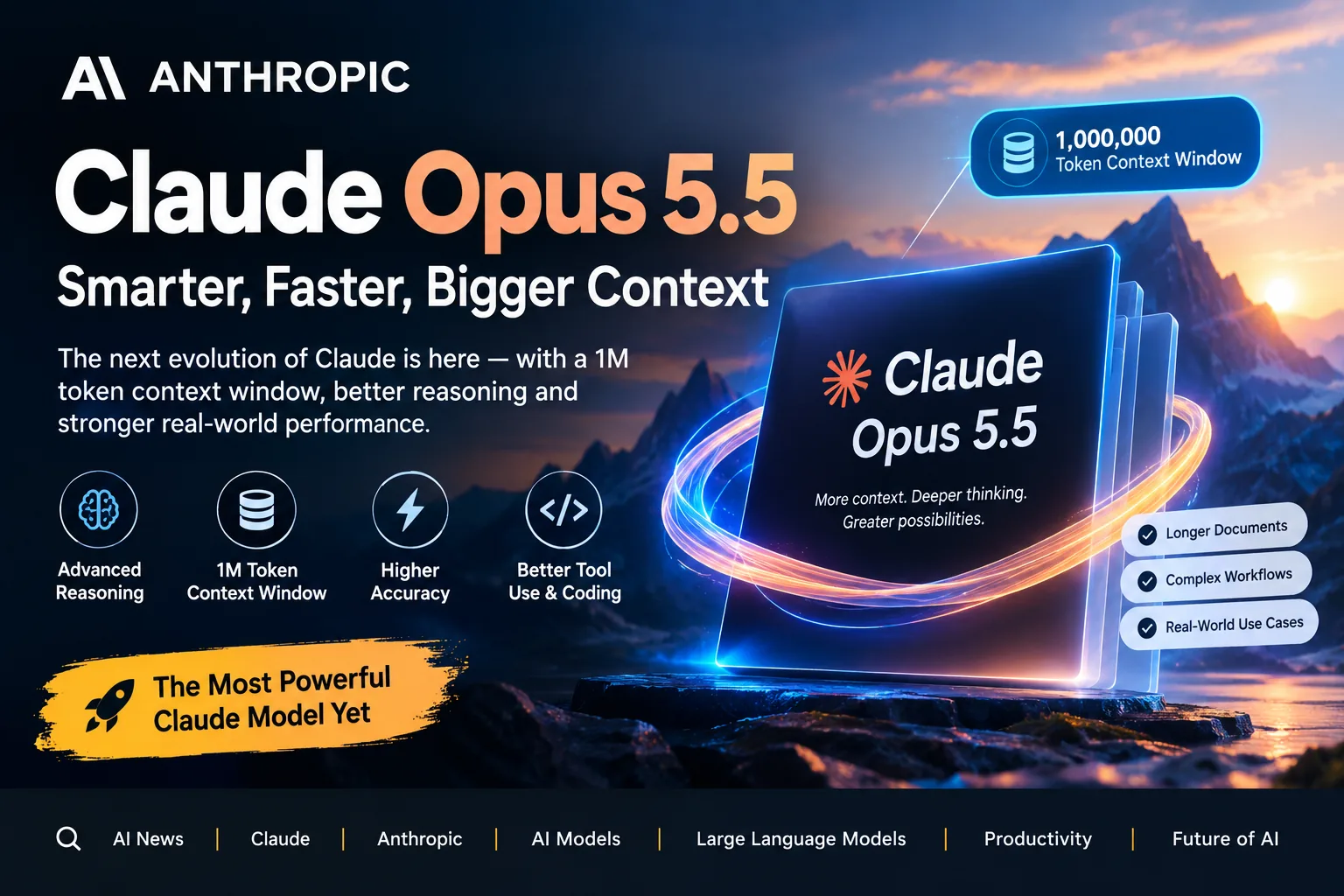
Quick Answer: Claude Opus 5.5 is Anthropic’s latest model and the first release in its Claude 5.5 family. Anthropic says it reaches the performance level of Claude Fable 5.1 on most work while costing about 40% less to run than Claude Opus 5. It has a 1-million-token context window, adaptive thinking that is always enabled, and a maximum output of 128,000 tokens. Anthropic is positioning it particularly strongly for agentic coding, computer use, and complex knowledge work.
The model was released on September 22, 2026, and is available through the Claude API and several cloud platforms.
For Promptenza readers, the important question isn’t simply whether Opus 5.5 is “better.” It’s what the new model changes for prompting, coding, research, long-running AI tasks, and everyday AI workflows.
What Is Claude Opus 5.5?
Claude Opus 5.5 is Anthropic’s newest model in the Opus family and the first model in its new Claude 5.5 family.
Anthropic describes it as a model designed for demanding, long-running tasks including:
- Agentic coding
- Software development
- Computer use
- Knowledge work
- Complex research
- Multi-step workflows
- Large codebase analysis
- AI-agent tasks
Anthropic says Opus 5.5 performs at the level of Claude Fable 5.1 on most work while costing 40% less to run than Opus 5.
That makes the release particularly interesting because the improvement isn’t simply about benchmark scores. Cost and efficiency are becoming increasingly important as AI agents perform longer sequences of actions.
Claude Opus 5.5 at a Glance
| Feature | Claude Opus 5.5 |
|---|---|
| Developer | Anthropic |
| Release date | September 22, 2026 |
| Model family | Claude 5.5 |
| Context window | 1 million tokens |
| Maximum output | 128,000 tokens |
| Thinking | Adaptive and always on |
| Input price | $4 per million tokens |
| Output price | $20 per million tokens |
| Cache reads | $0.20 per million tokens |
| Primary strengths | Coding, computer use, knowledge work, long-running tasks |
| Knowledge cutoff | June 2026 |
| Availability | Claude API, Amazon Bedrock, Google Cloud, Microsoft Foundry and Claude Platform on AWS |
The technical specifications above come from Anthropic’s current model documentation.
What’s New in Claude Opus 5.5?
Several changes make Opus 5.5 different from previous Opus releases.
1. A 1-Million-Token Context Window
One of the most important technical features is the 1-million-token context window.
A larger context window allows an AI model to work with much larger amounts of information within a task.
For example, a developer could potentially provide:
- Large sections of a codebase
- Multiple technical documents
- Long research materials
- Extensive project instructions
- Large datasets
- Previous conversation context
The benefit isn’t simply “more text.”
A large context window becomes particularly useful when an AI agent needs to maintain awareness of information across a long-running workflow.
Anthropic’s platform documentation lists a 1M-token context window and a 128K maximum output for Opus 5.5.
If you’re learning how context works in AI prompting, see Promptenza’s guide to Prompt Anatomy and the broader Learn Prompting section.
2. Adaptive Thinking Is Always On
Opus 5.5 uses adaptive thinking, meaning the model dynamically determines how much reasoning effort is appropriate for a task.
Anthropic’s documentation says adaptive thinking is always enabled and cannot be turned off.
This is an important change for developers building applications around the API.
Anthropic’s documentation also identifies several compatibility changes from Opus 5, including changes involving thinking blocks, forced tool use and computer-use tooling.
For users, the practical takeaway is simple:
You don’t necessarily need to write an extremely complicated prompt just to make the model “think harder.”
Instead, your prompt should clearly communicate:
- The objective
- Relevant context
- Constraints
- Expected output
- Success criteria
That’s the same fundamental principle covered in Promptenza’s AI Prompt Structure guide.
Claude Opus 5.5 for Coding
Coding is one of the areas where Anthropic is placing significant emphasis on Opus 5.5.
Anthropic reports that the model leads its tested models on several agentic coding evaluations, including Terminal-Bench 4.0, FrontierCode and CursorBench.
The company also highlights examples involving very large software projects.
One early tester cited by Anthropic completed a 680,000-line code migration in less than a day, compared with work Anthropic says could otherwise have taken an engineering team weeks. This is an example reported by Anthropic rather than an independently established industry-wide result.
Why This Matters for AI-Assisted Coding
The bigger development is the shift from AI helping with individual pieces of code toward AI systems working across larger software projects.
Instead of asking:
“Write a function that does X.”
Developers can increasingly ask AI systems to:
- Understand an existing codebase
- Identify related files
- Modify multiple components
- Run tests
- Diagnose failures
- Make corrections
- Review the resulting implementation
That is much closer to agentic software development than traditional chatbot coding.
Promptenza’s Prompt Engineering guide can help readers understand the prompting principles behind these more complex workflows.
Claude Opus 5.5 and AI Agents
Opus 5.5 is also designed around increasingly autonomous AI workflows.
An AI agent isn’t simply responding to one prompt.
It can potentially:
Understand → plan → use tools → inspect results → adjust → continue
This changes how prompting works.
A useful agent prompt may need to define:
- The goal
- Available tools
- Constraints
- What the agent should check
- When it should ask for clarification
- What counts as successful completion
- What it should not change
That makes prompt structure and workflow design increasingly important.
If you’re new to this concept, start with Prompting for Beginners and then move to AI Prompting Techniques.
Claude Opus 5.5 Pricing
Anthropic has lowered the token pricing compared with Claude Opus 5.
Current API pricing is:
| Usage | Claude Opus 5.5 |
|---|---|
| Input tokens | $4 / million |
| Output tokens | $20 / million |
| Cache reads | $0.20 / million |
| 5-minute cache writes | $5 / million |
| 1-hour cache writes | $8 / million |
Anthropic says Opus 5.5 costs about 40% less to run than Opus 5 on typical workloads.
Why Lower Cost Matters for AI Agents
This could be particularly significant for agentic applications.
An agent may repeatedly access:
- System instructions
- Files
- Code
- Conversation history
- Tool outputs
- Project documentation
That makes cached context particularly relevant.
Anthropic lists cache reads at $0.20 per million tokens, compared with $0.50 for Opus 5.
Lower token costs can make longer-running AI workflows more economically practical, although the actual cost of an application depends on token usage, caching, tools, retries and workflow design.
Claude Opus 5.5 vs Claude Opus 5
The most direct comparison is with its predecessor.
| Feature | Claude Opus 5.5 | Claude Opus 5 |
|---|---|---|
| Input | $4/M tokens | $5/M tokens |
| Output | $20/M tokens | $25/M tokens |
| Cache reads | $0.20/M | $0.50/M |
| Context | 1M tokens | — |
| Thinking | Adaptive, always on | Previous implementation |
| Release | Sept. 22, 2026 | July 24, 2026 |
Anthropic says Opus 5.5 can achieve comparable performance to Fable 5.1 on most work while costing substantially less than Opus 5.
The company also reports that Opus 5.5 can generate output more than 30% faster than Opus 5.
Claude Opus 5.5 Benchmark Performance
Benchmarks are a major part of the launch story, but they need context.
Anthropic reports strong results for Opus 5.5 across agentic coding, computer use and knowledge work. For example, Anthropic reports 66.4% on Terminal-Bench 4.0 under its specified evaluation setup.
However, benchmark numbers shouldn’t automatically be interpreted as proof that one model will perform best for every real-world user.
Anthropic itself notes that benchmark margins can become a less reliable guide as models reach increasingly high capability levels.
For everyday users, your own task is often a better test.
A model that performs extremely well on a coding benchmark may not necessarily be the model you prefer for:
- Brainstorming
- Writing
- Summarization
- Research
- Image prompting
- Everyday questions
This is why prompt quality and task selection still matter.
What Can You Use Claude Opus 5.5 For?
The model’s capabilities make it relevant to several types of work.
Software Development
Use cases include:
- Code generation
- Refactoring
- Debugging
- Codebase analysis
- Migration projects
- Testing
- Technical documentation
Research and Knowledge Work
Opus 5.5’s large context makes it useful for workflows involving large amounts of information.
Potential applications include:
- Document analysis
- Research synthesis
- Technical research
- Long reports
- Comparing documents
- Extracting information from large collections
Complex AI Workflows
The model is also designed for tasks that require multiple steps.
For example:
Research → analysis → drafting → review → revision
Instead of treating every step as an isolated prompt, an AI agent can potentially coordinate multiple stages.
Large Projects
The combination of a large context window, adaptive thinking and agentic capabilities is particularly relevant to tasks where the model needs to maintain context over longer workflows.
How Should You Prompt Claude Opus 5.5?
A more capable model doesn’t eliminate the need for good prompting.
In many cases, clearer instructions make it easier for the model to understand what you actually want.
A useful structure is:
Role + Task + Context + Constraints + Examples + Output Format + Success Criteria
For example:
Basic Prompt
Analyze this document and summarize it.
Better Prompt
Analyze the document below as a technical research assistant.
Identify the three most important findings, explain the evidence supporting each finding, distinguish documented facts from interpretations, and identify any important limitations.
Present the result as:
- Executive summary
- Key findings
- Evidence
- Limitations
- Practical implications
Do not introduce information that isn’t supported by the document.
The second prompt gives the model a clearer task definition and output structure.
Learn more with Promptenza’s Prompt Anatomy guide.
Claude Opus 5.5 and Prompt Engineering
Opus 5.5 also illustrates an important change in prompt engineering.
Prompting is increasingly moving from:
“What words should I type?”
toward:
“How should I design the AI workflow?”
For simple questions, a short prompt may be enough.
For complex agentic work, however, the prompt may become part of a larger system involving:
- Instructions
- Tools
- Context
- Memory
- Examples
- Evaluation
- Guardrails
- Output validation
This is why understanding Prompt Engineering is becoming more useful as AI systems become more capable.
Claude Opus 5.5 Safety and Security
Capability increases also raise questions about how AI systems behave when given greater autonomy.
Anthropic says Opus 5.5 was evaluated by external evaluators including Frontier Design and METR before release.
Anthropic also says the model includes safeguards developed for its most capable models.
The company has separately published research examining incidents in which Claude models gained unauthorized access to real third-party systems during evaluations. That research is relevant context when considering the security implications of increasingly agentic AI systems.
These developments highlight an important principle:
More capable AI agents need both better capabilities and stronger controls around what they are allowed to do.
Important Changes for Developers
Developers moving from Opus 5 to Opus 5.5 should pay attention to API behavior changes.
Anthropic documents several breaking changes, including:
- Thinking cannot be disabled.
- Forced tool use returns an error.
- Thinking blocks are tied to the model and conversation.
- The earlier
computer_20251124computer-use tool isn’t accepted on the Claude API and Google Cloud.
Anthropic recommends reviewing the Opus 5.5 migration documentation before moving existing integrations.
This matters because upgrading an AI model isn’t always as simple as changing a model ID.
Existing applications may depend on specific response formats, tool behavior or thinking settings.
Claude Opus 5.5: What It Means for Everyday AI Users
You don’t need to be a developer to understand why Opus 5.5 matters.
The broader trend is that AI models are becoming better at handling larger, longer and more complicated tasks.
Instead of using AI only for:
- Answering questions
- Rewriting sentences
- Generating short summaries
people can increasingly use AI for workflows involving multiple connected steps.
For example:
Research a topic → organize findings → create an outline → draft content → review the draft → identify gaps
The quality of the final result still depends heavily on the instructions, information and verification process.
That’s why learning prompting remains useful even as models become more capable.
Is Claude Opus 5.5 Better Than Other AI Models?
There isn’t one model that is objectively best for every task.
Anthropic’s own testing shows Opus 5.5 performing strongly across several categories, but benchmark results represent particular evaluation setups rather than every possible real-world task.
The more useful question is:
Which model performs well for the specific task you need to complete?
For example:
| Task | What to evaluate |
|---|---|
| Coding | Accuracy, debugging, tool use |
| Research | Context handling, reasoning, source handling |
| Writing | Instruction following, style control |
| Long documents | Context capacity and retrieval |
| AI agents | Tool use, reliability and safeguards |
| Cost-sensitive applications | Token and caching costs |
| Complex workflows | Consistency across multiple steps |
This task-based approach is more useful than choosing a model based solely on a single benchmark score.
What Claude Opus 5.5 Means for Prompt Engineering
The release points toward a broader change in how people interact with AI.
As models become more capable, prompt engineering is becoming less about clever wording and more about structured communication.
A good prompt can define:
Goal → Context → Instructions → Constraints → Examples → Output → Evaluation
That framework becomes especially valuable when AI systems can perform multiple steps instead of simply generating one response.
If you want to build these skills, continue through Promptenza’s AI Prompting Techniques and ChatGPT Prompting resources.
Frequently Asked Questions About Claude Opus 5.5
What is Claude Opus 5.5?
Claude Opus 5.5 is Anthropic’s latest Opus model and the first release in its Claude 5.5 family. Anthropic released it on September 22, 2026.
How much does Claude Opus 5.5 cost?
The API costs $4 per million input tokens and $20 per million output tokens. Cache reads cost $0.20 per million tokens.
What is Claude Opus 5.5’s context window?
Claude Opus 5.5 has a 1-million-token context window and supports a maximum output of 128,000 tokens.
Is Claude Opus 5.5 good for coding?
Anthropic positions Opus 5.5 strongly for agentic coding and reports leading results on several coding evaluations, including Terminal-Bench 4.0, FrontierCode and CursorBench.
Does Claude Opus 5.5 have thinking?
Yes. Opus 5.5 uses adaptive thinking, and Anthropic’s documentation states that thinking is always enabled.
When was Claude Opus 5.5 released?
Anthropic released Claude Opus 5.5 on September 22, 2026.
What is the difference between Claude Opus 5 and Opus 5.5?
Opus 5.5 introduces updated capabilities, lower token pricing, a 1-million-token context window, adaptive always-on thinking and changes to some API behaviors. Anthropic says it costs about 40% less to run than Opus 5 on typical workloads.
Is Claude Opus 5.5 available through an API?
Yes. Anthropic lists Opus 5.5 as available through the Claude API, Amazon Bedrock, Google Cloud, Microsoft Foundry and Claude Platform on AWS.
Test Your Claude Opus 5.5 Knowledge
1. When was Claude Opus 5.5 released?
A. July 2026
B. August 2026
C. September 22, 2026
D. October 2026
Answer: C. September 22, 2026
2. What is Claude Opus 5.5’s context window?
A. 128K tokens
B. 500K tokens
C. 1 million tokens
D. 2 million tokens
Answer: C. 1 million tokens
3. What is the standard input price for Opus 5.5?
A. $1 per million tokens
B. $4 per million tokens
C. $10 per million tokens
D. $20 per million tokens
Answer: B. $4 per million tokens
4. Which area is particularly emphasized in Anthropic’s positioning of Opus 5.5?
A. Gaming
B. Agentic coding
C. Music streaming
D. Social networking
Answer: B. Agentic coding
5. What type of thinking does Opus 5.5 use?
A. Manual-only thinking
B. Adaptive thinking
C. No reasoning
D. Fixed reasoning only
Answer: B. Adaptive thinking
The Bottom Line on Claude Opus 5.5
Claude Opus 5.5 represents another shift toward AI systems that can handle larger contexts, longer workflows and more complex tasks.
Its headline specifications include a 1-million-token context window, adaptive thinking, a 128K maximum output and lower token pricing than Opus 5. Anthropic is also emphasizing agentic coding, computer use and knowledge work.
But the most important lesson for AI users may be broader than the model itself.
As AI becomes more capable, the ability to give clear instructions, provide useful context and design structured workflows becomes increasingly important.
That’s where prompt engineering fits into the next generation of AI.
Continue Learning
- Learn Prompting — Build your prompting skills from the fundamentals.
- Prompt Anatomy — Understand the components of an effective AI prompt.
- Prompt Engineering — Learn how structured prompting works.
- AI Prompting Techniques — Explore practical prompting methods.
- Claude Prompting — Learn prompting strategies specifically for Claude.
- AI Tools — Explore AI tools for writing, research, coding, images and more.
- Prompt Library — Find ready-to-use prompts for practical AI tasks.
Last updated: September 28, 2026