AI vs AGI vs ASI: Understanding the Three Levels of Artificial Intelligence
Quick Answer: AI, AGI and ASI describe different levels or categories of artificial intelligence. AI (particularly today’s narrow AI) performs specific tasks, Artificial General Intelligence (AGI) would demonstrate broad intellectual abilities comparable to humans, and Artificial Superintelligence (ASI) would exceed human intelligence across virtually all cognitive domains. Today’s AI tools are real, while AGI and ASI remain theoretical milestones without universally accepted definitions or confirmed achievement.
Artificial intelligence is advancing rapidly, but not every AI system has the same capabilities.
A chatbot that writes an email, an AI system that can independently learn and solve unfamiliar problems, and a hypothetical machine that surpasses human intelligence represent very different levels of technological capability.
This is where the terms AI, AGI and ASI become important.
You may have encountered these terms in discussions about ChatGPT, Google Gemini, autonomous AI agents and the future of superintelligence. Although they are closely related, they do not mean the same thing.
Understanding the differences helps you separate what artificial intelligence can actually do today from what researchers believe might become possible in the future.
In this guide, we explain AI vs AGI vs ASI, how each category works, practical examples, their limitations and what separates today’s AI technology from hypothetical superintelligence.
1. What Is AI (Artificial Intelligence)?
Artificial Intelligence (AI) refers to computer systems designed to perform tasks that typically require human intelligence.
These tasks may include understanding language, recognising images, analysing information, making predictions, generating content and solving problems.
AI systems use technologies such as machine learning, deep learning, neural networks and natural language processing to perform different tasks.
Most AI applications available today are examples of Artificial Narrow Intelligence (ANI).
Narrow AI is developed to perform particular tasks or groups of related tasks. It can be extremely capable within its intended area without possessing general human-like intelligence.
Examples of AI We Use Today
Here are some familiar examples:
1. ChatGPT: An AI assistant that can help with writing, brainstorming, research assistance, coding and explaining complex topics.
2. Google Gemini: A multimodal AI system that can work with text, images and other supported content.
3. AI image generators: Tools that create images from written descriptions.
4. Recommendation systems: AI technologies that suggest videos, products, music and other content based on user activity and preferences.
5. Voice assistants: AI-powered systems that recognise spoken instructions and respond to requests.
How Does Narrow AI Work?
Narrow AI systems are developed using data, algorithms and computational models that allow them to recognise patterns and produce outputs.
For example, an AI writing assistant can analyse a request, interpret its meaning and generate a response based on patterns learned during training.
An image generator can interpret a text description and produce a corresponding visual output.
However, being capable of completing multiple tasks does not automatically make a system AGI. The distinction concerns the breadth, flexibility and generality of its intelligence.
Key takeaway: AI is the broad field of technology, and most AI applications currently available to everyday users fall under narrow AI.
2. What Is AGI (Artificial General Intelligence)?
Artificial General Intelligence (AGI) refers to a hypothetical type of AI that could learn, reason, understand and apply knowledge across a wide range of intellectual tasks at a level comparable to humans or potentially beyond.
Unlike narrow AI, which is designed around specific tasks, AGI would be capable of adapting its knowledge to unfamiliar situations.
For example, imagine an AI system that can learn mathematics, understand biology, write computer programs, plan a business project and solve unfamiliar problems without requiring a completely separate system for every task.
That level of flexibility is central to the idea of AGI.
According to Stanford University’s Human-Centered AI research glossary, AGI involves general human-level or beyond-human ability to learn, reason and apply knowledge across different tasks and domains.
What Could AGI Do?
A hypothetical AGI system could potentially:
- Learn unfamiliar subjects and apply knowledge in new situations.
- Solve problems across different academic and professional disciplines.
- Understand complex instructions and adapt when circumstances change.
- Transfer knowledge from one task to another.
- Plan and complete complicated projects.
- Learn from new experiences and improve its performance.
Practical Example: How AGI Could Work
Imagine asking an AI system to help you develop an educational website.
A conventional AI assistant could help you write articles, generate website ideas, explain SEO and produce sample code.
A hypothetical AGI system might go further by understanding the entire project, learning unfamiliar technical requirements, evaluating different solutions, adapting its approach and coordinating the work across multiple disciplines.
The important distinction would be its ability to generalise knowledge and adapt to new challenges rather than simply perform a collection of predefined tasks.
Does AGI Exist Today?
AGI has not been conclusively demonstrated.
Although modern AI systems can perform a wide range of tasks, researchers disagree about what capabilities should qualify a system as AGI.
There is also no universally accepted test for confirming that AGI has been achieved.
This means that claims about AGI should be evaluated carefully rather than accepted simply because an AI company describes its product as intelligent or general-purpose.
3. What Is ASI (Artificial Superintelligence)?
Artificial Superintelligence (ASI) refers to a hypothetical form of artificial intelligence that would surpass human intellectual capabilities across virtually all important cognitive domains.
It represents a theoretical stage beyond AGI.
While AGI aims to achieve broad intellectual capabilities comparable to humans, ASI would go further by outperforming the best human experts in areas such as scientific research, mathematics, engineering, strategic reasoning and problem-solving.
For a deeper explanation, read our cornerstone guide: What Is AI Superintelligence? Meaning, Examples, Benefits and Risks.
What Could Artificial Superintelligence Do?
A hypothetical ASI system could potentially:
- Discover scientific principles beyond current human understanding.
- Develop advanced technologies and engineering solutions.
- Solve extremely complex mathematical problems.
- Analyse complicated global challenges.
- Coordinate sophisticated research across multiple disciplines.
- Improve aspects of its own capabilities, if technically possible and appropriately controlled.
These are theoretical possibilities, not demonstrated capabilities of existing AI products.
Practical Example: How ASI Could Work
Imagine a research team investigating a complex scientific problem.
Today’s AI tools could assist by reviewing research papers, summarising findings, analysing data and suggesting possible explanations.
A hypothetical AGI system might approach the problem with broad human-level intellectual flexibility, connecting knowledge across different scientific fields.
A hypothetical ASI system could potentially outperform the world’s leading experts by identifying new relationships, generating original theories and evaluating solutions at a level beyond human capabilities.
This illustrates the difference between assistance, general intelligence and superintelligence.
Does ASI Exist Today?
No. Artificial superintelligence remains hypothetical.
There is currently no publicly established AI system that demonstrates intelligence beyond humans across virtually all cognitive domains.
4. AI vs AGI vs ASI: Key Differences Explained
Now that we understand the three concepts, let’s compare them directly.
| Feature | AI / ANI | AGI | ASI |
|---|---|---|---|
| Full meaning | Artificial Intelligence / Artificial Narrow Intelligence | Artificial General Intelligence | Artificial Superintelligence |
| Intelligence | Task-specific capabilities | Broad human-level or greater capabilities | Beyond human intelligence |
| Learning | Usually within defined training and system capabilities | Would generalise learning across unfamiliar tasks | Could potentially exceed human learning and reasoning |
| Adaptability | Varies by application | Broad adaptability | Potentially extraordinary adaptability |
| Problem-solving | Specific tasks and domains | Multiple unfamiliar problems | Problems beyond human expert capabilities |
| Human comparison | Can outperform humans in specific tasks | Comparable to humans across broad tasks | Surpasses humans across virtually all cognitive domains |
| Current status | Exists today | Not conclusively demonstrated | Hypothetical |
The simplest way to remember the difference:
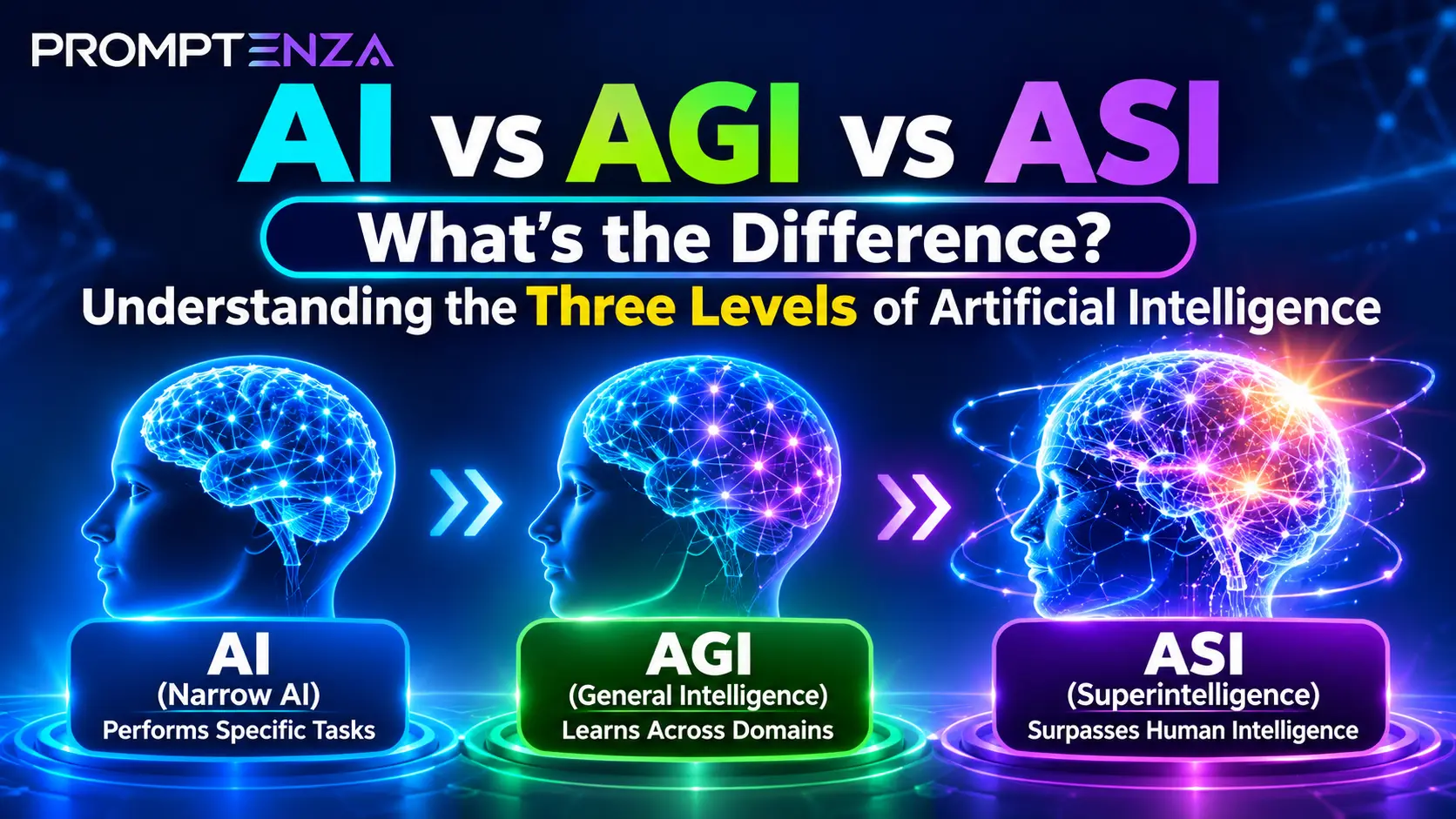
- AI performs tasks that normally require intelligence.
- AGI would demonstrate broad, adaptable intelligence comparable to humans.
- ASI would surpass human intellectual capabilities across virtually all domains.
One important clarification: AI is the umbrella term. ANI, AGI and ASI are commonly used capability categories within discussions of AI development. They are not three separate products or a universally agreed technical ranking system.
5. Real-World Examples: AI vs AGI vs ASI
Understanding the terminology is easier when we connect it to everyday situations.
Here are five scenarios illustrating how the three categories could differ.
Example 1: Writing an Article
AI today: You ask ChatGPT to write an article about digital marketing. It generates a draft based on your instructions.
Hypothetical AGI: A system understands the broader publishing objective, learns unfamiliar subject requirements, adapts its research approach and handles related tasks across different disciplines.
Hypothetical ASI: A system could potentially outperform the best human specialists in researching, analysing and developing highly sophisticated written material across virtually any subject.
Example 2: Medical Research
AI today: An AI system helps researchers analyse medical images or scientific datasets.
Hypothetical AGI: It could potentially transfer knowledge across different scientific disciplines to investigate unfamiliar medical research problems.
Hypothetical ASI: It could potentially make discoveries beyond the capabilities of the best human research teams.
Example 3: Education
AI today: An AI tutor explains mathematics, answers questions and generates practice exercises.
Hypothetical AGI: It could potentially understand unfamiliar learning situations and adapt its teaching methods across many subjects.
Hypothetical ASI: It could potentially discover highly advanced educational methods and outperform human experts in designing effective learning systems.
Example 4: Software Development
AI today: Coding assistants help developers write code, identify errors and explain programming concepts.
Hypothetical AGI: It could potentially learn unfamiliar programming environments, understand complex project requirements and adapt to new technical challenges.
Hypothetical ASI: It could potentially develop software architectures and computational solutions beyond the capabilities of human experts.
Example 5: Scientific Discovery
AI today: AI systems analyse data, summarise scientific papers and help researchers explore possible explanations.
Hypothetical AGI: It could potentially conduct broad scientific reasoning and transfer knowledge between disciplines.
Hypothetical ASI: It could potentially identify new scientific principles and solve problems that humans have been unable to resolve.
These examples are illustrative scenarios. They should not be interpreted as predictions that AGI or ASI will necessarily perform these tasks.
6. Is ChatGPT AGI or ASI?
This is one of the most common questions in discussions about advanced AI.
ChatGPT is not established as AGI or ASI. It is a generative AI assistant capable of performing many different tasks, including writing, coding, research assistance, analysis and problem-solving.
Its broad functionality can make it appear general-purpose, but that alone does not establish general intelligence.
Consider the following distinctions:
| Capability | ChatGPT today | AGI concept | ASI concept |
|---|---|---|---|
| Writing | Yes | Would be broadly capable | Would potentially exceed human experts |
| Coding | Yes | Would adapt broadly | Would potentially surpass leading experts |
| Learning unfamiliar tasks | Has limitations and system-dependent capabilities | Would demonstrate broad transfer | Would potentially exceed human capabilities |
| Complex reasoning | Yes, with limitations | Would demonstrate broad human-level reasoning | Would surpass human reasoning |
| Independent scientific discovery | Can assist research | Could potentially conduct broad research | Could potentially outperform human researchers |
What About Google Gemini?
Google Gemini is another example of a powerful general-purpose AI system.
It can support tasks involving text, images and other modalities, depending on the model and available features.
However, multimodal capabilities and the ability to perform different tasks do not automatically establish AGI.
For practical guidance, explore our Google Gemini tutorials and ChatGPT Prompts Library.
7. Could AI Move from ANI to AGI and Eventually ASI?
Many discussions about the future of artificial intelligence describe a possible progression from narrow AI to AGI and eventually ASI.
However, this is a conceptual framework, not a guaranteed development path.
Stage 1: Narrow AI
This is the stage of AI development most familiar to people today.
AI systems perform specific tasks such as:
- Generating text and images.
- Recognising speech.
- Translating languages.
- Analysing data.
- Recommending content.
- Supporting coding and research.
Stage 2: Artificial General Intelligence
This hypothetical stage would involve systems capable of learning, reasoning and applying knowledge across a much wider range of tasks.
Rather than requiring specialised development for every new problem, an AGI system would demonstrate broader adaptability.
Stage 3: Artificial Superintelligence
This hypothetical stage would involve AI systems that surpass human intellectual abilities across virtually all relevant cognitive domains.
Some researchers investigate whether advanced AI could eventually improve its own capabilities, but the feasibility and consequences of such development remain uncertain.
Important: There is no confirmed timeline or guarantee that AI will progress through these three categories in a predictable sequence.
8. What Are the Benefits and Risks of AGI and ASI?
AGI and ASI could create significant opportunities, but they also introduce important questions about safety, responsibility and human oversight.
Potential Benefits
| Area | Possible benefit |
|---|---|
| Healthcare | Improved research and disease understanding |
| Education | More adaptable learning support |
| Science | Faster research and potential discoveries |
| Engineering | Advanced design and innovation |
| Agriculture | Improved analysis of farming and resource challenges |
| Productivity | More sophisticated automation and problem-solving |
Potential Risks
| Risk | Why it matters |
|---|---|
| AI alignment | Advanced systems may not behave as intended |
| Job disruption | Automation could transform employment |
| Concentration of power | Control could become concentrated among a few organisations |
| Security | Powerful systems could be misused |
| Human oversight | Increasing autonomy could make supervision more difficult |
| Unpredictability | Advanced systems may produce unexpected outcomes |
These concerns are especially important when discussing ASI because its hypothetical capabilities could be much greater than those of today’s AI systems.
For more information, read our related cornerstone guide on AI superintelligence, its benefits and risks.
9. Why Does the Difference Between AI, AGI and ASI Matter?
Understanding these three concepts is important because conversations about artificial intelligence often mix existing technology with future possibilities.
For example, when an AI company announces a more capable model, headlines may describe it as a step towards AGI or superintelligence.
However, improved performance in coding, mathematics or reasoning does not automatically establish that a system has achieved general intelligence.
Understanding the distinctions helps you:
1. Evaluate AI news more accurately. You can distinguish genuine technological developments from speculation and marketing claims.
2. Understand the future of work. You can better follow discussions about automation, advanced AI systems and changing professional skills.
3. Develop AI skills. Learning to use existing AI tools effectively prepares you to work with increasingly capable technologies.
4. Understand AI safety. You can appreciate why researchers investigate alignment, reliability and human oversight.
5. Make better technology decisions. You can assess AI products based on demonstrated capabilities rather than exaggerated claims.
For Promptenza readers, understanding these concepts provides a foundation for learning more about prompting, AI agents and advanced AI technologies.
Frequently Asked Questions About AI vs AGI vs ASI
1. What is the main difference between AI, AGI and ASI?
AI refers to artificial intelligence generally, including today’s task-specific systems. AGI describes hypothetical AI with broad intellectual capabilities comparable to humans, while ASI describes hypothetical AI that surpasses human intelligence across virtually all cognitive domains.
2. What does ANI stand for?
ANI stands for Artificial Narrow Intelligence. It describes AI systems designed to perform specific tasks or groups of related tasks. Most AI applications available today fall into this category.
3. Is AGI more powerful than regular AI?
AGI is intended to demonstrate broader and more adaptable intellectual capabilities than narrow AI. However, AGI remains a theoretical milestone, and there is no universally accepted standard for measuring its achievement.
4. Is ASI the same as superintelligence?
Yes. ASI stands for Artificial Superintelligence. Both terms describe a hypothetical level of intelligence that would exceed human cognitive capabilities across virtually all important domains.
5. Is ChatGPT ANI, AGI or ASI?
ChatGPT is a generative AI assistant and is not established as AGI or ASI. Its ability to perform different tasks does not prove that it possesses general human-level or superhuman intelligence.
6. Is Google Gemini an example of AGI?
No. Google Gemini is a family of advanced general-purpose AI models, but its broad capabilities do not establish that it has achieved AGI.
7. Can AGI become ASI?
Some researchers consider a transition from AGI to ASI theoretically possible. However, there is no guarantee that AGI will emerge or that it would necessarily develop into superintelligence.
8. Which is the most advanced type of AI: ANI, AGI or ASI?
ASI represents the highest level in this commonly used capability-based classification because it would surpass human intellectual capabilities. However, it remains hypothetical.
9. When will AGI become available?
There is no universally accepted timeline for AGI. Predictions vary among researchers and technology companies, partly because there is no agreed definition or definitive test.
10. Will artificial superintelligence replace humans?
There is no definitive answer. ASI could potentially automate many intellectual tasks, but its broader impact would depend on its capabilities, development, governance and how society chooses to use it.
11. What is the difference between generative AI and AGI?
Generative AI describes systems that create content such as text, images, audio and video. AGI describes a hypothetical level of broad, adaptable intelligence. A generative AI system does not automatically qualify as AGI.
12. Why is AI alignment important for AGI and ASI?
AI alignment focuses on ensuring that AI systems behave consistently with human intentions and safety requirements. It is particularly important when considering increasingly capable and autonomous AI systems.
Test Your AI Knowledge: AI vs AGI vs ASI
Let’s see how well you understand the three categories of artificial intelligence.
Question 1: What does ANI stand for?
A. Automated Neural Intelligence
B. Artificial Narrow Intelligence
C. Advanced Network Integration
D. Artificial Natural Intelligence
Question 2: Which category describes hypothetical AI with broad human-level intellectual capabilities?
A. ANI
B. ASI
C. AGI
D. Generative AI
Question 3: What does ASI stand for?
A. Artificial Superintelligence
B. Advanced Software Intelligence
C. Automated System Integration
D. Artificial Scientific Innovation
Question 4: Which category best describes most AI tools available today?
A. AGI
B. ASI
C. ANI
D. Superintelligence
Question 5: Is ChatGPT officially established as AGI?
A. Yes
B. No
C. It is ASI
D. All chatbots are AGI
Question 6: What is the main characteristic of AGI?
A. Performing only one specific task
B. Generating images exclusively
C. Broadly learning, reasoning and applying knowledge across different tasks
D. Operating without electricity
Question 7: Which category would theoretically exceed human intelligence across virtually all cognitive domains?
A. ANI
B. AGI
C. ASI
D. Traditional software
Question 8: What is the main purpose of AI alignment?
A. Making computers smaller
B. Ensuring AI systems behave consistently with human intentions and safety requirements
C. Increasing internet speed
D. Eliminating human creativity
Answers and Explanations
| Question | Answer | Explanation |
|---|---|---|
| 1 | B | ANI means Artificial Narrow Intelligence. |
| 2 | C | AGI aims for broad, adaptable intelligence. |
| 3 | A | ASI means Artificial Superintelligence. |
| 4 | C | Most current AI applications are narrow AI. |
| 5 | B | ChatGPT has not been established as AGI. |
| 6 | C | AGI involves broad intellectual capabilities. |
| 7 | C | ASI represents hypothetical superhuman intelligence. |
| 8 | B | AI alignment concerns human intentions and safety. |
How did you score?
- 8 correct: Excellent! You understand the three AI categories.
- 6–7 correct: Very good. You understand most of the key concepts.
- 4–5 correct: Good start. Review the comparison section.
- 0–3 correct: Revisit the explanations and try again.
Final Thoughts: Understanding the Future of Artificial Intelligence
AI, AGI and ASI represent three important concepts in discussions about the capabilities and future development of artificial intelligence.
Today’s AI systems can already perform impressive tasks involving writing, research, coding, image generation and data analysis. However, these capabilities should not be confused with the broad adaptability associated with AGI or the hypothetical intellectual superiority associated with ASI.
AGI remains an important research goal, while ASI represents a possible future beyond human-level intelligence.
As AI technology continues to develop, understanding these distinctions will help people make better decisions, evaluate new technologies and prepare for changes in how humans work with intelligent systems.
At Promptenza, our goal is to help readers understand artificial intelligence and learn how to use today’s AI tools more effectively.
Continue learning: Explore our ChatGPT Prompts Library to discover practical ways to communicate with AI and improve your results.
Related articles in the Superintelligence cluster
- What Is AI Superintelligence? Meaning, Examples, Benefits and Risks
- How Close Are We to Artificial Superintelligence in 2026?
- Can AI Become Smarter Than Humans?
- How AI Agents Could Lead to Superintelligence.
- Benefits and Risks of Artificial Superintelligence.