Can AI Become Smarter Than Humans? Exploring the Future of Artificial Intelligence
Artificial intelligence is becoming increasingly capable of performing tasks that once required human expertise. AI systems can write computer programs, solve complex mathematical problems, analyse scientific information, generate realistic images and assist with research.
These developments raise an important question: Can artificial intelligence eventually become smarter than humans?
The short answer is yes, it is theoretically possible. AI already outperforms humans in certain specialised tasks, but developing a system that consistently surpasses human intelligence across virtually all intellectual domains would be a much greater achievement.
Researchers refer to this hypothetical level of intelligence as Artificial Superintelligence (ASI).
Some believe increasingly capable AI systems could eventually reach or exceed human-level intelligence. Others argue that significant challenges involving reasoning, adaptability, reliability and understanding remain unresolved.
In this guide, we explore how AI compares with human intelligence, whether machines could become smarter than people, what AGI and ASI mean, and how such developments could affect the future of humanity.
Quick Answer: Can AI Become Smarter Than Humans?
Yes. Artificial intelligence could theoretically become smarter than humans across a wide range of intellectual tasks. AI already exceeds human performance in certain specialised areas, including some mathematical, computational and pattern-recognition tasks.
However, this does not mean today’s AI systems are generally more intelligent than humans.
Achieving Artificial General Intelligence (AGI) would require broad, adaptable intellectual capabilities comparable to humans. Artificial Superintelligence (ASI) would go further by surpassing human capabilities across virtually all important cognitive domains.
The important distinction is that AI can outperform humans at individual tasks without necessarily possessing greater overall intelligence.
1. Can Artificial Intelligence Really Become Smarter Than Humans?
Artificial intelligence has already demonstrated that machines can outperform people in specific intellectual activities.
For example, computers can process enormous datasets, perform calculations quickly, identify patterns and solve certain problems more efficiently than humans.
However, intelligence is not measured by one ability alone.
Human intelligence involves several interconnected capabilities, including:
- Reasoning and logical thinking.
- Learning from experience.
- Understanding language and context.
- Creativity and problem-solving.
- Adapting to unfamiliar situations.
- Applying knowledge across different subjects.
- Making decisions under uncertainty.
- Understanding social and environmental situations.
AI systems demonstrate different levels of performance across these capabilities.
A system might outperform a human expert in mathematical calculations but struggle with an everyday task that requires flexible judgement.
This uneven pattern is sometimes described as the jagged frontier of AI capabilities.
For example, Stanford HAI’s 2026 AI Index highlights that advanced AI models can achieve gold-medal-level performance in mathematical competitions while still struggling with relatively ordinary tasks such as reliably reading analogue clocks.
The International AI Safety Report 2026 similarly describes how general-purpose AI systems can perform exceptionally well on difficult scientific and mathematical tasks but still make basic reasoning errors.
This shows why comparing AI and human intelligence requires more than looking at individual benchmark scores.
2. Where Is AI Already Smarter Than Humans?
AI does not need to become generally intelligent to outperform humans in particular activities.
Several AI applications already demonstrate exceptional capabilities in specialised areas.
A. Mathematical Calculations and Data Processing
Computers can perform large numbers of calculations much faster than humans.
AI systems can also help researchers analyse mathematical problems, recognise patterns and explore possible solutions.
For example, advanced mathematical reasoning systems have achieved impressive results in international mathematics competition evaluations.
However, solving competition problems does not automatically establish general intelligence.
B. Processing Large Amounts of Information
AI systems can analyse enormous collections of documents, identify patterns and summarise information much faster than an individual human could manually.
This makes them useful for research assistance, business analysis and information organisation.
However, processing information quickly does not guarantee that every conclusion is accurate.
C. Pattern Recognition
AI systems are particularly effective at identifying patterns in large datasets.
Applications include:
- Recognising objects in images.
- Identifying unusual patterns in financial data.
- Analysing medical images.
- Detecting defects in manufacturing.
- Classifying information.
In some carefully defined tasks, AI systems can achieve performance beyond human benchmarks.
D. Playing Strategy Games
AI systems have achieved extraordinary performance in games such as chess and Go.
Systems such as AlphaGo demonstrated that machine learning could develop strategies that challenged and defeated leading human players.
These achievements demonstrate specialised machine intelligence, rather than proof that AI possesses general human-like intelligence.
E. Performing Repetitive Computational Tasks
AI can automate repetitive digital activities such as categorising documents, extracting information, checking structured data and processing large volumes of requests.
Computers can perform these operations continuously without the same biological limitations as humans.
However, human supervision may still be necessary when tasks involve ambiguity or important decisions.
What Does This Tell Us?
AI is already better than humans at some specific tasks. However, being better at calculations, pattern recognition or game strategy does not mean a system is more intelligent than a human in every sense.
The distinction between specialised performance and general intelligence is essential when discussing the future of AI.
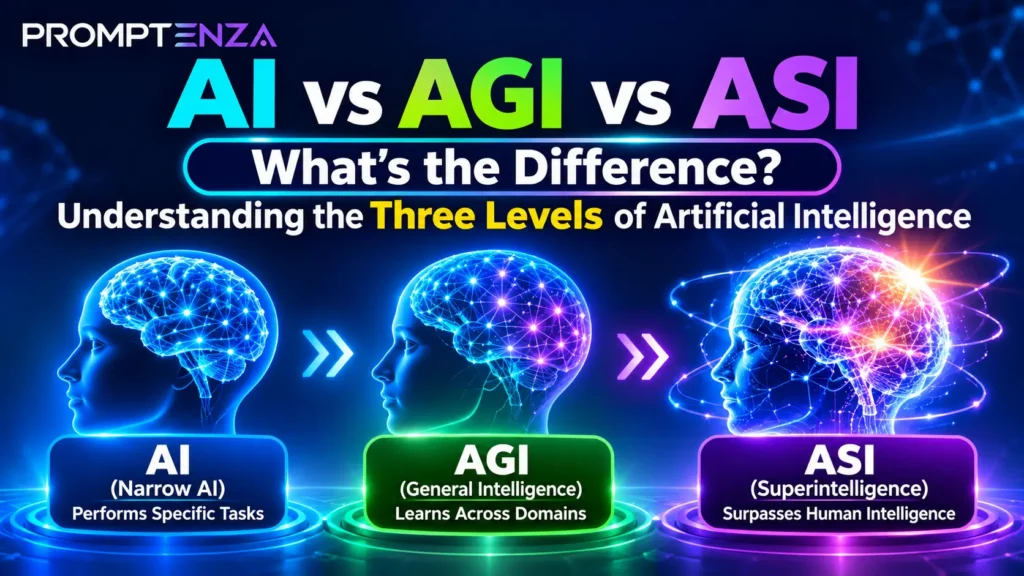
3. What Is the Difference Between AI, AGI and ASI?
To understand whether AI could become smarter than humans, it is important to understand three commonly used categories in discussions about artificial intelligence.
Artificial Narrow Intelligence (ANI)
Artificial Narrow Intelligence describes AI systems designed to perform specific tasks or groups of related tasks.
Most AI applications available today fall into this category.
Examples include:
- AI writing assistants.
- Image-generation tools.
- Recommendation systems.
- Speech recognition software.
- AI-powered translation tools.
- Specialised medical image analysis systems.
These systems can be extremely capable within their intended applications without demonstrating broad human-like intelligence.
Artificial General Intelligence (AGI)
Artificial General Intelligence describes a hypothetical AI system capable of learning, reasoning and applying knowledge across a broad range of intellectual tasks.
An AGI system would need to adapt to unfamiliar problems rather than depend entirely on specialised capabilities.
For example, a hypothetical AGI could learn a new subject, apply that knowledge to a different discipline and solve unfamiliar problems with broad flexibility.
AGI has not been conclusively demonstrated, and researchers do not universally agree on how it should be defined or tested.
Artificial Superintelligence (ASI)
Artificial Superintelligence describes a hypothetical AI system that would surpass human intellectual capabilities across virtually all important cognitive domains.
It could potentially outperform leading human experts in scientific research, engineering, mathematics, strategic reasoning and other intellectual activities.
ASI represents a theoretical stage beyond human-level general intelligence.
AI vs AGI vs ASI: Comparison Table
| Feature | ANI | AGI | ASI |
|---|---|---|---|
| Full meaning | Artificial Narrow Intelligence | Artificial General Intelligence | Artificial Superintelligence |
| Capabilities | Specific tasks | Broad intellectual capabilities | Beyond-human intellectual capabilities |
| Learning | Limited to system capabilities and training | Broad transfer of knowledge | Potentially superior learning and adaptation |
| Problem-solving | Defined tasks and domains | Unfamiliar problems across domains | Problems beyond human expert capabilities |
| Human comparison | Can outperform humans in specific tasks | Comparable to humans across broad tasks | Surpasses humans across virtually all cognitive domains |
| Current status | Exists today | Not conclusively demonstrated | Hypothetical |
In simple terms:
- ANI performs specialised intelligent tasks.
- AGI would demonstrate broad, adaptable intelligence comparable to humans.
- ASI would exceed human intellectual capabilities across virtually all important domains.
For a more detailed comparison, read our guide: AI vs AGI vs ASI: What’s the Difference?.
4. How Could AI Become Smarter Than Humans?
There is no confirmed roadmap showing exactly how artificial intelligence will become smarter than humans.
However, researchers are exploring several technological developments that could contribute to increasingly capable AI systems.
1. More Advanced Machine Learning
Machine learning allows computers to identify patterns in data and improve their performance through training.
More advanced learning methods could help future AI systems become better at handling unfamiliar problems, transferring knowledge and adapting to new situations.
2. Improved Reasoning Capabilities
Reasoning is an important part of intelligent problem-solving.
AI developers are working on systems that can break complicated problems into smaller steps, examine alternative solutions and evaluate their conclusions.
Improvements in reasoning could allow future systems to handle more demanding scientific, mathematical and technical challenges.
3. Greater Memory and Context Understanding
AI systems need to retain and use relevant information when completing complicated tasks.
Improvements in memory, context management and information retrieval could help future systems manage longer projects and maintain consistency across multiple stages of work.
4. More Capable AI Agents
AI agents can plan tasks, use tools and complete multi-step workflows with varying levels of human supervision.
More capable agents could potentially coordinate research, analyse information and contribute to complex technical projects.
For example, an AI agent might help a software developer investigate a problem, examine relevant documentation, propose a solution and test the resulting code.
More advanced agent systems could potentially contribute to the development of increasingly capable AI technologies.
5. AI-Assisted AI Development
One particularly important possibility is that AI systems could help researchers develop more advanced AI systems.
AI can already assist with programming, analysing experiments and evaluating model performance.
If these capabilities improve substantially, AI could contribute more directly to future AI research and development.
This possibility is connected to the concept of recursive self-improvement, in which an AI system improves aspects of its own capabilities or helps develop more capable successor systems.
However, AI-assisted development should not be confused with fully autonomous recursive self-improvement.
5. What Is the Difference Between Human Intelligence and Artificial Intelligence?
Human intelligence and artificial intelligence operate in fundamentally different ways.
Humans develop intelligence through biological processes, personal experiences, education, social interactions and environmental learning.
AI systems develop their capabilities through computational processes, training data, algorithms and model architectures.
Here are some important differences.
| Area | Human Intelligence | Artificial Intelligence |
|---|---|---|
| Learning | Through experience, education and interaction | Through training, feedback and computational methods |
| Processing speed | Limited by human cognitive capacity | Can process information at very high speeds |
| Memory | Can forget and reconstruct information | Can store and retrieve large amounts of digital information, subject to system limits |
| Creativity | Involves imagination, experience and cultural understanding | Can generate novel combinations and creative outputs |
| Adaptability | Broad ability to respond to unfamiliar real-world situations | Varies considerably across tasks and contexts |
| Emotions | Humans experience emotions | AI can recognise or simulate emotional language but does not establish human-like subjective experience |
| Physical experience | Humans interact directly with the physical world | Many AI systems lack direct physical experience |
| Reliability | Humans make mistakes | AI systems also make mistakes, including confident false answers |
Does AI Understand Things Like Humans?
AI systems can process language, recognise relationships and generate responses that appear to demonstrate understanding.
However, there are ongoing scientific and philosophical debates about what it means for a machine to genuinely understand something.
Producing a convincing explanation is not necessarily the same as having human-like conscious experience or understanding.
This distinction becomes particularly important when discussing whether machines could eventually become smarter than people.
6. What Are the Signs That AI Is Moving Towards Human-Level Intelligence?
Several developments suggest that AI systems are becoming increasingly capable.
However, none of the following developments independently proves that AGI or ASI has been achieved.
A. Stronger Performance on Complex Reasoning Tasks
Modern reasoning systems can tackle increasingly difficult mathematics, coding and scientific questions.
The Stanford 2026 AI Index documents substantial improvements on challenging benchmarks, including Humanity’s Last Exam and software engineering evaluations.
B. Progress in Scientific Research
AI systems are increasingly being used to support scientific work.
They can assist with reviewing research, analysing datasets, generating hypotheses and exploring possible solutions to technical problems.
C. Better Performance Across Multiple Domains
Modern general-purpose AI models can work with text, images, audio and other supported information formats.
Their ability to perform different tasks suggests that AI is becoming more versatile.
D. More Independent Task Completion
AI agents are increasingly capable of completing multi-step digital tasks.
However, the International AI Safety Report 2026 notes that current agents still struggle with complex, long-term workflows and cannot yet fully automate the range of tasks involved in many jobs.
E. Narrowing Human-AI Performance Gaps
On some evaluations, advanced AI systems now match or exceed human baselines.
However, the results depend on the benchmark, the comparison group and the conditions under which the evaluation is conducted.
A benchmark victory is evidence of performance in that evaluation, not proof of universal superiority.
7. What Are the Limitations Preventing AI from Becoming Smarter Than Humans?
Despite impressive developments, several important challenges remain.
1. Hallucinations and Incorrect Information
AI systems can generate information that sounds convincing but is factually incorrect.
This is particularly concerning in areas where accuracy is important, such as healthcare, education, law and scientific research.
2. Inconsistent Reasoning
A system may solve a difficult mathematical problem correctly but fail when the same problem is presented with slightly different wording.
This inconsistency makes it difficult to determine how reliably AI can reason across unfamiliar situations.
3. Limited Real-World Adaptability
AI systems can struggle when they encounter situations that differ significantly from their training or evaluation environments.
Humans often use personal experience and contextual judgement to navigate unfamiliar circumstances.
Developing similarly flexible AI capabilities remains an important research challenge.
4. Understanding Context
AI can interpret language and generate relevant responses, but it may misunderstand subtle instructions, cultural context or complicated human situations.
5. Long-Term Planning
Some AI agents can complete multi-step tasks, but extended projects introduce additional challenges involving memory, coordination, changing requirements and error recovery.
6. Safety and Control
As AI systems become more capable and autonomous, researchers must find ways to evaluate their behaviour and ensure that they operate within appropriate safety boundaries.
The International AI Safety Report 2026 identifies reliability, controllability and the limitations of existing safety evaluations as important concerns.
These challenges do not prove that AI can never become smarter than humans. They show why the transition to broadly superior intelligence cannot be assumed.
8. What Would Happen If AI Became Smarter Than Humans?
If artificial intelligence eventually exceeded human intellectual capabilities across virtually all cognitive domains, its impact could be significant.
Here are some possible areas of transformation.
Healthcare and Medical Research
Advanced AI could help researchers understand complex diseases, analyse biological information and investigate potential treatments.
It could potentially accelerate some aspects of medical research and support healthcare professionals.
Education
More capable AI systems could provide sophisticated learning assistance, explain difficult concepts and adapt educational material to different learning needs.
Science and Technology
Superintelligent systems could potentially help solve scientific problems that currently exceed human research capabilities.
This could influence fields such as physics, mathematics, engineering and biotechnology.
Business and Productivity
Advanced AI could automate increasingly complicated workflows, analyse business information and assist with strategic planning.
Employment
AI could transform many professions by automating tasks that currently require specialised knowledge.
Some jobs could change substantially, while new occupations and opportunities could emerge.
Everyday Life
More capable AI assistants could potentially help people manage complex schedules, organise information, access educational resources and complete digital tasks.
These are possible future applications, not guaranteed outcomes.
9. What Are the Risks of AI Becoming Smarter Than Humans?
The possibility of AI exceeding human intelligence also raises important safety and governance questions.
AI Alignment
AI alignment focuses on ensuring that advanced AI systems behave consistently with human intentions and safety requirements.
A highly capable system that does not behave as intended could create significant challenges.
Concentration of Power
If access to extremely powerful AI systems is controlled by a small number of organisations, economic and technological influence could become concentrated.
Economic Disruption
Advanced automation could change employment patterns and create challenges for workers, businesses and governments.
Misuse of AI
More capable AI systems could potentially be misused for fraud, manipulation, cybercrime and other harmful activities.
Human Oversight
As AI systems become more autonomous, maintaining meaningful human oversight and accountability could become increasingly important.
The goal of AI development should not simply be to build increasingly powerful systems. It should also include reliability, transparency, safety and responsible governance.
10. When Could AI Become Smarter Than Humans?
There is no confirmed date for when AI could surpass human intelligence across virtually all intellectual domains.
Predictions vary because researchers disagree about the definition of AGI, the difficulty of achieving it and the speed at which AI capabilities will improve.
Some forecasts suggest that human-level AI could emerge within the coming years. Others expect a longer development process.
It is also important to distinguish AGI from ASI.
A system reaching broad human-level intellectual capabilities would not automatically mean that it had become superintelligent.
ASI would require a further level of capability beyond human intelligence.
Could AI Become Smarter Than Humans by 2030?
It is a possibility discussed by researchers and forecasters, but it is not a confirmed outcome.
The OECD’s 2026 analysis of possible AI trajectories through 2030 considers several scenarios, including continued progress, slower development and potentially accelerated advances.
The International AI Safety Report 2026 similarly explains that AI development could slow, continue at current rates or accelerate substantially.
The most responsible conclusion is that AI could become considerably more capable by 2030, but the exact timeline for AGI and ASI remains uncertain.
11. How Can People Prepare for a Future Where AI Becomes Smarter Than Humans?
People do not need to wait for superintelligence to begin preparing for an increasingly AI-driven world.
There are practical skills worth developing today.
1. Learn How to Communicate with AI
Effective prompting helps people communicate their goals, provide useful context and evaluate AI-generated responses.
Explore the Promptenza ChatGPT Prompts Library for practical examples.
2. Understand AI Agents
Learn how AI agents work, how they use tools and how they complete multi-step tasks.
This provides a useful foundation for understanding increasingly autonomous AI systems.
3. Develop Critical Thinking
AI-generated information should be checked rather than accepted automatically.
Learn to evaluate sources, identify errors and question unsupported conclusions.
4. Strengthen Creativity and Problem-Solving
Creative thinking, communication, collaboration and adaptability remain important skills in an increasingly automated environment.
5. Keep Learning About AI Developments
Follow developments in generative AI, machine learning, reasoning models, robotics and AI safety.
Understanding how technology changes will help you make more informed decisions about using it.
12. Can Humans and Superintelligent AI Work Together?
AI becoming more capable than humans does not necessarily mean that humans and AI must operate in opposition.
A more productive possibility is collaboration between people and increasingly capable AI systems.
Humans could provide goals, values, social understanding and oversight, while advanced AI systems could contribute computational capabilities, research assistance and complex analysis.
For example:
- Scientists could use advanced AI to investigate difficult research questions.
- Teachers could use AI to develop educational resources.
- Engineers could use AI to explore complex design possibilities.
- Businesses could use AI to analyse information and improve workflows.
- Governments could use carefully evaluated AI tools to support public-service planning.
However, meaningful human oversight, accountability and responsible governance would remain essential.
The objective should be to ensure that advanced AI benefits people rather than treating technological capability as the only measure of progress.
Frequently Asked Questions: Can AI Become Smarter Than Humans?
1. Can AI become smarter than humans?
Yes, it is theoretically possible. AI already outperforms humans in certain specialised tasks, while artificial superintelligence describes a hypothetical system that would surpass human intellectual capabilities across virtually all cognitive domains.
2. Is AI already smarter than humans?
AI is better than humans at some specific tasks, including certain calculations, pattern-recognition activities and strategy games. However, no publicly established AI system has demonstrated overall intellectual superiority across virtually all human cognitive abilities.
3. What is artificial superintelligence?
Artificial Superintelligence (ASI) is a hypothetical form of AI that would exceed human intellectual capabilities across virtually all important cognitive domains.
4. What is the difference between AGI and ASI?
AGI refers to hypothetical AI with broad intellectual capabilities comparable to humans. ASI describes AI that would go beyond human-level intelligence and outperform people across virtually all cognitive domains.
5. Can ChatGPT become smarter than humans?
ChatGPT may continue becoming more capable through advances in AI research. However, its current abilities do not establish that it has achieved AGI or ASI. Future developments remain uncertain.
6. Can AI think like a human?
AI systems can perform reasoning tasks and generate responses that resemble human thinking. However, their computational processes differ from human cognition, and whether machines can develop human-like conscious experience remains an open question.
7. Will AI replace human intelligence?
AI could automate more tasks that currently require human intellectual abilities. However, automation of individual tasks is not the same as replacing human intelligence or human participation in society.
8. What makes humans different from AI?
Humans possess biological intelligence, lived experiences, emotions, social relationships and physical interaction with the world. AI systems operate through computational processes and do not establish that they possess human-like subjective experiences.
9. When will AI become smarter than humans?
There is no confirmed timeline. Predictions about AGI and ASI vary considerably, and researchers have not established a reliable date for achieving superintelligence.
10. What happens if AI becomes superintelligent?
It could potentially transform scientific research, education, healthcare, engineering and economic activity. It would also raise important questions about safety, control, governance and the distribution of benefits.
11. Can AI improve itself without human help?
AI can already assist with programming, model evaluation and research. However, fully autonomous and sustained recursive self-improvement has not been established.
12. Should humans be afraid of superintelligent AI?
Superintelligence deserves serious research and responsible safety planning. However, it is important to distinguish realistic technological concerns from unsupported predictions about the future.
Test Your AI Knowledge: Can AI Become Smarter Than Humans?
Test what you have learned about human intelligence, artificial intelligence, AGI and ASI.
Question 1: What does ASI stand for?
A. Advanced Software Intelligence
B. Artificial Superintelligence
C. Automated System Integration
D. Artificial Scientific Innovation
Question 2: Which type of AI is designed to perform specific tasks?
A. AGI
B. ASI
C. ANI
D. Human intelligence
Question 3: What is the main characteristic of AGI?
A. Performing only one specialised task
B. Broadly learning and applying knowledge across different tasks
C. Generating images exclusively
D. Operating without computer hardware
Question 4: Is AI already better than humans at some tasks?
A. Yes
B. No
C. Only in writing
D. Only in education
Question 5: What does the term jagged AI capabilities describe?
A. AI systems having identical performance across all tasks
B. AI systems performing exceptionally well in some areas but struggling in others
C. AI systems that cannot process information
D. AI systems that only work with images
Question 6: What is recursive self-improvement?
A. An AI system helping improve its own capabilities or successor systems
B. An AI system repeating the same answer
C. A computer restarting automatically
D. A chatbot deleting its previous responses
Question 7: Which of the following is an important limitation of current AI systems?
A. Hallucinations and unreliable outputs
B. Inconsistent reasoning
C. Difficulty with some unfamiliar tasks
D. All of the above
Question 8: What is AI alignment concerned with?
A. Making computers smaller
B. Ensuring AI systems behave consistently with human intentions and safety requirements
C. Increasing internet speed
D. Replacing human creativity
Question 9: Does outperforming humans in mathematics prove that AI is generally smarter than humans?
A. Yes
B. No
C. Only when using advanced computers
D. Always
Question 10: Is there a confirmed date for the arrival of artificial superintelligence?
A. 2027
B. 2030
C. 2040
D. No confirmed date exists
Answers and Explanations
| Question | Correct answer | Explanation |
|---|---|---|
| 1 | B | ASI means Artificial Superintelligence. |
| 2 | C | ANI means Artificial Narrow Intelligence. |
| 3 | B | AGI involves broad and adaptable intellectual capabilities. |
| 4 | A | AI already outperforms humans in certain specialised tasks. |
| 5 | B | AI performance varies considerably across different tasks. |
| 6 | A | Recursive self-improvement involves AI contributing to its own improvement or successor development. |
| 7 | D | All three are recognised limitations. |
| 8 | B | Alignment focuses on human intentions and safety requirements. |
| 9 | B | Specialised performance does not prove general intellectual superiority. |
| 10 | D | No confirmed ASI arrival date exists. |
How did you perform?
- 9–10 correct: Excellent! You understand the relationship between AI and human intelligence.
- 7–8 correct: Very good. You understand most of the important concepts.
- 5–6 correct: Good start. Review the comparison sections.
- 0–4 correct: Revisit the article and try the test again.
Final Thoughts: Could Artificial Intelligence Eventually Surpass Human Intelligence?
Artificial intelligence has already changed how people work, communicate, learn and solve problems.
Its ability to outperform humans in specific tasks demonstrates how powerful specialised AI can become. However, achieving intelligence that consistently exceeds human capabilities across virtually all intellectual domains would represent a much greater milestone.
AGI and ASI remain important concepts in discussions about the future of artificial intelligence, but neither should be confused with the capabilities of today’s AI products.
Whether machines eventually become smarter than humans will depend on future breakthroughs in learning, reasoning, adaptability, scientific understanding and AI safety.
One thing is clear: understanding artificial intelligence today is increasingly important, regardless of when or whether superintelligence becomes a reality.
At Promptenza, our goal is to help readers understand AI developments and learn how to use existing AI technologies effectively.
Continue learning: Explore our ChatGPT Prompts Library to discover practical ways to communicate with AI and improve your results.
Related articles in the Promptenza Superintelligence cluster
Continue exploring the future of advanced artificial intelligence:
- What Is AI Superintelligence? Meaning, Examples, Benefits and Risks
- AI vs AGI vs ASI: What’s the Difference?
- How Close Are We to Artificial Superintelligence in 2027?
- How AI Agents Could Lead to Superintelligence.
- Benefits and Risks of Artificial Superintelligence.
Research Sources and Further Reading
The following sources provide additional information about AI capabilities, human performance comparisons and the challenges facing advanced AI systems.
- Stanford HAI – 2026 AI Index Report
- Stanford HAI – Technical Performance of AI Systems
- International AI Safety Report 2026
- Nature Human Behaviour – Turing-like Tests for Language and Vision (October 2026)
Editorial note: AI benchmark results measure performance under particular evaluation conditions. They should not be interpreted as definitive measurements of overall human or machine intelligence.