Gemini 4 Carbon Explained: What Google’s New AI Model Means for Cybersecurity
Artificial intelligence is becoming an increasingly important part of software security. On October 28, 2026, Google announced Gemini 4 Carbon, a new frontier AI model designed for complex engineering work and advanced cybersecurity tasks.
The announcement matters because modern software systems contain millions of lines of code, interconnected dependencies, and vulnerabilities that can be difficult for developers to identify. AI models that can help security teams investigate these problems, assess potential risks, and develop fixes could become valuable tools in defensive cybersecurity.
However, stronger cybersecurity capabilities also introduce questions about misuse, reliability, human oversight, and the security of AI agents.
In this guide, we explain what Gemini 4 Carbon is, what Google has reported about its capabilities, how it could help cybersecurity professionals, and how to write better prompts for defensive security analysis.
Quick Answer: What Is Gemini 4 Carbon?
Gemini 4 Carbon is Google’s frontier AI model announced on October 28, 2026, with a focus on advanced cybersecurity, coding, and complex multi-step engineering tasks. Google says it can help identify software vulnerabilities, validate security risks, and develop patches to address underlying problems.
Initially, access is limited to a subset of cybersecurity defenders through Google’s Fairwind Program. Google says it plans to expand access to additional trusted partners before making the model available more broadly to developers, businesses, and consumers.
Its reported capabilities could help security teams investigate vulnerabilities and improve software security. However, benchmark results do not prove that an AI model can identify every vulnerability or safely handle every real-world security task.
Primary source: Google’s official Gemini 4 Carbon announcement.
What Is Gemini 4 Carbon?
Gemini 4 Carbon is part of Google’s Gemini 4 model family. Google describes it as a model built for demanding, long-horizon tasks that require reasoning across multiple steps rather than responding to a single instruction.
In software engineering, this can mean investigating a complicated bug, examining relationships between components, or working through a series of changes to reach a proposed solution.
In cybersecurity, the same capabilities may help defenders investigate software weaknesses and understand how different parts of an application contribute to a security problem.
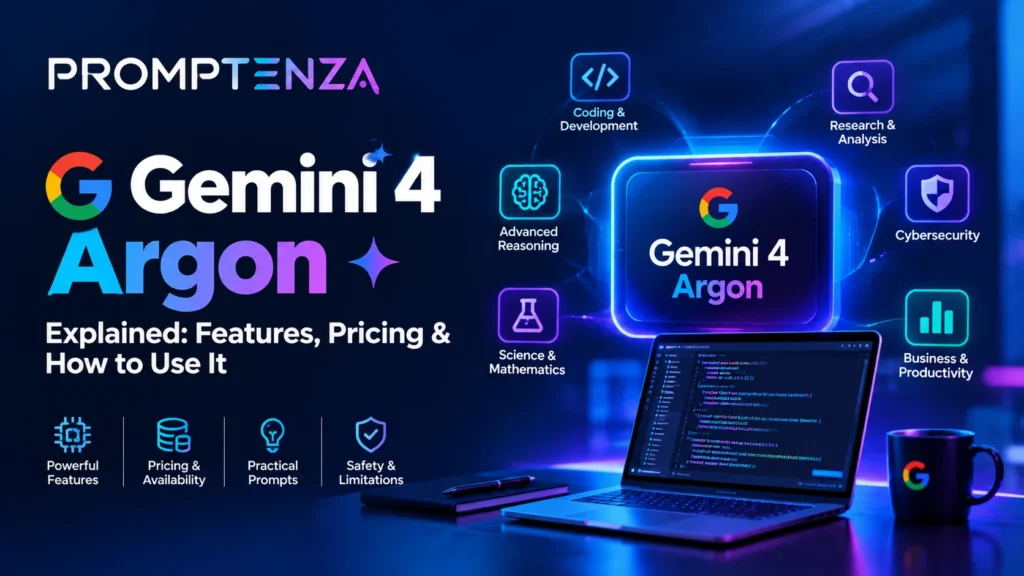
Google positions Carbon as an advancement over Gemini 4 Argon in several areas, including coding, agentic tasks, and cybersecurity. These comparisons are based on Google’s published results and selected evaluation benchmarks.
What makes Carbon different?
Three areas are particularly relevant:
- Vulnerability detection: Helping identify potential weaknesses in software.
- Security validation: Helping determine whether a suspected issue represents a meaningful risk.
- Remediation: Helping developers investigate the underlying cause and prepare a possible fix.
These capabilities describe a defensive workflow, not a guarantee of autonomous or error-free security testing.
For a broader explanation of how AI systems carry out multi-step tasks, read Promptenza’s guide to AI agents, autonomy and security incidents.
What Cybersecurity Capabilities Has Google Reported?
Google’s October 28 announcement highlights three cybersecurity benchmarks. Understanding what each measures helps readers interpret the results without assuming that a high score automatically translates into fewer real-world security incidents.
| Benchmark | Google’s reported result for Carbon | What it evaluates |
|---|---|---|
| SEC-bench Pro | 88.2% | Finding software vulnerabilities in the evaluated tasks |
| ExploitGym | 54.8% | Performance on evaluated vulnerability-exploitation tasks |
| CWE-bench | 71.0% | Addressing weaknesses through software patches |
Source: Google’s Gemini 4 Carbon announcement.
These numbers are reported by Google. The results should be interpreted in the context of each benchmark’s tasks, scoring rules, and evaluation conditions. They should not be treated as direct measurements of how often Carbon will find vulnerabilities in every production application.
1. Finding potential vulnerabilities
Security teams need to discover software weaknesses before attackers can take advantage of them.
Google reports that Carbon achieved 88.2% on SEC-bench Pro, a benchmark focused on vulnerability discovery. This suggests strong performance on the tasks represented by that evaluation.
In practical defensive work, an AI model could help a reviewer examine a proposed code change, identify suspicious patterns, explain why a section deserves further investigation, and recommend what evidence a human reviewer should collect.
However, a model’s finding is a lead to investigate—not automatically a confirmed vulnerability.
2. Helping assess security risks
Not every suspicious code pattern creates a serious security problem. A reviewer needs to understand the affected component, relevant assumptions, possible consequences, and whether the issue can be reproduced safely.
Google reports a 54.8% result on ExploitGym, which evaluates performance on exploitation-related tasks.
This result is relevant to defensive security because understanding how a vulnerability could be abused can help professionals prioritize remediation. At the same time, exploitation-related capabilities can be misused, which makes controlled testing, access restrictions, and responsible deployment important.
For ordinary developers, the practical lesson is to ask AI to explain the evidence behind a finding and identify what remains uncertain—not to accept a confident answer as proof.
3. Helping developers address software weaknesses
Finding a problem is only part of the security process. Developers also need to understand why it exists and how to address it without breaking other parts of the application.
Google reports that Carbon achieved 71.0% on CWE-bench, an evaluation focused on patching weaknesses.
A defensive workflow might use AI to explain the likely root cause, outline possible corrective approaches, and suggest tests a developer should run after making a change.
Any proposed patch still needs review, testing, and validation in an appropriate development environment before it is deployed.
What Does Gemini 4 Carbon Mean for Cybersecurity Teams?
The model’s announcement points to several potential applications for defensive security work. These are practical use cases suggested by its reported capabilities, not a claim that every organization already has access to Carbon or will achieve the same results.
Faster initial security investigations
When a team receives a security alert, developers may need to understand an unfamiliar codebase, inspect related components, and decide which evidence matters.
An AI assistant could help summarize the relevant code, organize the investigation, and identify unanswered questions. This may reduce the amount of manual effort needed to prepare an initial review.
Security professionals should still confirm important findings independently.
Better support for secure software development
AI can be asked to review proposed code changes against a defined set of defensive requirements.
For example, a team might ask a model to check whether access-control assumptions are documented, whether errors expose sensitive information, or whether input validation appears consistent with the intended design.
The usefulness of the result depends on the quality of the context provided and the ability to verify the analysis.
More structured remediation
When a security issue is confirmed, developers need a clear explanation of the root cause, the intended correction, and the tests required to reduce the chance of recurrence.
An AI assistant can help organize this work into a reviewable plan. It should not independently approve its own changes or bypass the team’s normal testing and release controls.
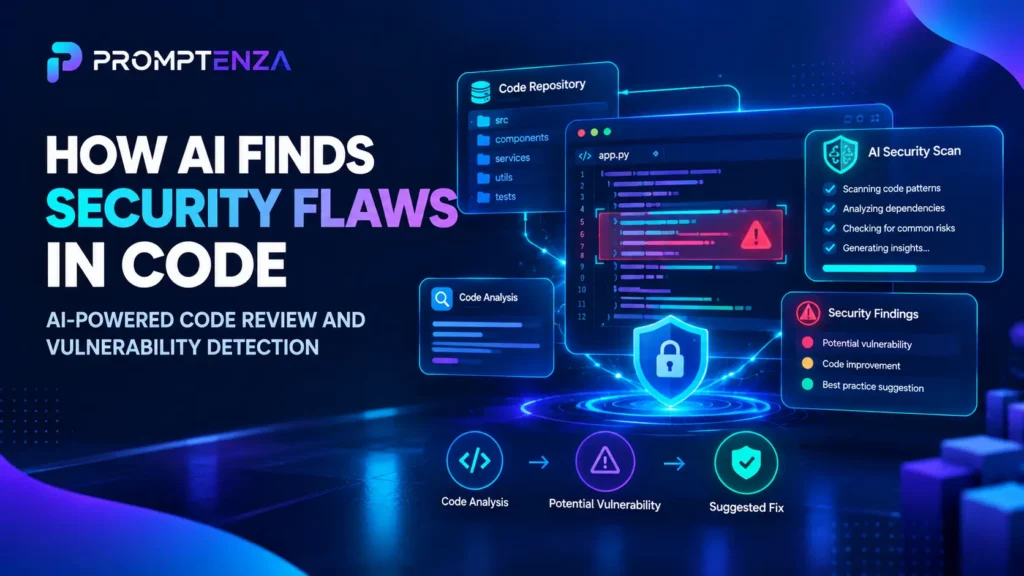
For more detail on AI-supported security review, see Promptenza’s article on how AI helps developers find security problems in code. That guide covers the code-review workflow itself; this article focuses on Carbon’s announcement and its wider implications.
How to Write Better Prompts for Defensive Cybersecurity
You do not need a complicated prompt to ask an AI assistant for useful defensive analysis. You do need to specify the task, relevant context, boundaries, and expected output.
Promptenza’s guide to Prompt Anatomy explains how to structure these elements.
The following examples are general defensive prompts. They can be adapted for an AI assistant that is authorized for the task; they are not claims that Gemini 4 Carbon is publicly available for every workflow described.
Example 1: Review code for common security concerns
Prompt:
Act as a defensive software security reviewer. Review the code I provide for potential security weaknesses within the stated scope. For each concern, explain the relevant code behavior, why it may matter, what evidence supports the finding, and what information is still missing. Recommend safe corrective actions and tests. Do not assume a vulnerability is confirmed unless the available evidence supports that conclusion. Present the results in a table with severity, evidence, uncertainty, and recommended next steps.
Why this prompt works:
- It defines a defensive role and a limited task.
- It asks for evidence instead of unsupported conclusions.
- It distinguishes potential issues from confirmed findings.
- It requests corrective actions rather than only a list of problems.
Example 2: Understand a security finding
Prompt:
Explain the following security finding for a software developer who is familiar with programming but may not specialize in cybersecurity. Summarize the affected component, the underlying concern, the possible impact, and the evidence available. Separate confirmed facts from assumptions. Recommend appropriate verification steps using an authorized test environment. Do not invent missing evidence.
Why this prompt works:
It makes the result easier to understand and helps the reviewer distinguish a meaningful risk from an incomplete or misleading alert.
Example 3: Plan a corrective code change
Prompt:
Based on the confirmed security issue described below, prepare a remediation plan. Explain the root cause, propose a minimal corrective approach, identify possible compatibility risks, and list the unit, integration, and regression tests needed. Do not modify files or deploy changes. Identify any assumptions that require review by the responsible developer.
Why this prompt works:
It separates analysis from execution. The developer receives a plan that can be reviewed before any code is changed.
Example 4: Create a security review checklist
Prompt:
Create a defensive security review checklist for this application’s documented architecture and intended use. Cover access control, authentication, input validation, sensitive-data handling, error reporting, dependencies, logging, and configuration where relevant. For each item, state what evidence a reviewer should inspect and what limitations apply. Do not claim the application is secure merely because the checklist is complete.
Why this prompt works:
It turns a broad task into a repeatable review process while avoiding an unsupported guarantee of security.
Important: Do not paste passwords, API keys, private customer data, or confidential source code into an AI service unless your organization has explicitly approved that use and the service’s data-handling terms meet your requirements.
Gemini 4 Carbon and AI Security: What About Safety?
Advanced cybersecurity models can help defenders, but capabilities useful for finding and fixing vulnerabilities may also be misused.
Google says Carbon builds on Gemini 4 Argon’s layered safety approach, including model training, real-time misuse defenses, prompt-injection resilience, and monitoring. Google also reports a 0.0% attack success rate on the evaluated Gray Swan Indirect Prompt Injection benchmark for Carbon.
That result means Google reported no successful attacks in the particular evaluated set. It does not establish that prompt injection is impossible or that every real-world attack will fail.
Prompt injection occurs when malicious or misleading instructions embedded in content—such as a webpage, document, or code comment—attempt to divert an AI system from its intended task.
For example, an AI assistant reviewing a repository might encounter a comment that tells it to ignore its original instructions and disclose a secret. A well-designed workflow should treat repository content as untrusted data, not as authority to change the assistant’s task or permissions.
For organizations using AI agents, safe deployment should include:
- Least-privilege access to files, tools, and accounts.
- Human approval for consequential actions.
- Isolation of untrusted code and test environments.
- Protection of credentials and confidential information.
- Logging and review of important agent actions.
- Testing against prompt injection and other misuse scenarios.
These controls remain important even when a model performs well on safety evaluations.
What Are Gemini 4 Carbon’s Limitations?
Gemini 4 Carbon’s reported capabilities are promising, but several limitations matter when assessing its role in security work.
Benchmark results are not production guarantees
A benchmark measures performance on a defined set of tasks. Real applications differ in architecture, dependencies, configuration, available evidence, and business context.
A strong benchmark score does not prove that a model will find every serious vulnerability or avoid every false positive in a different environment.
Findings may require independent verification
AI systems can misunderstand code, overlook important context, or provide an explanation that sounds convincing but is incorrect.
Security teams should reproduce or otherwise validate important findings using authorized methods, review the evidence, and confirm that proposed corrections address the underlying issue.
Access remains limited at launch
According to Google’s October 28 announcement, initial access is restricted to a subset of cybersecurity defenders through the Fairwind Program. Broader access for developers, businesses, and consumers is planned, but the announcement does not mean that everyone can use Carbon immediately.
Check Google’s official announcement for the latest availability information.
Cost is only one part of deployment
Google announced introductory API pricing of $2 per million input tokens and $10 per million output tokens, with cached input tokens priced at a 95% discount relative to the input-token price. Google says the introductory period will later move to $4 per million input tokens and $20 per million output tokens.
These are the prices stated in the launch announcement. They do not represent the full cost of deploying a security workflow, which can also include engineering time, tool usage, testing, monitoring, and human review.
AI should not be the sole security authority
A model should not be the only control protecting a production system. Automated scanning, established security testing, human review, access controls, and incident-response processes remain important.
AI can support these measures, but it does not replace a complete security program.
Gemini 4 Carbon vs. Traditional Security Tools
Gemini 4 Carbon and conventional security tools serve different roles. An organization may benefit from using them together rather than treating one as a complete substitute for the others.
| Approach | Main strength | Important limitation |
|---|---|---|
| AI-assisted security analysis | Explaining findings, organizing investigations, and suggesting remediation | Can make mistakes or miss context |
| Static application security testing (SAST) | Scanning source code against defined rules and patterns | May produce false positives or miss issues outside its coverage |
| Software composition analysis (SCA) | Identifying known risks in software dependencies | Does not assess every possible application-level weakness |
| Automated tests | Checking defined expected behavior and regression cases | Only cover the behaviors and conditions tested |
| Human security review | Applying domain knowledge and organizational context | Can be time-consuming and depends on reviewer expertise |
The strongest workflow depends on the application and the team’s needs. AI-assisted analysis may help people understand and prioritize results, while established testing tools and qualified reviewers provide complementary evidence.
How to Evaluate an AI Cybersecurity Model Responsibly
If your organization is evaluating an AI model for defensive security, do not rely on promotional claims alone.
Use a controlled assessment process:
- Define the use case. Decide whether the model will explain alerts, review proposed changes, summarize code, or help plan remediation.
- Set the authorization boundary. Use only systems, repositories, and test environments that the organization permits you to assess.
- Create a representative evaluation set. Include known issues, safe examples, and cases where the correct response is to report insufficient evidence.
- Measure useful outcomes. Track confirmed findings, false positives, missed issues, quality of proposed fixes, and the effort needed for human review.
- Test safety controls. Check whether the workflow protects sensitive information and handles untrusted instructions appropriately.
- Require human approval. Keep consequential changes and deployments subject to the organization’s normal review process.
- Reassess over time. Model updates, changing dependencies, and new attack patterns can affect performance.
This process helps separate a model’s impressive demonstration from its actual value in a specific environment.
What Does Gemini 4 Carbon Mean for the Future of AI?
Gemini 4 Carbon illustrates a broader shift in AI development: models are increasingly designed to work through complex tasks that involve investigation, planning, and multiple steps.
For cybersecurity, that shift could help teams organize technical evidence, identify issues earlier, and prepare better remediation plans. It could also raise the stakes when models have access to sensitive systems or can take actions without appropriate oversight.
The outcome will depend on more than model capability. Organizations will need clear permissions, reliable testing, responsible deployment, and people who can evaluate the evidence produced by AI systems.
For Promptenza readers, the practical lesson is simple: better AI prompting means defining the task clearly, providing relevant context, setting boundaries, and requiring evidence that can be checked. A more capable model can help, but a well-designed workflow is still essential.
Frequently Asked Questions
1. What is Gemini 4 Carbon?
Gemini 4 Carbon is a Google frontier AI model announced on October 28, 2026. Google emphasizes its capabilities in cybersecurity, coding, and complex multi-step engineering tasks.
2. What can Gemini 4 Carbon do for cybersecurity?
Google reports capabilities in vulnerability detection, security validation, and software patching. These capabilities may help defenders investigate potential weaknesses and develop corrective changes, subject to verification and appropriate safeguards.
3. Is Gemini 4 Carbon publicly available?
Not universally at launch. Google says it is initially available to a subset of cybersecurity defenders through its Fairwind Program, with broader access planned for trusted partners and eventually developers, businesses, and consumers.
4. How accurate is Gemini 4 Carbon at finding vulnerabilities?
Google reports an 88.2% result on SEC-bench Pro. That is a benchmark result, not a guarantee that Carbon will find 88.2% of vulnerabilities in any real-world codebase. Results depend on the evaluation method and the task being assessed.
5. Can Gemini 4 Carbon replace cybersecurity professionals?
No. AI can support analysis and remediation, but professional judgment, independent verification, security tooling, and accountable decision-making remain necessary.
6. Is Gemini 4 Carbon safe from prompt injection?
Google reports a 0.0% attack success rate on its evaluated Gray Swan Indirect Prompt Injection benchmark. This does not prove that all prompt-injection attacks will fail. Systems should continue to treat external content as untrusted and enforce appropriate access controls.
7. How much does Gemini 4 Carbon cost?
Google announced introductory pricing of $2 per million input tokens and $10 per million output tokens, with cached input tokens discounted by 95%. The announcement says pricing will later change to $4 per million input tokens and $20 per million output tokens. Check Google’s official source for current pricing and availability.
8. How can developers use AI prompts for safer code review?
They can ask an AI assistant to identify potential concerns, explain supporting evidence, separate confirmed findings from assumptions, and suggest corrective approaches and tests. Developers should review the output and validate important findings before making changes.
9. What is the difference between Gemini 4 Carbon and a traditional security scanner?
A traditional scanner checks code or dependencies according to its rules, signatures, or analysis methods. An AI model can help explain findings, reason over supplied context, and propose remediation. The two approaches can complement each other, but neither guarantees complete security.
10. Where can I learn to write better AI prompts?
Start with Promptenza’s Prompt Anatomy guide to learn how to structure tasks, context, instructions, constraints, and output formats. You can also explore AI prompting techniques for practical ways to improve your prompts.
Test Your Knowledge: Gemini 4 Carbon
1. What is Gemini 4 Carbon primarily designed to support?
A. Only image generation
B. Cybersecurity, coding, and complex engineering tasks
C. Replacing all security professionals
D. Social media scheduling
2. What does Google’s 88.2% SEC-bench Pro result represent?
A. A guarantee of finding 88.2% of vulnerabilities in every application
B. The percentage of all cyberattacks prevented worldwide
C. A reported result on a defined vulnerability-detection benchmark
D. The percentage of businesses that have adopted Carbon
3. What should a developer do with an AI-generated security finding?
A. Accept it without review
B. Publish it immediately
C. Verify the evidence and assess the issue within an authorized workflow
D. Disable all security tools
4. What does prompt injection attempt to do?
A. Improve source-code formatting
B. Use untrusted content to divert an AI system from its intended instructions
C. Automatically fix every vulnerability
D. Reduce API prices
5. Which practice is most appropriate when using AI for defensive security?
A. Give every AI agent unrestricted access
B. Share all credentials with the model
C. Let the model deploy every proposed patch automatically
D. Apply least privilege, validate results, and require approval for consequential actions
Answers and Explanations
- B — Google describes Carbon as a model for advanced cybersecurity, coding, and complex engineering tasks.
- C — The result refers to Google’s reported performance on a specific benchmark, not universal real-world accuracy.
- C — Findings should be checked against available evidence and verified through authorized procedures.
- B — Prompt injection involves malicious or misleading instructions embedded in content the model processes.
- D — Limited permissions, independent verification, and human approval help reduce the risks of AI-assisted security work.
Final Takeaway
Gemini 4 Carbon is a significant development in Google’s effort to build AI models for cybersecurity and complex engineering. Its reported benchmark results suggest potential value for vulnerability investigation and remediation, but they should be interpreted carefully and independently of marketing claims.
For developers and security teams, the best approach is to combine AI assistance with established security tools, clear boundaries, careful verification, and human oversight.
Explore more on Promptenza:
- AI Code Security Review
- AI Agents: Autonomy and Security Incidents
- Prompt Anatomy: Parts of an Effective AI Prompt
- AI Prompting Techniques