Claude Duet Explained: Anthropic’s New AI Agent and What It Means for Users
Artificial intelligence is moving beyond chatbots that wait for questions. Anthropic’s new Claude Duet is designed to act more proactively: it can review connected information, identify tasks that need attention, prepare work, and continue working while users are away.
Announced on October 21, 2026, Claude Duet is a standalone AI agent app aimed at professionals and small-business owners who need help managing work across multiple applications. Anthropic says it can assist with everything from scheduling and email follow-ups to building dashboards, preparing forecasts, and developing web apps.
But what makes Claude Duet different from a regular chatbot? How does it work, what can it do, and what should users know about privacy, availability, and reliability?
Here is what the announcement means—and how to prepare for the growing shift toward AI agents.
Quick Answer: What Is Claude Duet?
Claude Duet is Anthropic’s standalone AI agent app designed to help users manage and complete work proactively. Rather than waiting for every instruction, it can review connected apps, prepare daily briefings, identify items that need attention, and carry out assigned tasks in the background.
Anthropic opened Claude Duet as a research preview on October 21, 2026. Access initially requires joining a waitlist and is available to eligible Claude Pro and Max subscribers in the United States. It is available as a standalone app on iOS and Android and through Claude’s website.
What Did Anthropic Announce?
Anthropic introduced Claude Duet as a new way to work with Claude. The key difference is that the product is designed to take more initiative instead of relying entirely on users to start every interaction.
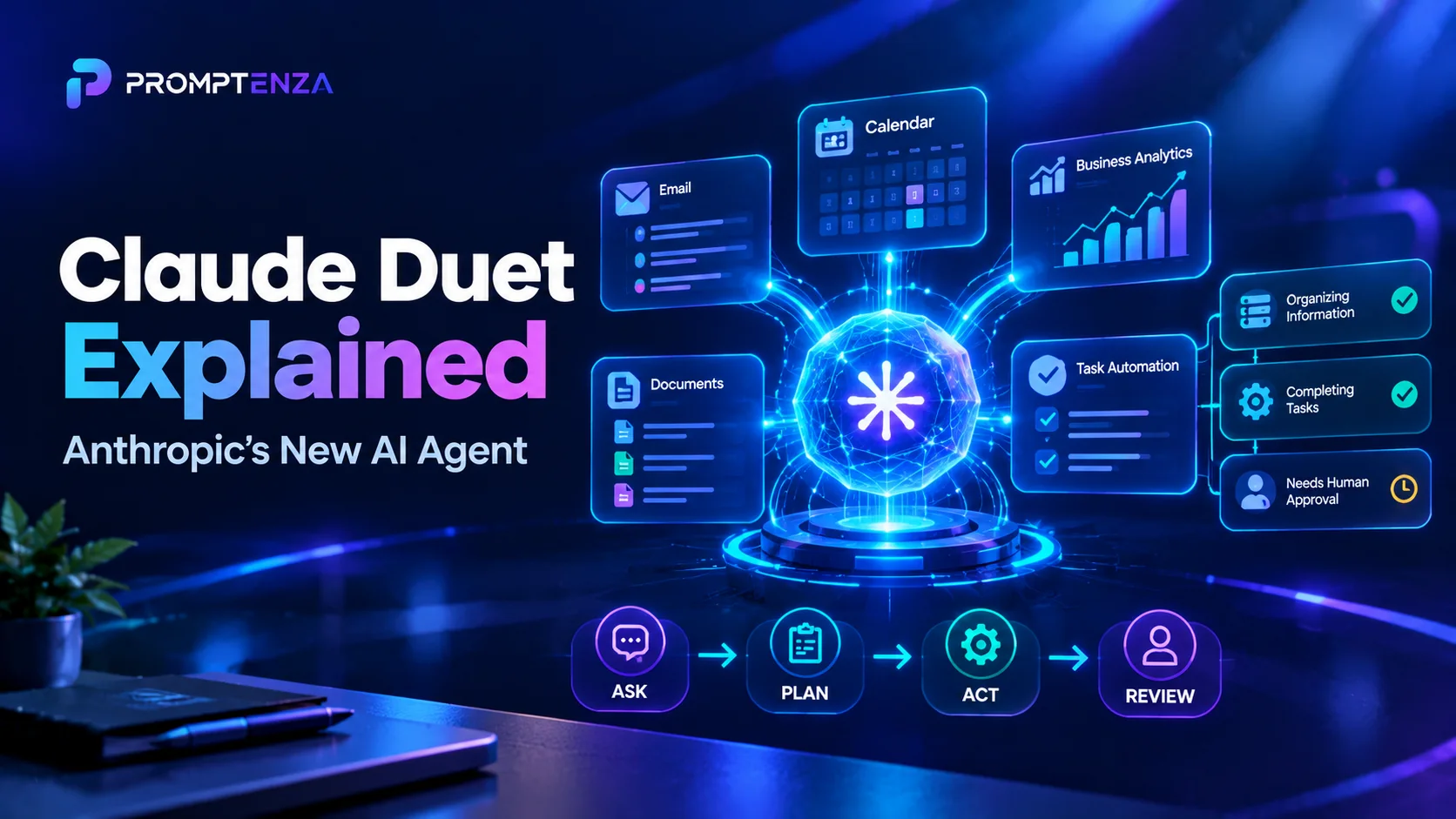
According to Anthropic, Claude Duet can:
- Prepare a morning briefing based on information from connected applications.
- Monitor connected apps periodically and notify users when something needs attention.
- Draft email replies and follow-up messages.
- Help organize meetings and other administrative tasks.
- Work on more complex projects, including dashboards, financial forecasts, prototypes, and web apps.
- Continue assigned work in the background while the user steps away.
- Ask for approval before carrying out important actions such as sending messages, making payments, signing documents, or deleting information.
These capabilities are described in Anthropic’s announcement. They should be understood as advertised product functionality, not a guarantee that every task will be completed correctly.
How Is Claude Duet Different From a Regular Chatbot?
A conventional chatbot generally responds when you send it a question or instruction. An AI agent can combine reasoning with tools, connected information, and multiple steps to pursue a goal.
Claude Duet is designed around this more proactive approach.
| Feature | Traditional chatbot workflow | Claude Duet’s intended workflow |
|---|---|---|
| Starting work | You usually begin by asking a question | It can proactively surface information that needs attention |
| Managing information | You provide the context for each request | It can use information from connected apps |
| Completing tasks | It generates answers, plans, or drafts | It can work through multistep tasks using connected tools |
| Background activity | Usually focused on the active conversation | It can continue assigned work while you step away |
| Important actions | Often requires you to take the next step yourself | It requests approval for specified consequential actions |
| Reliability | Answers can contain mistakes | Agent actions can also be mistaken and need review |
The distinction is not that chatbots are incapable of helping with complex work. It is that AI agents are designed to connect several steps into a workflow and, where permitted, use tools to move that workflow forward.
For a more detailed introduction, see Promptenza’s AI agents and autonomy guide.
How Does Claude Duet Work?
Anthropic describes several features that make Claude Duet different from an ordinary chat experience.
1. It brings important information to you
Claude Duet can prepare a short morning briefing using connected applications. During the day, it checks those applications periodically and can alert you when it identifies something requiring attention.
Anthropic says these checks happen every few hours rather than continuously, partly to manage usage. This means users should not assume the agent detects every important change immediately.
2. It can work across connected apps
Claude Duet integrates with tools through the Claude Marketplace. Anthropic says the marketplace includes more than 6,000 connectors and plugins.
Examples in the announcement include using Gmail and Slack to find messages, QuickBooks or Stripe to identify unpaid invoices, and Canva to help prepare a social campaign. The exact workflow depends on the available integrations and permissions.
3. It can continue working in the background
Anthropic says Claude Duet has its own virtual machine and browser, allowing it to continue assigned work without requiring your personal computer or phone to remain on.
You can give it a task, let it work through the steps, and receive a notification when the task is complete or requires your review. Larger projects may consume more of your plan’s usage allowance than a normal conversation.
4. It keeps users involved in important decisions
Claude Duet is designed to prepare work independently but ask for approval before specified consequential actions.
For example, it may prepare a message without immediately sending it. It can then show you what it intends to do and wait for your approval.
This approval process is important, but it does not eliminate every risk. Users still need to check the content, confirm recipients, review financial details, and understand what permissions they have granted.
What Could People Use Claude Duet For?
Claude Duet is intended to support professional and small-business workflows. Here are practical examples of how agent-style tools could be used.
| Task | Example workflow | What a person should check |
|---|---|---|
| Email management | Find unanswered customer emails and draft replies | Accuracy, tone, recipients, and confidential information |
| Meeting preparation | Gather relevant notes and prepare a briefing | Whether the information is current and complete |
| Business administration | Identify unpaid invoices and draft reminders | Invoice amounts, customer details, and payment records |
| Content planning | Organize a product launch into a proposed social campaign | Facts, originality, brand voice, and publication dates |
| Data analysis | Prepare a dashboard or sales forecast | Source data, calculations, assumptions, and conclusions |
| Web development | Help prototype a web application | Security, functionality, accessibility, and testing |
These are illustrative workflows based on the kinds of tasks Anthropic describes. They are not a guarantee of performance, and some may require compatible integrations, setup, or additional user input.
Example: Using an AI agent to organize a content workflow
Imagine that you manage a website and have several articles to publish.
You could ask an AI agent to review your editorial plan, identify incomplete tasks, prepare a draft publishing schedule, and suggest internal links to relevant articles.
The agent could then present a proposed plan for your review. You would still verify the facts, inspect the links, edit the content, and approve any publication actions.
This is especially relevant to website owners learning how to combine AI with editorial judgment. Explore Promptenza’s AI prompt examples and AI prompt templates for ways to structure repeatable workflows.
How to Write Better Instructions for AI Agents
AI agents can perform multiple steps, so vague instructions can lead to wasted effort or incorrect actions. Good prompts should define the goal, available context, boundaries, expected output, and approval requirements.
Use this framework when writing instructions for an AI agent.
Goal + Context + Steps + Constraints + Output + Approval
Copyable AI agent prompt template
Goal: Help me complete [specific task].
Context: Use the following information and approved connected resources: [describe the context].
Steps: First, review the available information. Next, identify what needs to be done. Then prepare the requested work and check it for errors.
Constraints: Do not invent facts, make assumptions without identifying them, or access unrelated information. Do not take actions outside the permissions I have granted.
Output: Present the completed work, important findings, unresolved questions, and anything that needs my attention.
Approval: Before sending messages, publishing content, spending money, deleting information, or making other consequential changes, show me the proposed action and wait for my explicit approval.
This template is a general prompting recommendation, not an official Claude Duet command format. Adapt it to the capabilities and controls of whichever agent you use.
Example 1: Research and summarize
Weak instruction:
Research AI agents.
Better instruction:
Research the latest developments in AI agents using reliable, recent sources. Summarize the three most important developments, include publication dates and source links, distinguish confirmed announcements from predictions, and list any claims that need further verification. Do not publish anything or contact anyone.
Example 2: Organize a content calendar
Weak instruction:
Plan my website content.
Better instruction:
Review the editorial topics and existing articles I provide. Create a four-week content calendar with one main topic per article, its intended audience, search intent, a proposed headline, and relevant internal links. Flag possible topic overlap and explain your recommendations. Do not invent traffic figures or claim that a keyword is trending without evidence. Present the plan for approval before making changes.
Example 3: Prepare customer follow-ups
Weak instruction:
Reply to my customers.
Better instruction:
Review the customer messages available through the authorized connection. Group them by topic and urgency, then draft a reply for each message using a professional, helpful tone. Do not send any replies. Flag messages involving sensitive information, financial disputes, or unclear requests so I can review them first.
The principle is simple: give an agent a clear goal, but also tell it what it must not do.
For more guidance, read Promptenza’s Prompt Anatomy guide and guide to improving AI prompts.
Is Claude Duet Safe to Use?
Safety is one of the most important questions surrounding AI agents because they may access connected information and perform actions rather than simply generate text.
Anthropic says Claude Duet includes safeguards for credentials, sensitive information, consequential actions, and malicious instructions hidden in content. It also says the system has undergone adversarial testing and external penetration testing. These are statements from the company about its own product and security work, not independent proof that the system is risk-free.
Users should consider the following risks before connecting an AI agent to important accounts.
Privacy and account permissions
Only connect applications you genuinely need for the task. Review the permissions requested, consider the sensitivity of the information involved, and disconnect access when it is no longer necessary.
Incorrect decisions
An agent may misunderstand a message, misjudge urgency, or produce an inaccurate result. Anthropic acknowledges that Claude Duet may misread a thread or miscalibrate what is urgent during the research preview.
Prompt injection
Prompt injection occurs when malicious or misleading instructions are embedded in content an AI system reads, such as a document, email, or webpage. An agent might encounter these instructions while carrying out an otherwise legitimate task.
Do not assume that an agent will correctly identify every malicious instruction. Avoid granting unnecessary permissions, and review sensitive actions carefully.
Unintended actions
Before approving an action, check the exact content, destination, amount, and consequences. Approval prompts are useful safeguards, but they are not a substitute for careful review.
Usage and cost limits
Background activity and complex tasks can use more of an AI plan’s allowance than a short chat. Understand the applicable usage limits before assigning large or recurring jobs.
Practical rule: Begin with low-risk tasks, use the smallest necessary permissions, and keep human approval in place for consequential decisions.
Claude Duet Availability: Who Can Use It?
As of October 23, 2026, Anthropic says Claude Duet is available through a waitlisted research preview for Claude Pro and Max subscribers in the United States. It is offered as a standalone app on iOS and Android and through Claude’s website. The preview shares usage limits with the rest of Claude.
This is an early release, not a statement of universal availability. Users in other countries, including Ghana, should check the official announcement and access page for current eligibility rather than assume that the preview is available to them.
For the latest details, visit Anthropic’s official Claude Duet announcement.
Claude Duet and the Wider AI Agent Competition
Claude Duet arrives as major AI companies compete to build assistants that can do more than answer questions.
The broader direction is toward AI products that can work with connected tools, coordinate multistep tasks, and take action within defined permissions. Reuters reported that Anthropic’s launch comes amid competition with companies including OpenAI and Meta to develop more autonomous AI agents.
For users, the most useful question is not simply which company has launched an agent. It is whether the tool can complete a relevant task reliably, integrate with the apps they use, protect their information, and give them enough control over its actions.
An agent that saves time on a repetitive workflow may be useful. An agent that requires constant correction or has excessive access may create more problems than it solves.
That is why evaluating practical performance matters more than relying on launch-day promises.
What Claude Duet Means for Prompt Engineering
As AI agents become more capable, prompting is likely to involve more than asking a chatbot for a well-written answer.
Users will increasingly need to define goals, establish constraints, specify acceptable sources, set boundaries on tool use, and decide which actions require approval.
Three prompting skills are especially important:
- Goal definition: State the outcome you need, not just a broad topic.
- Constraint setting: Define limits, permitted resources, and prohibited actions.
- Verification: Ask the agent to explain what it completed, identify uncertainty, and flag work that needs human review.
These skills are useful across many AI systems, not only Claude Duet.
You can build them with Promptenza’s guides to prompt engineering, AI prompting techniques, and AI prompt constraints.
Frequently Asked Questions
What is Claude Duet?
Claude Duet is Anthropic’s standalone AI agent app, designed to proactively help professionals and small-business owners manage information and complete work across connected applications.
When was Claude Duet announced?
Anthropic announced Claude Duet on October 21, 2026, initially opening it as a research preview. <Cite refs={[“turn485243search0”]}/>
Is Claude Duet available to everyone?
No. As of October 23, 2026, the research preview is waitlisted and initially available to eligible Claude Pro and Max subscribers in the United States. Check Anthropic’s official announcement for updates.
Can Claude Duet work while I am away?
Anthropic says it can continue assigned work in the background using its own virtual machine and browser. Users are notified when work is completed or when their attention is required. Performance depends on the task and the available integrations.
Can Claude Duet send emails or make payments without approval?
Anthropic says it requires approval before specified consequential actions, including sending messages and making payments. Users should review the proposed action and not assume every workflow is fully automatic.
Is Claude Duet free?
The announced research preview is included with eligible Claude Pro and Max plans and shares their usage limits. It should not be described as a free standalone product based on the current announcement.
Can people in Ghana use Claude Duet?
The initial research preview is described as being for US Pro and Max subscribers. Availability for Ghanaian users is not confirmed by that announcement, so check the official access page for the latest eligibility details.
Will AI agents replace chatbots?
Not necessarily. Chatbots remain useful for questions, explanations, brainstorming, and writing. AI agents add a focus on coordinating tools and carrying out multistep tasks. Both approaches can coexist, and neither guarantees accurate results.
Test Your AI Agent Knowledge
1. What is the main difference between a traditional chatbot and an AI agent?
A. An AI agent always provides correct answers.
B. An AI agent can use tools and coordinate steps toward a goal.
C. A chatbot cannot write text.
D. An AI agent never needs human supervision.
2. Why should you specify constraints in an AI agent prompt?
A. To make the prompt longer.
B. To prevent the agent from asking questions.
C. To define boundaries, permissions, and actions it should avoid.
D. To guarantee that the task will succeed.
3. What should you do before approving an agent’s consequential action?
A. Assume the system has already checked everything.
B. Review the proposed action and its possible consequences.
C. Give it access to every account.
D. Ignore the approval request.
4. What is Claude Duet’s initial availability status?
A. A universally available free product.
B. A waitlisted research preview for eligible US Pro and Max subscribers.
C. A desktop-only product for developers.
D. A product available only to large enterprises.
Answers and explanations
- B — Agents can combine tools and multiple steps to pursue a task.
- C — Constraints clarify what the agent is allowed to do and what it must avoid.
- B — Human review helps catch errors and unintended consequences.
- B — Anthropic initially announced a waitlisted research preview for eligible US Pro and Max subscribers.
Final Verdict: Is Claude Duet Worth Watching?
Claude Duet is worth watching because it illustrates a significant direction in AI development: moving from systems that primarily generate responses toward assistants that can proactively organize information and carry out multistep work.
Its practical value will depend on reliability, supported integrations, privacy protections, user control, and how well it handles real tasks outside a demonstration.
For anyone learning to use AI effectively, the takeaway is clear: stronger prompting is not only about getting better answers. It is also about defining goals, limiting permissions, checking results, and deciding when an AI system should stop and ask for human approval.
Follow Promptenza’s AI News section for more developments in AI tools, agents, and practical prompting.