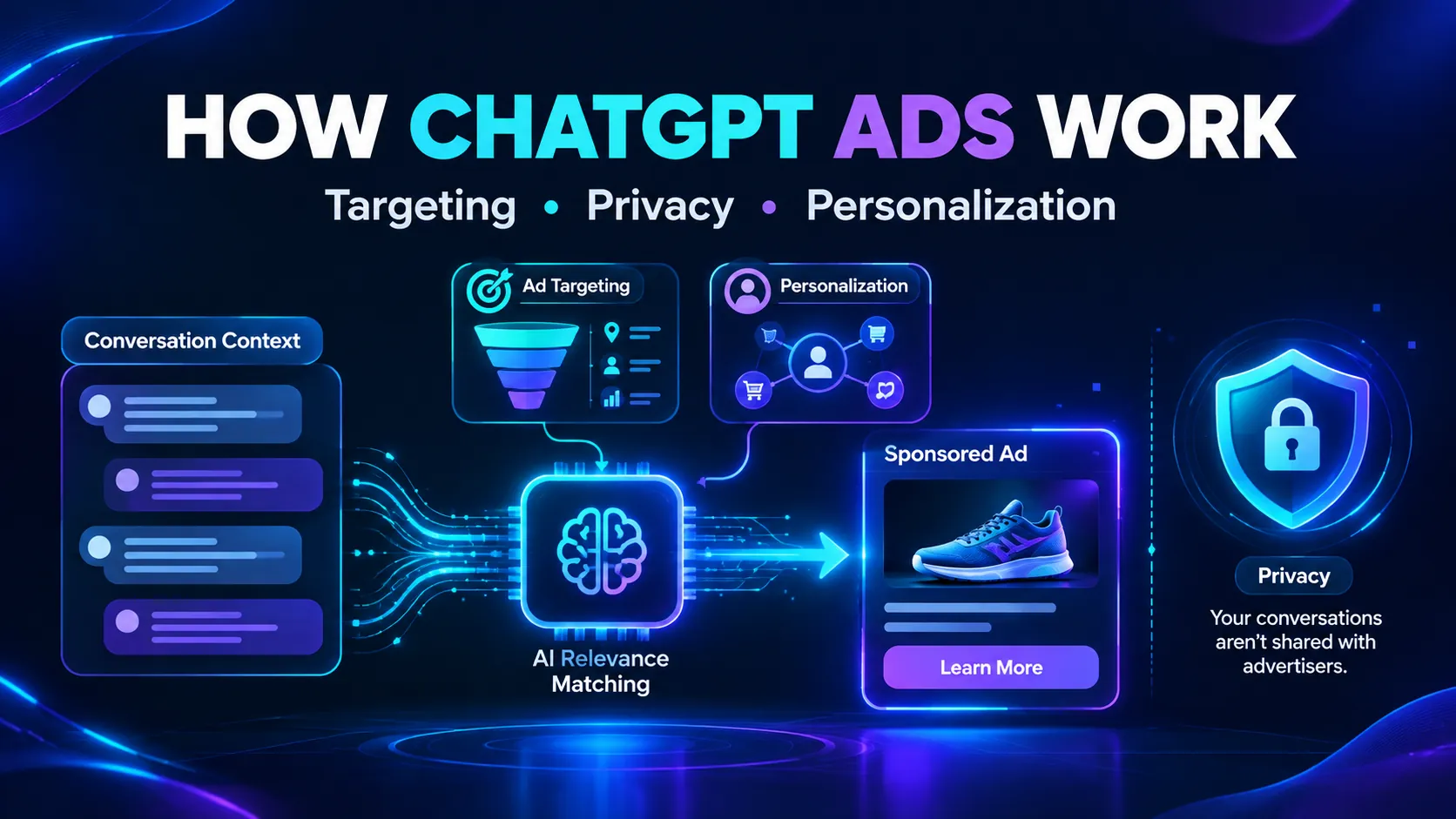
ChatGPT ads are selected using signals such as the context and intent of the current conversation, information supplied by the advertiser, and—when ad personalization is enabled—selected signals from a user’s broader ChatGPT experience.
OpenAI says advertisers do not receive users’ conversations, chat history, memories, or personal details, and ads are kept separate from ChatGPT’s answers. Advertising is not supposed to influence the answers ChatGPT provides.
The important distinction is that ChatGPT can use information within its system to determine which ad may be relevant without giving that information to the advertiser.
How Do ChatGPT Ads Work?
ChatGPT advertising is different from traditional keyword-based advertising.
Instead of simply matching an advertisement to a search query, OpenAI’s current advertising system can evaluate the conversation’s context and intent when determining which eligible advertisement is relevant.
For example, imagine someone is using ChatGPT to research options for furnishing a home.
The conversation could reveal that the person is:
- comparing products
- looking for a particular type of item
- working within certain constraints
- trying to decide between alternatives
An eligible advertisement may be selected because it is relevant to that conversational context.
OpenAI describes this as an AI-native advertising environment in which people can discover products and services while they explore options and make decisions.
Related on Promptenza
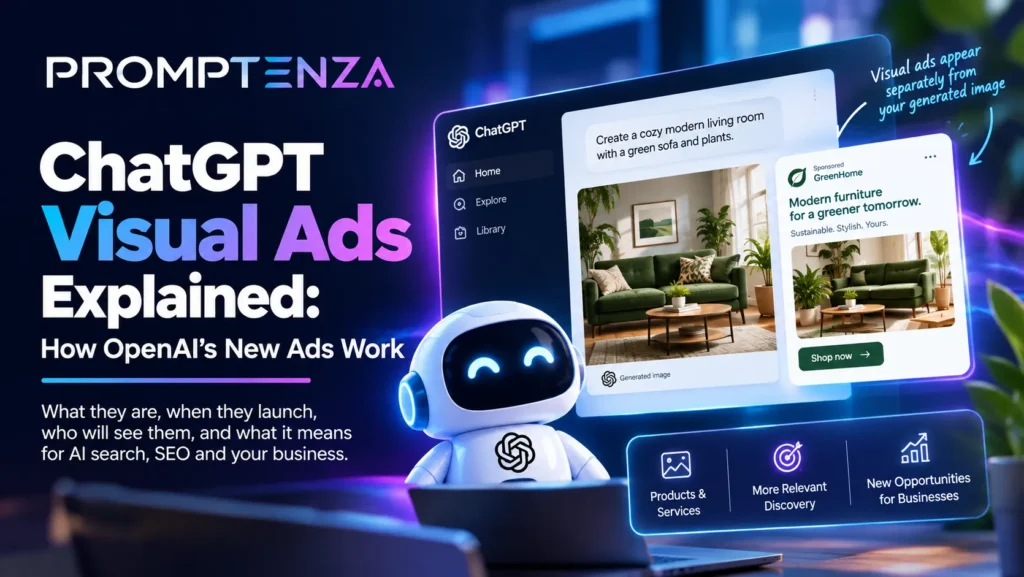
If you’re new to the development, start with our guide to ChatGPT Visual Ads Explained: How OpenAI’s New Ads Work.
That article focuses on the new visual advertising format, while this guide explains the underlying targeting and personalization system.
How ChatGPT Selects an Ad
The ad-selection process involves multiple signals rather than one simple keyword match.
According to OpenAI’s current documentation, the system can consider:
- The current conversation
- The intent of the conversation
- The advertiser’s ad title and copy
- The advertiser’s landing page
- Advertiser-provided context hints
- Selected signals from the user’s broader ChatGPT experience when personalization is enabled
OpenAI says these signals are used to help determine which advertisements are expected to be relevant and useful.
This is an important difference from conventional search advertising.
Traditional search advertising
A simplified model looks like:
Search query → keyword/ad matching → advertisement
Conversational advertising
A simplified model is closer to:
Conversation context + intent + eligible ads + personalization signals → relevance assessment → advertisement
The exact internal ranking system is proprietary, so it would be inaccurate to claim that ChatGPT uses a single fixed formula for determining which advertisement wins.
Does ChatGPT Read Your Conversation to Show Ads?
ChatGPT can use the context of the current conversation as a signal for ad relevance.
That does not mean advertisers receive the conversation.
OpenAI explicitly says that conversations remain private from advertisers and that advertisers do not receive users’ chats, chat history, memories, or personal details.
This distinction is crucial:
The advertising system can use information internally to determine relevance without giving that information to the advertiser.
For example, if a conversation indicates that someone is researching a particular type of product, the system may determine that an eligible advertisement is relevant.
The advertiser doesn’t receive the user’s conversation as a targeting report.
What Information Can Be Used for ChatGPT Ad Targeting?
The signals available to the advertising system depend partly on the user’s settings.
OpenAI’s current documentation says that advertising relevance can involve information such as:
Current conversation context
The topic and intent of the current conversation can help determine whether an advertisement is relevant.
General contextual information
OpenAI says basic context such as general location or language can be considered for ad delivery.
Ad interactions
When personalization is enabled, interactions with advertisements can contribute to future ad relevance—for example, whether a user engages with or dismisses an ad.
Broader ChatGPT experience
When ads personalization is enabled, selected signals from a user’s broader ChatGPT experience can be used to make advertisements more relevant.
OpenAI’s documentation indicates that this can include aspects of previous chats and memory, subject to the applicable settings and controls.
What Is ChatGPT Ads Personalization?
ChatGPT ad personalization allows OpenAI to use selected signals from a user’s broader ChatGPT experience to help determine which advertisements may be relevant.
This goes beyond simply looking at the conversation currently on screen.
The important point is that personalization does not mean advertisers receive your personal ChatGPT data.
OpenAI says the relevant signals remain within ChatGPT and aren’t shared with advertisers as individual user data.
This creates two separate layers:
Layer 1: Relevance
ChatGPT determines which ads may be relevant to the user.
Layer 2: Advertiser information
The advertiser receives campaign-performance information rather than access to the user’s private conversations.
That distinction is central to understanding the system.
Can Advertisers See Your ChatGPT Conversations?
No.
According to OpenAI, advertisers do not receive:
- Your ChatGPT conversations
- Your chat history
- Your memories
- Your name
- Your email address
- Your precise location
- Your IP address
- Sensitive personal information
OpenAI says advertisers instead receive aggregated information about advertising performance, such as views and clicks.
So if ChatGPT determines that an advertisement is relevant based on a conversation, the advertiser doesn’t simply get a message saying:
“This person talked about X, so show them your product.”
The matching happens within the advertising system. Dive deeper here[Can Advertisers See Your ChatGPT Conversations? Privacy Explained]
Does OpenAI Sell ChatGPT Conversations to Advertisers?
OpenAI says it does not sell user data to advertisers.
Its advertising principles state that conversations are kept private from advertisers and that customer data isn’t sold to advertisers.
This is one of the most important distinctions between using data to determine ad relevance and selling user data to advertisers.
They are not the same thing.
Do ChatGPT Ads Change the Answers You Receive?
According to OpenAI, no.
OpenAI’s advertising principles specifically state that advertisements do not influence the answers ChatGPT provides. Ads are designed to remain separate from the AI-generated answer.
That means there are effectively two separate experiences:
ChatGPT answer
→ generated based on the user’s request and the model’s response system
Advertisement
→ selected by the advertising system based on advertising relevance signals
This separation is important because users need to be able to distinguish between an AI response and sponsored content.
Where Do ChatGPT Ads Appear?
OpenAI says ads appear below ChatGPT responses and are clearly labeled.
Current ad units can include:
- Advertiser name
- Advertiser favicon
- Headline
- Description
- Landing page
- Creative image
OpenAI has also introduced a new visual ad format, which is the subject of our related guide:
ChatGPT Visual Ads Explained: How OpenAI’s New Ads Work
The newer format is designed to make products and services more visually discoverable within ChatGPT.
Who Can See ChatGPT Ads?
OpenAI currently says ads may appear for eligible users on the Free and Go plans.
Ads are not shown to users on:
- ChatGPT Plus
- ChatGPT Pro
- ChatGPT Business
- ChatGPT Enterprise
- ChatGPT Edu
OpenAI also says advertisements are not shown to accounts identified as belonging to users under 18.
Availability can vary as OpenAI continues expanding its advertising platform internationally.
How Advertisers Target People on ChatGPT
ChatGPT advertising is designed around conversational intent, rather than traditional keyword targeting alone.
An advertiser can provide context hints describing conversations, topics, or keywords where its product could be relevant.
However, OpenAI says these aren’t exact-match keywords and don’t guarantee that an ad will appear in a particular conversation.
That difference is significant.
Google-style targeting
A marketer might think:
“I want my ad to appear when someone searches this keyword.”
ChatGPT-style conversational targeting
The marketer can instead describe the kinds of conversations where its product is relevant.
The system then evaluates eligible ads against the broader context.
This is one reason AI advertising could become very different from conventional search advertising.
How Are ChatGPT Ads Ranked?
When multiple eligible advertisements could match a conversation, OpenAI says the system considers factors including relevance and advertiser bids.
Its current advertising documentation says ChatGPT uses a relevance-weighted, second-price auction when selecting among eligible ads.
That means simply paying more isn’t the whole story.
An advertisement still needs to be eligible and relevant to the context.
For advertisers, this makes the quality of the ad’s message, landing page, targeting context and relevance important parts of the campaign.
Does ChatGPT Use Your Past Chats for Ads?
It can, when ads personalization is enabled.
OpenAI’s current documentation says selected signals from a user’s broader ChatGPT experience can be used for ad personalization.
These may include:
- Current conversations
- Previous chats
- Memories
- Interactions with advertisements
The exact signals available depend on the user’s settings and OpenAI’s current advertising controls.
This is why it’s important to distinguish between contextual advertising and personalized advertising.
Contextual advertising
The advertisement is selected based primarily on what you’re discussing now.
Personalized advertising
Selected information from your broader ChatGPT experience can also help determine which advertisements may be relevant.
Can You Control ChatGPT Ad Personalization?
OpenAI says users have control over their ad personalization settings.
Its advertising principles state that people can turn off personalization and clear data used for ads.
This gives users an important choice:
Personalized ads ON
→ potentially more relevant advertising based on eligible signals from the broader ChatGPT experience.
Personalized ads OFF
→ less use of broader personal signals for advertising relevance.
The exact controls and interface can change as OpenAI continues developing the advertising system, so users should check ChatGPT’s current privacy and ad settings rather than relying on screenshots from older articles.
What Do Advertisers Actually See?
Advertisers can access campaign-performance information through OpenAI’s advertising tools.
Current reporting can include metrics such as:
- Impressions
- Clicks
- Spend
- Click-through rate
- Average CPC
- Average CPM
- Conversions
OpenAI says advertisers receive aggregated reporting rather than users’ private conversations.
This means an advertiser can learn whether its campaign is performing without being given the individual conversation that caused a particular ad to appear.
Why ChatGPT Ads Are Different From Google Ads
The biggest difference is context.
Google Search advertising is fundamentally built around search behavior and keyword/query intent.
ChatGPT is conversational.
A user might spend several messages explaining:
- what they’re trying to accomplish
- their preferences
- their budget
- what they’ve already considered
- what alternatives they’re comparing
- what problem they’re trying to solve
That creates a much richer context for advertising.
OpenAI is explicitly positioning ChatGPT Ads around moments when people are exploring, comparing and making decisions.
This could make AI advertising one of the most significant changes in digital advertising over the coming years.
Why ChatGPT Ads Matter for SEO and AEO
The rise of ChatGPT advertising is important even if you aren’t an advertiser.
It signals that AI platforms are becoming complete discovery environments.
Users can increasingly:
- Ask a question.
- Research options.
- Compare products.
- Evaluate alternatives.
- Make a decision.
- Discover businesses or products.
All inside a conversational interface.
That changes the environment in which websites compete for visibility.
Traditional SEO remains important, but businesses also need to understand AI visibility and Answer Engine Optimization (AEO).
For Promptenza, this is particularly important because the same conversational systems that answer questions are increasingly becoming places where users discover products, services and brands.
The Bigger Picture: ChatGPT Is Becoming an Advertising Platform
ChatGPT Ads are no longer just an experiment.
OpenAI says the advertising platform has expanded internationally, with advertisers using the system across more than 60 countries as of September 2026.
OpenAI has also been adding:
- New ad formats
- Self-service Ads Manager
- CPC bidding
- Conversion measurement
- AI-powered advertising tools
- Sponsored Agents
- Ecommerce integrations
- CRM integrations
- More measurement capabilities
The direction is clear: OpenAI is building an advertising ecosystem around conversational AI rather than simply inserting traditional banner advertising into ChatGPT.
ChatGPT Ads: What Users Should Remember
Here’s the simplest way to understand the system:
| Question | Answer |
|---|---|
| Does ChatGPT use conversation context for ads? | Yes |
| Can personalization use broader ChatGPT signals? | Yes, when enabled |
| Can advertisers read your chats? | No |
| Does OpenAI say it sells conversations to advertisers? | No |
| Do ads influence ChatGPT’s answers? | OpenAI says no |
| Are ads clearly labeled? | Yes |
| Are ads separate from ChatGPT answers? | Yes |
| Can users control ad personalization? | Yes |
| Are paid plans ad-free? | Eligible paid plans are ad-free |
| Are ads shown to accounts identified as under 18? | No |
Frequently Asked Questions
How does ChatGPT decide which ad to show?
ChatGPT evaluates eligible advertisements using signals including the current conversation’s context and intent, advertiser-provided information, the ad and landing page, and—when personalization is enabled—selected signals from the user’s broader ChatGPT experience.
Does ChatGPT use my conversations for advertising?
The advertising system can use the context of your conversation to determine ad relevance. OpenAI says your conversations are not shared with advertisers.
Can advertisers see my ChatGPT history?
No. OpenAI says advertisers don’t receive users’ chats, chat history, memories or personal details.
Are ChatGPT ads personalized?
They can be. When ad personalization is enabled, selected signals from a user’s broader ChatGPT experience may help determine which ads are relevant.
Do ChatGPT ads affect AI answers?
OpenAI says advertising does not influence the answers ChatGPT provides. Ads are kept separate from ChatGPT’s responses.
Who sees ads in ChatGPT?
OpenAI currently says ads may appear for eligible Free and Go users. Plus, Pro, Business, Enterprise and Edu accounts do not have ads. Accounts identified as belonging to users under 18 are also excluded.
Can advertisers target specific conversations?
Advertisers can provide context hints describing conversations, topics or keywords where their products may be relevant. OpenAI says these hints guide matching but aren’t exact-match keywords and don’t guarantee delivery in a particular conversation.
Final Takeaway
ChatGPT Ads are built around conversational relevance rather than traditional keyword matching alone.
OpenAI can use the context and intent of a conversation to determine which advertisements may be relevant. When personalization is enabled, selected signals from a user’s broader ChatGPT experience can also contribute to that process.
At the same time, OpenAI says advertisers don’t receive users’ private conversations or personal ChatGPT information, and advertising does not influence ChatGPT’s answers.
The bigger development is that ChatGPT is evolving from an AI assistant into a discovery, comparison and decision-making environment with its own advertising infrastructure.
For users, that makes understanding privacy and personalization increasingly important.
For businesses, it creates an entirely new way to reach people.
And for SEO and AEO, it signals that visibility inside AI conversations is becoming a major part of the future of search.
Related Promptenza ChatGPT Guides
- ChatGPT Visual Ads Explained: How OpenAI’s New Ads Work
- 100+ ChatGPT Prompts for Research: Research Smarter & Faster
- 10 Things ChatGPT Can Do That Most People Never Try (2026)
- 15 ChatGPT Tricks That Feel Like Hidden Features
- 100+ ChatGPT Prompts: Best Prompts for Work, Research & More