Last Updated September 9, 2026
Prompt engineering is the practice of designing, testing, and refining instructions given to an AI model to produce a more useful, accurate, relevant, and consistent result.
You can ask an AI tool the exact same question twice and get dramatically different results. The difference often comes down to how you write the instruction.
That is where prompt engineering comes in.
Prompt engineering is the practice of designing, testing, and refining instructions given to an AI model so it produces a more useful, accurate, relevant, and consistent result.
You don’t need to be a programmer to learn it. If you use AI for writing, studying, research, business, coding, content creation, or everyday tasks, understanding prompt engineering can help you communicate your goals more clearly.
In this guide, you’ll learn what prompt engineering means, how it works, why it matters, the main techniques to know, practical examples, common mistakes, and a simple framework you can use to create better AI prompts.
What Is Prompt Engineering?
Prompt engineering is the process of deliberately designing and improving the instructions you give an AI model to achieve a particular outcome.
A prompt can be as simple as:
“Summarize this article.”
Or it can be much more specific:
Prompt:
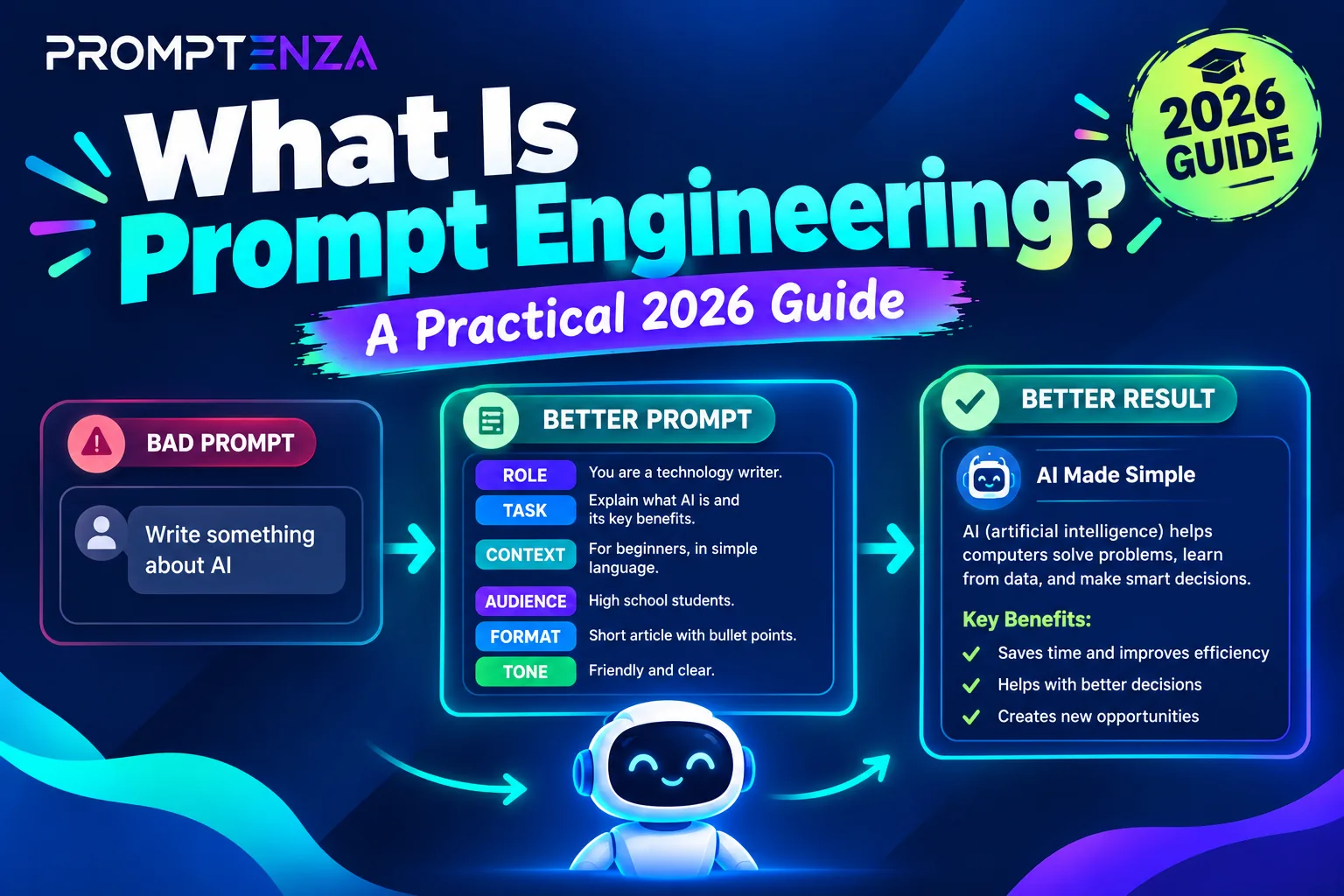
Summarize the article below for a busy marketing manager. Identify the five most important insights, explain why each matters, and present the result as a numbered list. Keep each explanation under 50 words.
The second prompt gives the AI more information about the task, audience, output, and limitations.
That doesn’t mean longer prompts are always better.
The goal of prompt engineering is not to write the longest possible prompt. The goal is to provide the right information at the right level of detail.
Google Cloud describes prompt engineering as designing and optimizing prompts to guide AI models toward desired responses, while OpenAI similarly defines it as designing and optimizing inputs to effectively guide model responses.
Prompt Engineering in Simple Terms
Think of an AI model like a highly capable assistant.
If you say:
“Write something about marketing.”
The assistant has to make many decisions for you.
What type of marketing?
Who is the audience?
What industry?
What format?
How long?
What objective?
Now compare that with:
Prompt:
Act as a digital marketing strategist. Create 10 marketing ideas for a small online clothing store targeting college students in the United States. Focus on low-cost strategies that can be implemented through TikTok, Instagram, and email. Give each idea a short explanation and an estimated difficulty level.
The second instruction removes much of the ambiguity.
That’s the basic idea behind prompt engineering.
Clearer instructions → less ambiguity → more controllable output.
Why Is Prompt Engineering Important?
AI models can generate impressive results, but they don’t automatically know exactly what you mean.
Your prompt provides the instructions and context the model uses to determine what kind of response to generate.
Good prompt engineering can help you:
- Get more relevant answers
- Reduce unnecessary information
- Control tone and style
- Create consistent outputs
- Specify the format of a response
- Provide important context
- Handle complex tasks more systematically
- Make AI workflows easier to repeat
- Improve the usefulness of AI-generated content
OpenAI recommends being clear and specific, providing sufficient context, and refining prompts based on the results you receive.
Prompting vs. Prompt Engineering: What’s the Difference?
The terms are closely related, but they aren’t identical.
What Is Prompting?
Prompting is simply giving an AI system an instruction, question, or piece of information.
For example:
“Explain inflation.”
That’s a prompt.
What Is Prompt Engineering?
Prompt engineering involves deliberately designing and refining the instruction to produce a particular type of result.
For example:
Prompt:
Explain inflation to a high school student who has never studied economics. Use a simple everyday example, explain three common causes, and finish with five key terms the student should remember.
Here, you’ve defined the audience, task, context, structure, and requirements.
That’s prompt engineering.
Prompting is asking. Prompt engineering is designing the ask.
The Anatomy of an Effective AI Prompt
One of the easiest ways to understand prompt engineering is to break a prompt into its individual components.
A useful structure is:
Role + Task + Context + Instructions + Constraints + Examples + Output Format
You don’t need every component for every prompt.
A simple question may need only a task.
A complex workflow may benefit from several components.
For a detailed explanation of these components, see Promptenza’s Prompt Anatomy: The Essential Parts of an Effective AI Prompt.
1. Role
A role tells the AI what perspective or function to use.
Prompt:
Act as a professional resume editor.
Roles can be useful when a particular perspective matters.
However, adding “act as an expert” to every prompt isn’t necessary. The actual task, context, and requirements often matter more.
2. Task
The task tells the AI what you want it to accomplish.
Weak:
“Marketing.”
Better:
“Generate marketing ideas.”
More specific:
“Generate 15 low-cost marketing ideas for a local coffee shop targeting college students.”
The more clearly you define the objective, the less the AI has to guess.
3. Context
Context gives the AI information it needs to understand your situation.
For example:
“I run a small online clothing store that sells affordable casual clothing to college students in the United States.”
That information can dramatically change the recommendations the AI gives you.
4. Instructions
Instructions explain how the AI should complete the task.
For example:
“Prioritize ideas that can be implemented without paid advertising.”
You can also specify the writing style, level of detail, audience, or process.
5. Constraints
Constraints define limitations or things the AI should avoid.
Examples include:
“Keep the answer under 500 words.”
“Do not use technical terminology.”
“Use only information provided in the document.”
Constraints can make outputs easier to control.
6. Examples
Examples demonstrate what you want.
This can be particularly useful when you need a specific format, classification system, writing style, or pattern.
This technique is known as few-shot prompting.
You can learn more in Promptenza’s Few-Shot Prompting guide.
7. Output Format
Tell the AI what the final answer should look like.
For example:
“Return the results in a table with columns for Strategy, Cost, Difficulty, and Expected Benefit.”
Without an output format, the AI may choose its own structure.
A Simple Prompt Engineering Formula
For beginners, this formula is a useful starting point:
GOAL → CONTEXT → REQUIREMENTS → OUTPUT → EXAMPLES → EVALUATION
You don’t have to use every component.
For example:
Goal: Create a weekly content plan.
Context: The website teaches beginners how to use AI tools.
Requirements: Focus on practical topics that solve common beginner problems.
Output: Create a table with topic, target audience, format, and content angle.
Examples: Include tutorials, comparisons, guides, and practical use cases.
Evaluation: Prioritize topics that provide clear value to beginners.
This is considerably more useful than simply saying:
“Give me AI content ideas.”
Promptenza’s broader Prompt Engineering guide explores this framework and additional techniques.
Prompt Engineering Examples
The easiest way to understand prompt engineering is to see it in action.
Example 1: Writing
Weak:
“Write a blog post about AI.”
Better:
Prompt:
Write a beginner-friendly article explaining how generative AI works. The audience is adults in the United States who have never studied artificial intelligence. Use simple language, practical examples, short paragraphs, and clear H2 and H3 headings. Explain important technical terms when they first appear.
The improved version provides audience, topic, structure, and readability requirements.
Example 2: Research
Instead of:
“Research electric vehicles.”
Try:
Prompt:
Compare the main advantages and disadvantages of electric vehicles for a first-time car buyer in the United States. Cover purchase price, charging, maintenance, range, incentives, and long-term ownership. Separate established facts from areas where costs vary by location.
The second prompt gives the AI a clear research scope.
Example 3: Studying
Instead of:
“Help me study biology.”
Try:
Prompt:
Act as a biology tutor. Teach me cellular respiration as if I am a beginner. Explain the process in simple language, use a real-world analogy, then give me five practice questions. Do not reveal the answers until after I attempt them.
The task, audience, teaching approach, and output are clearly defined.
Example 4: Business
Prompt:
Act as a small-business strategy consultant. Analyze the following business idea for a U.S. market. Identify the target customer, problem being solved, potential competitors, revenue model, major risks, and three low-cost ways to test demand. Present the analysis in a table.
This prompt tells the AI what role to take, what to analyze, and how to organize the answer.
Example 5: Content Creation
Prompt:
Create 20 YouTube video ideas for a channel about practical AI tools. Target beginners in the United States. Prioritize topics that solve specific problems rather than generic AI news. For each idea, provide a title, viewer problem, unique angle, and suggested thumbnail concept.
This is much more actionable than:
“Give me YouTube ideas about AI.”
The Most Useful Prompt Engineering Techniques
Prompt engineering includes many techniques, but beginners don’t need to learn all of them at once.
Clear and Specific Prompting
The foundation is simple: tell the AI exactly what you want.
Instead of:
“Make this better.”
Try:
“Rewrite this introduction to make the main benefit clearer, remove repetition, and make it easier for beginners to understand.”
Zero-Shot Prompting
Zero-shot prompting asks an AI model to perform a task without providing examples.
For example:
Prompt:
Classify this customer review as Positive, Negative, or Neutral:
“The product arrived on time but stopped working after two days.”
No example classifications are provided.
Learn more with Promptenza’s Zero-Shot Prompting guide.
Few-Shot Prompting
Few-shot prompting gives the model examples before asking it to complete the task.
Prompt:
“Excellent product and fast delivery.” → Positive
“The product arrived damaged.” → Negative
“The package arrived yesterday.” → NeutralNow classify:
“The product works well but delivery was late.”
The examples demonstrate the pattern the AI should follow.
Role Prompting
Role prompting gives the AI a particular perspective.
Prompt:
Act as a professional copy editor. Review the following article for grammar, clarity, repetition, and readability.
This can be useful when the requested perspective genuinely affects the task.
Structured Prompting
Structured prompts organize instructions into clearly labeled sections.
For example:
ROLE: SEO strategist
TASK: Analyze the article
CONTEXT: Beginner AI audience
REQUIREMENTS: Identify missing topics and search-intent gaps
OUTPUT: Return a prioritized table
This makes complex prompts easier for both humans and AI systems to interpret.
Constraint Prompting
Constraints help control the result.
For example:
“Explain the topic in fewer than 300 words.”
Or:
“Use only the information provided below.”
Iterative Prompting
Your first prompt doesn’t have to be perfect.
You can review the output and improve the instruction.
A simple workflow is:
Prompt → Review → Identify Problem → Refine → Test Again
This is one of the most practical parts of prompt engineering.
How to Improve a Bad Prompt
Consider this prompt:
“Write a social media post about our product.”
It leaves many questions unanswered.
Who is the audience?
Which platform?
What’s the objective?
What tone?
How long?
What product benefit?
Now improve it:
Prompt:
Write three Instagram captions promoting a new wireless noise-canceling headphone. The audience is college students in the United States. Focus on studying, commuting, and concentration. Use a friendly, energetic tone. Keep each caption under 100 words and end with a clear call to action.
The second prompt gives the AI substantially more useful information.
Common Prompt Engineering Mistakes
Being Too Vague
Bad:
“Tell me about AI.”
Better:
“Explain three practical ways small businesses can use generative AI to reduce repetitive administrative work.”
Adding Unnecessary Information
More information isn’t automatically better.
If a piece of context doesn’t help the AI complete the task, it may not belong in the prompt.
Giving Conflicting Instructions
Avoid requirements that work against each other.
For example:
“Write a comprehensive 2,000-word explanation in exactly 50 words.”
Clearly define what matters most.
Forgetting the Audience
A response for a developer will look very different from a response for someone completely new to AI.
Tell the model who the content is for when audience matters.
Forgetting the Output Format
If you need a table, checklist, JSON structure, bullet list, or another format, specify it.
Expecting One Prompt to Solve Everything
Complex tasks can sometimes work better when divided into stages.
For example:
Research → Analyze → Outline → Draft → Review
This approach is often called prompt chaining.
Not Checking AI-Generated Information
Prompt engineering improves how you communicate with AI. It does not guarantee that every AI-generated statement is correct.
For research, health, financial, legal, academic, or other important information, verify significant claims using reliable sources.
Does Prompt Engineering Require Coding?
No, not for basic prompt engineering.
Anyone who uses generative AI can learn the fundamentals of prompt engineering without becoming a programmer.
You can use prompt engineering for:
- Writing
- Research
- Studying
- Brainstorming
- Marketing
- Business planning
- Summarization
- Data organization
- Image generation
- Content creation
- Everyday productivity
Programming becomes more relevant when prompt engineering is incorporated into software, APIs, automated workflows, AI agents, or production systems.
Is Prompt Engineering Only for Chatbots?
No.
Prompt engineering can be applied to many generative AI systems.
Depending on the AI tool, prompts can be used to generate or transform:
- Text
- Images
- Audio
- Video
- Code
- Structured data
- Summaries
- Classifications
The exact prompting approach can differ between models and applications.
Can Prompt Engineering Work With Different AI Models?
Yes, but you shouldn’t assume that one prompt will produce identical results everywhere.
Different AI models can interpret instructions differently and have different capabilities, limitations, context windows, and output behaviors.
A prompt designed for one model may need to be adjusted for another.
That’s why testing matters.
How Do You Test a Prompt?
Don’t judge a prompt based on one response.
Instead:
1. Define Success
Decide what a good response looks like.
2. Test Multiple Inputs
Try the prompt with different examples and situations.
3. Look for Failure Patterns
Does the AI ignore a requirement?
Does it use the wrong format?
Does it invent information?
Does the tone change?
4. Refine the Instructions
Change the part of the prompt that caused the problem.
5. Test Again
Repeat the process until the results become reliable enough for your use case.
This turns prompt engineering from guesswork into a repeatable process.
A Reusable Prompt Engineering Template
Here’s a practical template you can adapt to almost any AI task:
ROLE:
Act as [role or perspective].GOAL:
Your objective is to [specific goal].CONTEXT:
Here is the relevant background information: [context].TASK:
Complete the following task: [task].REQUIREMENTS:
- [Requirement 1]
- [Requirement 2]
- [Requirement 3]
CONSTRAINTS:
- [Limit or restriction]
- [Something to avoid]
INPUT:
[Insert information here]OUTPUT FORMAT:
Return the result as [table/list/article/checklist/etc.].SUCCESS CRITERIA:
The final result should [describe what good output looks like].
Remove any section you don’t need.
A simple prompt does not need to become a complicated template.
What Makes a Good Prompt?
A good prompt usually has five characteristics.
It Has a Clear Goal
The AI knows what you want accomplished.
It Provides Relevant Context
The model has enough information to understand the situation.
It Defines Important Requirements
The important rules are explicit rather than implied.
It Specifies the Desired Output
The AI knows how you want the result presented.
It Can Be Improved Through Testing
You can evaluate the response and refine the prompt when necessary.
Is a Longer Prompt Better?
Not necessarily.
One of the biggest misconceptions about prompt engineering is that effective prompts must be extremely long.
They don’t.
A simple task may only need one sentence.
For example:
“Translate this sentence into Spanish.”
Adding several paragraphs of unnecessary instructions won’t necessarily improve the translation.
For a complex task, however, additional context, constraints, examples, and output requirements may be useful.
The best prompt is not the longest prompt. It is the prompt that gives the AI the information it needs without unnecessary complexity.
What Is the Future of Prompt Engineering?
Prompt engineering continues to evolve as AI models become better at following natural-language instructions.
The skill is also becoming connected to broader practices such as:
- Context management
- AI workflow design
- Structured outputs
- Evaluation
- AI agents
- Tool use
- Automated workflows
- Retrieval-augmented generation
- Model-specific optimization
This means prompt engineering is increasingly less about discovering “magic words” and more about designing reliable interactions between people and AI systems.
Prompt Engineering vs. Fine-Tuning
Prompt engineering and fine-tuning are different.
Prompt Engineering
You change the instructions provided to the model.
You don’t change the underlying model itself.
Fine-Tuning
A model is adapted using additional training data so that it behaves differently for a particular use case.
For many everyday AI tasks, prompt engineering is much simpler because you can modify the instruction immediately without retraining a model.
Frequently Asked Questions About Prompt Engineering
What is prompt engineering in simple terms?
Prompt engineering is the process of writing and refining instructions so an AI model better understands what you want and produces a more useful result.
What is an example of prompt engineering?
Instead of asking “Write a blog post about AI,” you might specify the audience, topic, objective, tone, length, structure, examples, and information the AI should use. Designing those instructions is prompt engineering.
Do I need coding skills for prompt engineering?
No. Basic prompt engineering can be learned without programming. Coding becomes more relevant when prompts are incorporated into applications, APIs, automated workflows, or AI systems.
Why is prompt engineering important?
It can make AI interactions more clear, controllable, repeatable, and useful by reducing ambiguity and specifying the desired outcome.
Are longer prompts better?
No. A prompt should contain the information necessary for the task. Adding irrelevant instructions can make a prompt unnecessarily complicated.
What are the main parts of a prompt?
Common components include the role, goal, task, context, instructions, constraints, examples, input, output format, and success criteria. Not every prompt needs every component.
What is the difference between prompting and prompt engineering?
Prompting is giving an AI instruction or input. Prompt engineering involves deliberately designing, testing, and refining that input to improve the desired result.
What is zero-shot prompting?
Zero-shot prompting asks an AI model to complete a task without providing examples of the desired output.
What is few-shot prompting?
Few-shot prompting provides examples that demonstrate the task or desired output before asking the AI to process new information.
Can prompt engineering improve AI accuracy?
Clear prompts can help an AI better understand the task and reduce ambiguity, but prompt engineering does not guarantee factual accuracy. Important information should still be verified.
Can I use prompt engineering with different AI tools?
Yes. Prompt engineering principles can be applied across many AI systems, although prompts may need to be adapted because different models have different capabilities and behaviors.
The Bottom Line
Prompt engineering is not about finding a secret phrase that makes AI smarter.
It’s about learning how to communicate your goal clearly.
A strong prompt gives an AI model the information it actually needs:
Goal + Context + Instructions + Requirements + Output
When a task becomes more complicated, you can add examples, constraints, structured inputs, and evaluation criteria.
Start simple.
Be specific.
Provide useful context.
Tell the AI what success looks like.
Then test the result and refine the prompt.
If you’re ready to build stronger prompting skills, start with Promptenza’s Prompting for Beginners guide, learn the components in Prompt Anatomy Guide, and then move into Prompt Engineering Guide and the AI Prompt Library for practical examples.
The better you understand how prompts work, the easier it becomes to get useful results from AI.
Related Promptenza Guides
- Prompt Anatomy: The Essential Parts of an Effective AI Prompt
- Prompting for Beginners: Guide to Writing Better AI Prompts
- AI Prompting Techniques: 20 Powerful Techniques
- Zero-Shot Prompting: Examples, Guide & Best Practices
- Few-Shot Prompting: Examples, Guide & Best Practices
- AI Prompt Library
About Promptenza Editorial Team
The Promptenza Editorial Team creates practical guides, prompt templates, AI tool resources, and educational content designed to help readers use generative AI more effectively.
Last Updated September 9, 2026