AI Agent Skills Are Going Open: What It Means for Prompt Engineering
AI prompting is evolving beyond writing a good instruction for a chatbot. As AI agents become capable of handling multi-step tasks, people increasingly need ways to give them reusable instructions, specialized knowledge, and consistent workflows.
That is where AI Agent Skills come in.
On October 22, 2026, Anthropic announced that it was contributing its Agent Skills standard to the Agentic AI Foundation (AAIF), giving the project a home under neutral, community-oriented governance. Anthropic says the format has already been adopted by more than 70 agent platforms. Source: Anthropic’s announcement.
The development matters to prompt engineers, content creators, developers, researchers, and businesses because it points toward a future where useful AI instructions can be organized into repeatable workflows instead of being rewritten for every task.
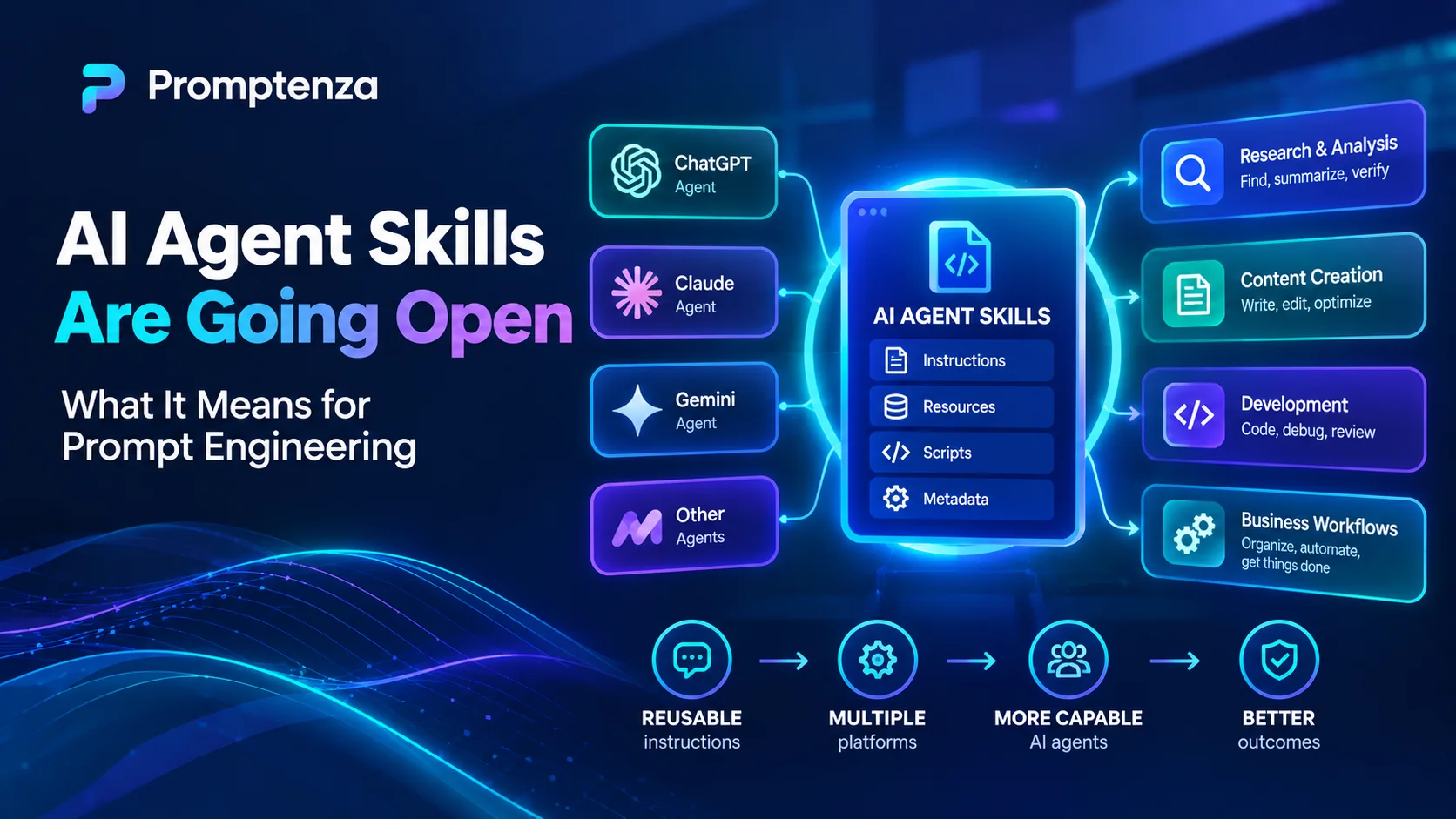
Quick Answer: AI Agent Skills are reusable packages of instructions, resources, and sometimes scripts that teach compatible AI agents how to perform particular tasks. The open standard is designed to make those workflows easier to share across supported tools. For prompt engineering, this means a well-designed prompt can become part of a larger, reusable process—with clear steps, constraints, and quality checks.
What Are AI Agent Skills?
AI Agent Skills are structured sets of instructions and supporting resources that help an AI agent carry out a specific type of task.
A skill might explain how to:
- Turn research notes into a structured article outline.
- Apply a consistent brand voice to marketing content.
- Review a document against a defined checklist.
- Organize information into a research summary.
- Follow a team’s coding or documentation conventions.
- Check whether a completed task meets specified requirements.
Rather than relying on a user to explain the entire process from scratch each time, a compatible agent can load the relevant skill when it is needed.
According to Anthropic, a skill typically consists of a folder containing a SKILL.md file, with optional scripts and reference materials. The instructions describe the task and the process the agent should follow. Source: Anthropic’s Agent Skills announcement.
The important distinction is that a skill is not simply a clever sentence. It is a reusable package of task-specific guidance.
For a deeper foundation, read Promptenza’s guide to Prompt Anatomy, which explains the main components of an effective AI prompt.
Why Are AI Agent Skills Becoming More Important?
Traditional prompting is useful when you need an AI tool to answer a question, generate ideas, explain a concept, or produce a one-time result.
However, repeated tasks often require more than one instruction.
Imagine asking an AI assistant to prepare a weekly industry report. You might need it to:
- Gather information from approved sources.
- Separate confirmed facts from opinions.
- Organize findings by topic.
- Summarize important developments.
- Flag missing information.
- Produce a report using your preferred format.
- Check the result against a quality checklist.
You could write this entire process into a long prompt every week. Alternatively, you could organize the instructions into a reusable workflow that a compatible agent can load when appropriate.
This is the problem Agent Skills are designed to address: making specialized instructions reusable, structured, and easier to maintain.
The October 2026 announcement
Anthropic announced on October 22 that it was contributing Agent Skills to the Agentic AI Foundation. The foundation described the contribution as part of a broader effort to develop shared infrastructure and standards for AI agents.
The same announcement included other projects, such as Open Responses, OpenEnv, and OpenSandbox, contributed by different organizations. These projects address different parts of the AI agent ecosystem, so they should not be confused with Agent Skills themselves. Source: Agentic AI Foundation.
Anthropic also reported that more than 70 agent platforms had integrated Agent Skills since the standard was published in December 2025. That figure is an adoption claim from Anthropic, not an independent measurement of how effectively every platform implements the format. Source: Anthropic.
The significance is not that every AI tool can suddenly perform every task. It is that a shared format can make it easier for compatible tools to use and exchange specialized workflow instructions.
How Do AI Agent Skills Differ From Ordinary Prompts?
The two concepts are related, but they serve different purposes.
| Feature | Ordinary AI prompt | AI Agent Skill |
|---|---|---|
| Main purpose | Direct a particular AI response or task | Provide reusable guidance for a task or workflow |
| Typical format | A message or instruction | A structured package of instructions and supporting files |
| Reuse | Often copied, adapted, or rewritten | Designed to be reused by compatible agents |
| Complexity | Can range from a simple question to a long workflow | Can include procedures, reference materials, and optional scripts |
| When used | Supplied as part of a request | May be loaded when the agent determines it is relevant or when the workflow calls for it |
| Portability | Depends on the prompt and tool | The open format aims to support compatible platforms |
| Quality control | Depends on the instructions and review process | Can include reusable checks and evaluation steps |
A prompt can be short and effective. A skill can contain prompts, but it can also organize broader task instructions and resources.
Neither approach automatically guarantees a correct result. The quality of the instructions, the model’s capabilities, the available tools, and the verification process all matter.
For practical examples of individual instructions, visit Promptenza’s AI Prompt Examples library.
How Agent Skills Fit Into Prompt Engineering
Prompt engineering involves designing and refining instructions so an AI system can produce useful, relevant, and appropriately constrained outputs.
Agent Skills extend that idea into repeatable processes.
Instead of asking only, “What should I tell the AI right now?”, you can also ask:
- What process should the agent follow every time?
- What information does it need before starting?
- Which rules must it respect?
- What should it do when information is missing?
- How should it check its work?
- Which parts of the workflow can be reused in other compatible tools?
These questions help transform an isolated prompt into a more reliable working method.
1. From one-time prompts to reusable workflows
Suppose you regularly create educational articles.
A one-time prompt might be:
“Write an article explaining AI agents to beginners.”
A more structured workflow would specify the intended audience, research requirements, article structure, internal-linking rules, fact-checking expectations, and final review criteria.
A skill can package those instructions so a compatible agent can reuse them across relevant assignments.
This does not mean every prompt needs to become a skill. Simple questions and one-off tasks are often best handled with ordinary prompts.
2. From general instructions to task-specific guidance
General instructions can tell an AI to be clear, helpful, and accurate. A task-specific skill can explain what those qualities mean in a particular context.
For example, an educational writing workflow might require:
- A concise answer near the beginning.
- Clear headings and short paragraphs.
- Definitions of technical terms.
- Practical examples.
- Links to relevant existing articles.
- A final review for unsupported claims.
The skill gives the agent a repeatable process instead of leaving every detail to the latest user message.
3. From generating content to checking results
A useful workflow should define not only how to create an output but also how to evaluate it.
For example, a research skill could ask an agent to label uncertain claims, identify missing evidence, and flag statements that need human verification.
These checks can improve consistency, but they cannot guarantee accuracy. Important claims still need appropriate verification.
To learn more about refining individual instructions before turning them into reusable processes, read How to Improve AI Prompts.
Practical AI Agent Skill Examples
You do not need to build a complicated AI system to understand the concept. Start with a task you repeat and define a process that could be reused.
The examples below are illustrative workflows, not claims that every AI platform supports them automatically.
Example 1: An AI research skill
Goal: Turn a research question into an organized, reviewable summary.
Possible instructions:
- Clarify the research question and scope.
- Identify suitable sources available to the agent.
- Separate directly supported facts from interpretations.
- Record the source for each important factual claim.
- Flag contradictions and information gaps.
- Summarize the findings using predefined headings.
- List claims that still require human verification.
Why it helps: The workflow provides a repeatable research method instead of relying on an improvised instruction each time.
Important limitation: The skill cannot guarantee that the available sources are complete, current, or correct.
Example 2: An AI content-planning skill
Goal: Help a content team plan useful articles without creating unnecessary duplicates.
Possible instructions:
- Identify the article’s search intent and intended audience.
- Review a supplied list of existing URLs and topics.
- Identify the primary keyword and closely related terms.
- Check whether an existing article already serves the same intent.
- Recommend an article structure and useful examples.
- Suggest internal links to relevant existing pages.
- Flag unsupported facts and claims requiring research.
Why it helps: The workflow can make content planning more consistent and reduce avoidable topic overlap.
Important limitation: Keyword strategy still requires editorial judgment and, where possible, real search-performance data.
Example 3: An AI document-review skill
Goal: Review a document against a defined checklist.
Possible instructions:
- Identify the document’s purpose.
- Check whether all required sections are present.
- Flag unclear statements and inconsistent terminology.
- Identify claims that need citations.
- Compare the document with the supplied style guide.
- Produce a list of suggested revisions.
- Leave the original unchanged until a human approves the changes.
Why it helps: The same review criteria can be applied repeatedly.
Important limitation: A review checklist does not replace expert judgment, particularly for legal, financial, medical, or other high-impact decisions.
How to Design a Better Workflow Before Turning It Into a Skill
The most useful skills begin with a clear process. If the process is confusing, packaging it into a reusable format will not solve the underlying problem.
Use this framework to design the instructions.
| Component | Question to answer | Example |
|---|---|---|
| Purpose | What task should the agent perform? | Prepare a beginner-friendly research summary |
| Context | What background information does it need? | Audience, topic, source list |
| Inputs | What must be provided before starting? | Research question and relevant documents |
| Procedure | What steps should it follow? | Review sources, organize findings, summarize |
| Constraints | What must it avoid? | Do not invent facts or citations |
| Output | What should the final result look like? | Summary, evidence notes, unanswered questions |
| Quality checks | How should it review the result? | Check sources, completeness, and uncertainty |
| Approval | Which actions require human permission? | Publishing or changing shared documents |
This framework is closely related to the principles in Promptenza’s Prompt Anatomy guide and its AI Prompting Techniques resource.
A well-designed skill should make the process clearer, not simply make the instruction longer.
A Reusable Prompt for Designing an AI Workflow
You can use the following prompt with a suitable AI assistant to plan a repeatable workflow. It creates a draft specification; it does not automatically install or activate an Agent Skill.
Copy-and-use prompt:
Help me design a reusable AI workflow for the following task: [describe the task].
The intended user is: [describe the audience].
The workflow should:
- Identify the task’s objective and required inputs.
- Ask for essential missing information before proceeding.
- Break the task into clear, logical steps.
- Define constraints and actions the AI must not take.
- Specify the expected output format.
- Include quality checks and explain what requires human verification.
- Identify actions that need explicit approval before execution.
- Explain which parts of the workflow could be reused for similar tasks.
Separate confirmed information from assumptions. Do not invent capabilities, sources, or results.
Return the draft under these headings: Purpose, Required Inputs, Workflow, Constraints, Output Format, Quality Checks, Human Approval, and Limitations.
Once the workflow has been tested and refined, it can be adapted into the format supported by the agent platform you intend to use.
For more ready-to-adapt instructions, explore Promptenza’s AI Prompt Templates.
Does an Open Agent Skills Standard Mean Skills Work Everywhere?
No. An open standard can make interoperability easier, but it does not mean every platform supports every feature or executes every workflow identically.
A compatible agent still needs the capabilities, permissions, and resources required to carry out the task.
For example, a skill might describe how to review a spreadsheet. An agent that can read the relevant file may be able to analyze it. An agent without file access cannot perform the same workflow simply because the skill exists.
Differences may also arise in how platforms load instructions, handle scripts, provide tools, and enforce permissions.
The safest approach is to check a platform’s documentation and test the skill in a controlled environment before relying on it for important work.
Open standards can reduce dependence on one provider’s format, but they do not eliminate technical differences or guarantee identical results.
Security: Why You Should Review Skills Before Using Them
Reusable instructions can save time, but they also create a new question: Should you trust instructions created by someone else?
A skill may contain instructions, reference files, and scripts. Depending on the platform and permissions involved, a poorly designed or malicious skill could encourage unsafe actions or expose information that should remain private.
Before using a skill, consider these precautions:
- Review its source. Prefer skills from maintainers or repositories you can evaluate.
- Read the instructions. Check what the skill asks the agent to do and what resources it references.
- Inspect scripts where applicable. Do not assume a script is safe simply because it accompanies a useful workflow.
- Limit permissions. Give the agent access only to the files and tools necessary for the task.
- Protect sensitive information. Avoid providing passwords, private keys, or unnecessary personal and confidential data.
- Test in a controlled setting. Start with non-sensitive sample material.
- Require approval for consequential actions. Review changes before publishing content, sending messages, modifying important records, or taking other consequential steps.
- Verify the output. A polished answer is not proof that the process was safe or the result was correct.
These are general security practices, not a claim that every skill is dangerous. The risk depends on the instructions, implementation, available tools, and permissions.
For additional context, read Promptenza’s guide to AI Agent Autonomy and Security Incidents.
What the Open Standard Could Mean for the Future of Prompt Engineering
The contribution of Agent Skills to the Agentic AI Foundation is an important development in the move toward shared AI infrastructure. Its long-term impact will depend on how the standard evolves, how widely it is implemented, and how well compatible systems handle security and quality.
Three potential changes are worth watching.
1. Prompt engineering may become more workflow-oriented
Prompt engineers may spend more time designing repeatable processes, defining quality criteria, and testing instructions across tasks.
Writing a good prompt will remain useful. The additional opportunity is to organize successful instructions into reusable workflows.
2. Teams may be able to preserve their working knowledge
A team can document how it handles recurring tasks, what standards it follows, and what a successful result looks like.
If those procedures are packaged in a compatible skill format, they may be easier to maintain and reuse across supported agent tools.
The value comes from the documented knowledge and its ongoing maintenance—not from the file format alone.
3. Portability could become a more important buying consideration
As organizations use different AI products, they may want to avoid rebuilding every workflow whenever they change tools.
An open format can help make that possible where platforms implement it appropriately. Organizations will still need to evaluate compatibility, permissions, maintenance, and the quality of results.
These are reasonable possibilities, not guaranteed outcomes. The standard’s adoption and practical usefulness will need to be assessed over time.
How to Get Started With AI Agent Skills
If you are new to this subject, you do not need to begin by building an autonomous agent.
Start by improving a task you already perform.
- Choose a repeated task. Look for something with a clear purpose and recurring steps.
- Write down your current process. Include the information needed, the steps followed, and the definition of a good result.
- Turn the process into instructions. Specify inputs, constraints, expected outputs, and checks.
- Test the workflow. Try it on several representative examples and note where it fails.
- Improve the instructions. Make unclear steps more precise and add checks for common errors.
- Explore skill compatibility. Consult the documentation for a platform that supports the Agent Skills standard.
- Review security and permissions. Test with non-sensitive data and require approval for important actions.
You can begin with the fundamentals in Learn Prompting, then apply them to reusable workflows.
Frequently Asked Questions
What are AI Agent Skills?
AI Agent Skills are reusable packages of instructions and supporting resources that help compatible AI agents perform specialized tasks or follow defined workflows.
Who created the Agent Skills standard?
Anthropic developed Agent Skills and published the format as an open standard in December 2025. On October 22, 2026, Anthropic announced that it was contributing the standard to the Agentic AI Foundation. Source.
Are AI Agent Skills the same as prompts?
No. A prompt is an instruction or request for an AI system. A skill is a reusable package that can contain task-specific instructions, reference materials, and sometimes scripts. Skills can incorporate prompting techniques, but they can support a broader workflow.
Does the Agent Skills standard work across AI platforms?
It is designed to support portability across compatible platforms. However, actual support and behavior depend on each platform’s implementation, available tools, and permissions.
Do I need coding skills to understand Agent Skills?
No. You can understand and design a workflow using plain language. Creating, packaging, or extending some skills may require technical knowledge, especially when scripts or platform-specific integrations are involved.
Are Agent Skills safe to install?
Not automatically. Review the source and instructions, inspect scripts where applicable, limit permissions, and test unfamiliar skills with non-sensitive data. Follow the security guidance provided by the platform you use.
Will Agent Skills replace prompt engineering?
There is no evidence that they will replace prompt engineering. Instead, skills build on many of the same principles by organizing instructions into repeatable processes. Individual prompts will remain useful for questions and tasks that do not need a reusable workflow.
What is the difference between Agent Skills and AI agents?
An AI agent is a system that can use a model, tools, and a defined process to work toward a goal. An Agent Skill supplies specialized instructions and resources that a compatible agent can use. The skill does not, by itself, provide every capability an agent needs.
Test Your Knowledge: AI Agent Skills
1. What is the main purpose of an AI Agent Skill?
A. To guarantee that every AI response is correct
B. To package reusable instructions and resources for a task
C. To replace every AI prompt
D. To give every AI system unlimited access to tools
2. What did Anthropic announce on October 22, 2026?
A. That all AI agents would use one model
B. That prompt engineering would end
C. That it was contributing Agent Skills to the Agentic AI Foundation
D. That every skill would work identically on every platform
3. Which statement best describes the relationship between prompts and skills?
A. Prompts and skills are identical
B. Skills can organize reusable instructions into broader workflows
C. Skills guarantee factual accuracy
D. Prompts cannot include constraints
4. What should you do before using an unfamiliar skill?
A. Give it access to every available file
B. Assume it is safe if it is popular
C. Review its source, instructions, permissions, and scripts where applicable
D. Disable all human review
5. Why are quality checks important in a reusable workflow?
A. They eliminate every possible error
B. They help evaluate whether the result meets defined requirements
C. They make source verification unnecessary
D. They ensure all platforms behave identically
Answers
- B — A skill packages reusable instructions and resources for a task.
- C — Anthropic announced the contribution to the Agentic AI Foundation on October 22, 2026.
- B — Skills can organize instructions into a repeatable workflow.
- C — Review and test unfamiliar skills before trusting them.
- B — Quality checks help identify problems but cannot eliminate every error.
Final Takeaway
AI Agent Skills represent a practical step toward making prompt engineering more reusable and workflow-oriented. Instead of repeatedly explaining the same process, users can package task-specific guidance into a format that compatible agents can load and use.
Anthropic’s contribution of the standard to the Agentic AI Foundation is significant because it creates an opportunity for broader community participation in its future. But portability alone is not enough: good instructions, suitable capabilities, careful permissions, security reviews, and human verification remain essential.
For Promptenza readers, the best starting point is simple: learn to write clear prompts, turn recurring tasks into documented workflows, test those workflows, and only then explore packaging them as Agent Skills.
Continue learning: Prompt Anatomy · AI Prompting Techniques · AI Prompt Templates · AI Agents and Security