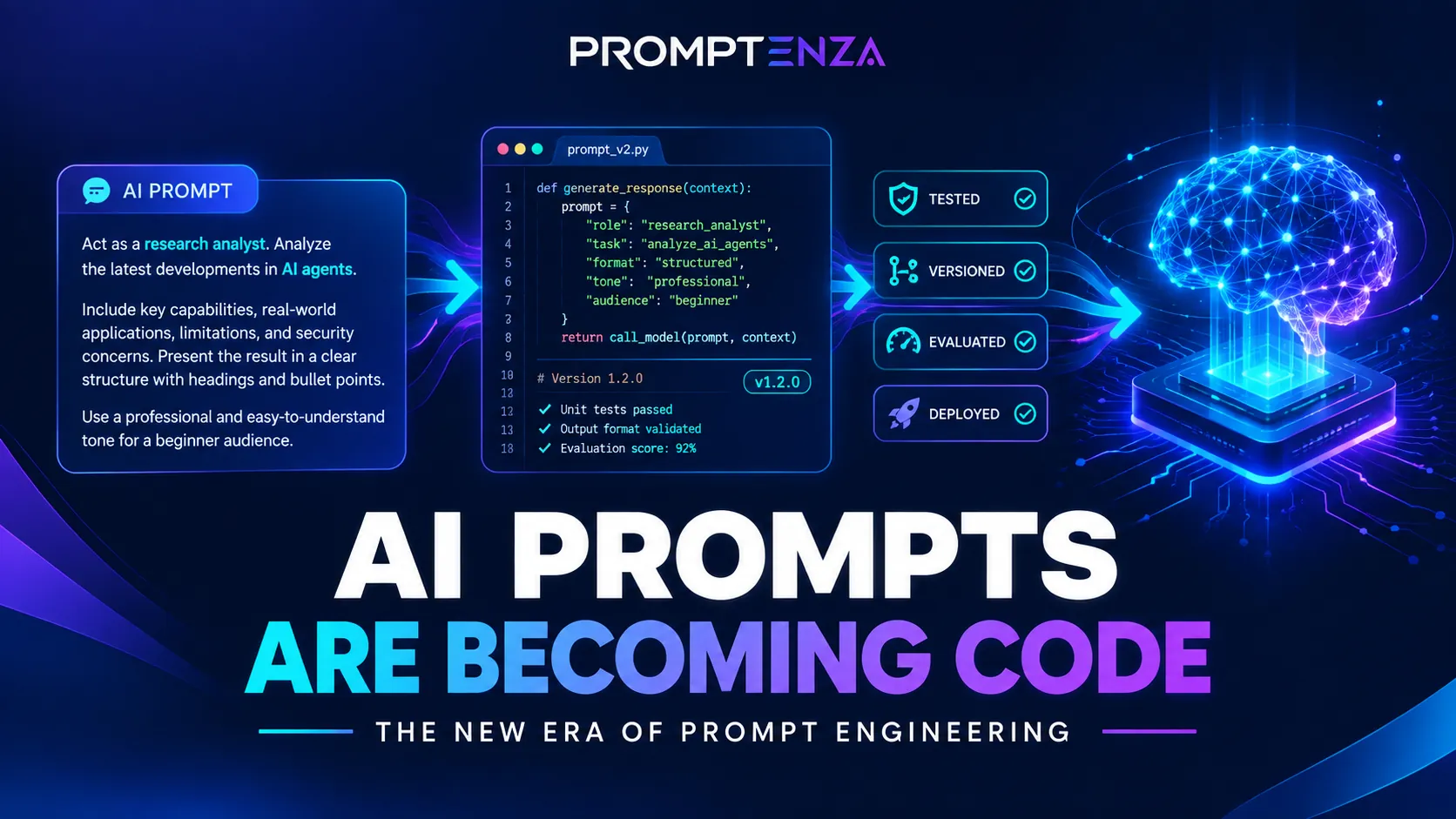
Prompt engineering is entering a new phase. AI prompts are no longer just instructions typed into a chatbot—they are increasingly being treated like application code that needs to be structured, tested, versioned, reviewed, and improved.
Last updated: September 26, 2026
For years, prompt engineering was often presented as the art of finding the right words to get better answers from AI.
That idea is changing.
As AI models become more capable and move into software development, research, automation, and autonomous workflows, prompts are becoming part of the systems that control those models.
OpenAI’s current prompting guidance now explicitly recommends treating production prompts as application code. Its documentation advises developers to keep prompts in code-managed modules, use typed inputs, test prompt changes, review them through normal development workflows, and evaluate performance before deploying changes.
That is a significant shift.
The future of prompt engineering isn’t simply:
Write a better prompt.
It is increasingly:
Design, test, version, and maintain a better AI instruction system.
What Does It Mean to Treat a Prompt Like Code?
A traditional prompt might look like this:
Write a professional customer-support response to this complaint.
You type it into an AI chatbot, receive an answer, and decide whether you like the result.
A production prompt is different.
It may contain:
- system instructions
- task instructions
- variables
- examples
- formatting requirements
- business rules
- contextual information
- safety constraints
- expected output structure
- evaluation criteria
That prompt may then be used thousands or millions of times inside an application.
If you change one instruction, the behavior of the application can change.
That is why modern AI development increasingly treats prompts as something that needs engineering discipline, not just good wording.
Why AI Prompts Are Becoming Code
There are several reasons behind this change.
1. AI Is Moving Into Real Applications
AI is no longer limited to standalone chat interfaces.
Modern systems can use models to:
- analyze documents
- write and review code
- classify information
- interact with software
- search for information
- call tools
- generate structured data
- automate workflows
- operate as agents
OpenAI’s latest models, for example, are being positioned for increasingly demanding professional, coding, computer-use, and agentic workloads.
As AI becomes part of an application’s workflow, the prompt becomes part of the application’s behavior.
That makes prompt reliability much more important.
2. A Small Prompt Change Can Change AI Behavior
Imagine an application that uses this instruction:
Summarize customer complaints and identify the main issue.
A developer changes it to:
Summarize customer complaints and identify the main issue. Return the result as JSON.
That small change could affect:
- output formatting
- parsing
- downstream software
- error handling
- database storage
- evaluation results
If another developer later changes the prompt again, it becomes difficult to know which version produced which behavior unless the changes are tracked.
That’s exactly the kind of problem software version control is designed to solve.
3. AI Outputs Are Not Completely Predictable
Traditional software generally follows explicit instructions.
AI models are different.
The same basic prompt can sometimes produce different outputs depending on the model, context, inputs, and other settings.
OpenAI’s prompt-engineering documentation describes prompting as both an art and a science and recommends testing and evaluation because model behavior can vary.
This creates an important engineering question:
How do you know that a new prompt version is actually better?
You test it.
Prompt Testing Is Becoming a Core Prompt Engineering Skill
Suppose you have Prompt Version 1.
You modify it to create Version 2.
Version 2 looks better when you test it once.
That doesn’t necessarily mean it performs better across hundreds of real examples.
A proper evaluation process might test both versions against a representative dataset.
For example:
| Test | Prompt V1 | Prompt V2 |
|---|---|---|
| Accuracy | ✓ | ✓ |
| Correct format | ✓ | ✓ |
| Handles missing information | ✗ | ✓ |
| Follows length limit | ✓ | ✓ |
| Avoids unsupported claims | ✗ | ✓ |
This is the difference between “I think this prompt is better” and “Our tests show that this prompt performs better on the cases we care about.”
OpenAI’s current documentation recommends using tests and evaluation cases when iterating on prompts.
For a deeper introduction to prompt evaluation, see Promptenza’s Prompt Engineering guide.
Prompt Versioning: Why Every Important Prompt Needs a History
Imagine an AI application has been using a customer-support prompt for six months.
The team improves it several times.
Without versioning, you may only have the latest version.
But what happens if the new version performs worse?
You need to know:
- what changed
- when it changed
- who changed it
- why it changed
- which model was used
- what the previous results were
This is why prompt versioning is becoming increasingly important.
OpenAI’s current guidance recommends keeping production prompts in version-controlled code and using normal development processes such as pull requests, release tags, and feature flags to manage changes.
In other words:
Prompt changes can become software changes.
OpenAI Is Moving Production Prompts Into Code
This is one of the clearest signs of the shift.
OpenAI’s current API documentation says developers should store production prompts in code-managed, versioned helpers rather than relying on reusable prompt objects.
The documentation also says reusable prompt objects are being deprecated, with prompt creation de-emphasized beginning June 3, 2026 and the v1/prompts API scheduled to shut down on November 30, 2026.
OpenAI recommends a workflow where developers:
- Keep prompts in a small code module.
- Use typed parameters for dynamic information.
- Generate instructions and inputs directly.
- Add representative test cases.
- Run evaluation checks.
- Review changes through the deployment process.
- Use feature flags or configuration when staged rollouts are needed.
This is a major conceptual change.
The prompt isn’t just something the AI sees.
It is part of the software system.
What a Code-Managed Prompt Looks Like
Instead of scattering prompts throughout an application, developers can create a dedicated prompt module.
Conceptually, a prompt might look like:
Customer Support Prompt

Role:
Act as a customer-support assistant.

Task:
Respond to the customer's question.

Context:
Customer information and previous messages are provided below.

Rules:
- Do not invent account information.
- Do not make promises about refunds.
- Escalate issues requiring human review.

Output:
Return the response in the approved support format.
The application can then supply changing information such as:
- customer name
- account details
- previous conversation
- current issue
This separates the stable instructions from the dynamic data.
That makes the prompt easier to maintain and test.
Prompt Structure Still Matters
Treating prompts like code does not mean traditional prompt-engineering principles have become obsolete.
They become more important.
A production prompt still needs a clear structure.
A useful framework is:
Role → Task → Context → Constraints → Examples → Output Format → Success Criteria
This connects directly with Promptenza’s existing AI Prompt Structure guide and Prompt Anatomy guide.
For example:
Role: Act as a customer-support specialist.
Task: Respond to the customer’s billing question.
Context: Use the customer information and conversation history supplied below.
Constraints: Do not invent account information or promise a refund.
Output: Provide a concise response followed by the recommended next action.
Success criteria: The response must answer the customer’s question accurately and identify when human escalation is necessary.
This is not merely a “better sentence.”
It is a structured instruction system.
Prompt Engineering Is Becoming a Software Lifecycle
A useful way to think about modern prompt engineering is as a lifecycle:
Design → Test → Evaluate → Version → Deploy → Monitor → Improve
Let’s look at each stage.
1. Design
Define what the AI needs to accomplish.
2. Test
Run the prompt against representative examples.
3. Evaluate
Measure whether the outputs satisfy your requirements.
4. Version
Save meaningful changes so you can compare them.
5. Deploy
Release the prompt through the same controlled process used for software changes.
6. Monitor
Watch how the prompt behaves in real usage.
7. Improve
Use failures and evaluation results to create the next version.
This is a much more mature approach than repeatedly changing a prompt until the answer “looks good.”
Prompt Evaluation: The Missing Skill in Many AI Workflows
One of the biggest mistakes people make with prompting is evaluating only one output.
For example:
“I changed the prompt and the answer looks better.”
That’s useful—but it isn’t enough for a production system.
A better approach is to create a collection of representative examples.
For a customer-support application, your test set might include:
- simple questions
- ambiguous questions
- angry customers
- missing information
- unusual requests
- questions requiring escalation
- requests outside the system’s capabilities
Then compare prompt versions against the same cases.
OpenAI’s evaluation guidance describes evals as a way to test whether outputs meet specified criteria and recommends datasets and graders for systematic evaluation.
Few-Shot Examples Become Testable Components
Examples inside prompts can be extremely useful.
For instance:
Example 1
Input: Where is my order?
Output: Your order is currently…
Example 2
Input: I want a refund.
Output: I can help explain the refund process…
But examples should not simply be added randomly.
You should test whether they actually improve performance.
OpenAI’s current prompting guidance recommends keeping examples concise and structured so teams can update them easily.
This turns examples into something closer to test fixtures than decoration.
Prompt Constraints Are Becoming Like Software Requirements
A prompt might say:
Keep the answer short.
That’s a vague constraint.
A more testable requirement might be:
Keep the response between 80 and 120 words.
Or:
Return exactly five bullet points.
Or:
Return valid JSON using these five fields.
Clear constraints make outputs easier to evaluate.
This connects directly with Promptenza’s AI Prompt Constraints guide.
The more your AI system interacts with other software, the more important predictable output becomes.
AI Agents Make Prompt Engineering Even More Important
The shift toward code-managed prompts becomes especially important with AI agents.
A chatbot may simply answer a question.
An agent can potentially:
- Understand a goal.
- Plan a task.
- Search for information.
- Use tools.
- Modify files.
- Execute actions.
- Check results.
- Continue working.
That means the instructions guiding the system can affect much more than the wording of an answer.
Recent AI developments show this trend clearly. Anthropic, for example, is developing increasingly autonomous coding and computer-use systems, while its recent research has examined incidents involving Claude models accessing real third-party systems during cybersecurity evaluations.
Prompt engineering therefore increasingly intersects with:
- tool permissions
- validation
- testing
- security
- error handling
- human oversight
Promptenza explores this broader shift in AI Agents Are Becoming More Autonomous: What Recent Security Incidents Teach Us.
A Prompt Can Become Part of an Application’s Logic
Consider an AI email assistant.
The prompt might tell the model:
Determine whether the customer is asking for a refund.
The application’s code could then use the model’s output to decide what happens next.
Now the prompt has become part of a larger decision process.
A change from:
Identify refund requests.
to:
Identify refund requests and billing disputes.
could change how the application behaves.
This is why prompt changes deserve the same attention as other changes to application logic.
Prompt Caching Adds Another Layer
Modern prompt engineering also involves performance.
OpenAI’s current prompting documentation highlights prompt caching, which allows applications to reuse stable prompt prefixes to reduce latency and input-token costs when cache hits occur.
This means developers may need to think about how they organize prompts.
For example:
Stable section
- system instructions
- company policies
- formatting rules
- examples
Dynamic section
- customer question
- document
- current task
- user-specific information
Separating stable and changing information can make the prompt easier to manage and can also support efficient caching strategies.
What This Means for Beginners
You don’t need to become a software engineer to benefit from this change.
The basic principles are useful even when you’re simply using ChatGPT, Claude, Gemini, or another AI assistant.
Start thinking about your prompts as reusable instructions.
Instead of:
Write me a blog post about AI.
Try:
Role: Act as an AI technology writer.
Audience: Beginners learning about artificial intelligence.
Task: Explain how AI agents differ from traditional chatbots.
Requirements: Use practical examples and explain technical terms in simple language.
Output: Use H2 and H3 headings, a comparison table, five FAQs, and a short knowledge test.
Accuracy: Clearly distinguish documented facts from company claims.
Now you have a prompt that can be improved, reused, and tested.
That’s the beginning of thinking like a prompt engineer.
Prompt Engineering vs Prompt Programming
The terms are sometimes used interchangeably, but there is a useful distinction.
Prompt engineering
Focuses on designing instructions that produce useful model behavior.
It includes:
- prompt structure
- context
- examples
- constraints
- output formats
- model selection
- evaluation
Prompt programming
Can be thought of as the next step: embedding those instructions into software systems.
It can involve:
- prompt templates
- variables
- APIs
- version control
- automated tests
- evaluation pipelines
- deployment
- monitoring
The boundary isn’t universally defined, so “prompt programming” is better treated as a useful description than a formal replacement for “prompt engineering.”
The important development is that production prompting increasingly has software-engineering characteristics.
7 Signs Your Prompt Needs an Engineering Approach
Your prompts probably need more structure when:
1. You use the same prompt repeatedly
Create a reusable template.
2. Several people maintain the prompt
Use a shared, version-controlled location.
3. Your prompt contains variables
Separate stable instructions from changing inputs.
4. The output feeds another system
Define a predictable output format.
5. A small prompt change can break your workflow
Add tests.
6. You need consistent behavior
Create an evaluation set.
7. The AI can take actions
Add stronger validation, permissions, and monitoring.
A Practical Prompt Engineering Workflow
If you’re building an AI-powered application today, this is a useful starting workflow.
Step 1: Define the task
What exactly should the model accomplish?
Step 2: Define success
What does a good output look like?
Step 3: Build the prompt
Add the role, task, context, constraints, examples, and output requirements.
Step 4: Create test cases
Use realistic examples, including difficult edge cases.
Step 5: Run the prompt
Generate outputs against the test set.
Step 6: Evaluate the results
Measure accuracy, consistency, formatting, and other relevant criteria.
Step 7: Version the prompt
Record meaningful changes.
Step 8: Deploy carefully
Use your normal software release process.
Step 9: Monitor
Watch for unexpected behavior.
Step 10: Iterate
Improve the prompt based on evidence.
This workflow turns prompt engineering into an ongoing engineering process rather than a one-time writing exercise.
What This Means for the Future of Prompt Engineering
The future of prompting is unlikely to be about finding a single “magic prompt.”
Instead, prompt engineering is moving toward a combination of:
Instructions + context + examples + tools + evaluation + software engineering
This is happening because AI systems themselves are becoming more capable.
Newer models can reason through more complicated tasks, use tools, interact with computers, write software, and operate within larger workflows. OpenAI’s GPT-6 Astra and Anthropic’s newer agentic models are examples of this broader direction.
As the capabilities grow, the cost of poorly controlled instructions can also grow.
That’s why prompt testing, versioning, and evaluation matter.
Frequently Asked Questions
Are AI prompts becoming code?
Increasingly, yes—especially in production AI applications. OpenAI’s current guidance explicitly recommends treating production prompts as application code and managing them through code, version control, testing, review, and deployment workflows.
Why should prompts be versioned?
Versioning allows developers to see what changed, compare prompt behavior, restore previous versions, and understand which prompt was responsible for a particular result.
What is prompt evaluation?
Prompt evaluation is the process of testing model outputs against defined criteria to determine whether a prompt performs as intended. It can involve datasets, graders, test cases, and other evaluation methods.
Does prompt engineering require coding?
No. You can learn prompt engineering without programming. However, production prompt engineering increasingly benefits from software-development practices such as version control, testing, APIs, and automated evaluation.
What is prompt versioning?
Prompt versioning means keeping track of different versions of a prompt so you can compare changes and return to an earlier version when necessary.
Why are prompts important for AI agents?
Agents can use models to plan tasks, call tools, interact with software, and perform multiple steps. Their instructions therefore influence more than a single text response.
Should every prompt be treated like code?
Not necessarily. A casual prompt used once in a chatbot does not need a software-development workflow. The code-like approach becomes particularly valuable when prompts are reused, embedded in applications, or responsible for important workflows.
Test Your Prompt Engineering Knowledge
1. Why are production prompts increasingly treated like code?
A. AI models can only read programming languages
B. Prompts can influence application behavior and therefore need testing and version control
C. Text prompts are becoming obsolete
D. Every AI user must learn programming
Answer: B
Production prompts can affect application behavior, so structured development practices can make them easier to test and maintain.
2. What is prompt versioning?
A. Making a prompt longer
B. Translating a prompt
C. Keeping track of changes between prompt versions
D. Asking the AI to repeat itself
Answer: C
Versioning allows teams to understand, compare, and manage prompt changes.
3. Why are evaluation datasets useful?
A. They make AI models larger
B. They provide repeatable cases for testing prompt behavior
C. They automatically guarantee accurate answers
D. They replace prompts
Answer: B
A consistent dataset lets you compare prompt versions against the same cases.
4. Which is a useful prompt structure?
A. Topic → random words → answer
B. Role → Task → Context → Constraints → Output
C. Question → repetition → question
D. One extremely long paragraph
Answer: B
Structured prompts make instructions and requirements easier to understand.
5. When is treating a prompt like code particularly useful?
A. When using a prompt once
B. When a prompt is embedded in a production application
C. When writing a casual question
D. When asking for a joke
Answer: B
Production prompts can influence application behavior and benefit from testing, review, and version control.
The New Definition of Prompt Engineering
Prompt engineering isn’t disappearing.
It is becoming more sophisticated.
The simple version of prompt engineering asks:
How do I phrase this instruction so the AI gives me a better answer?
The modern production version asks:
How do I design, test, evaluate, version, deploy, and maintain instructions that reliably control an AI system?
That is a much bigger discipline.
And as AI agents, coding assistants, computer-use systems, and automated workflows become more capable, the distinction becomes increasingly important.
The prompt is no longer just something you type into an AI. In many applications, it is part of the software.
For anyone learning prompt engineering, that means the next level isn’t simply learning more prompting tricks.
It’s learning how to build reliable AI instructions.
Continue Learning Prompt Engineering
Start with Promptenza’s core guides:
- Prompt Engineering: Complete Guide to Writing Better AI Prompts
- Prompt Anatomy: Parts of an Effective AI Prompt
- AI Prompt Structure: 7 Essential Parts of an Effective Prompt
- How to Improve AI Prompts
- AI Prompt Constraints
- AI Prompt Examples
- AI Prompt Templates
- AI Agents
For related AI developments, see Promptenza’s coverage of AI agent autonomy and security and the latest AI news and updates.